

employed widely in transport modeling of hydrogeological systems. Depending on
the pulling f and restoring φ forces, one can discriminate between a “trumpet”
(1/N
ν
( φ < f < 1), “stem-trumpet” (φ < 1 < f ), and “stem” (1 < φ < f )
regimes of desorption. Remarkably, in all these cases the time dependence of
the number of desorbed monomers M(t) ¼ N À N ads (t) and the height of the
end monomer (i.e., the monomer that experiences the applied external pulling
force) h(t) follow an universal
ffi ffi
t
p À law (even though this is not a diffusion
phenomenon). There is, however, a common physical background with the wellknown Lucas–Washburn
ffi ffi
t
p
-law of capillary filling [65], as with the ejection
kinetics of a polymer chain from a cavity (virus capsid) [66]. In these seemingly
different phenomena there is always a constant driving force (meniscus curvature
or polymer entropy) that acts against a gradually changing drag force (friction) in
the course of the process.
1.5.2 Polymer Translocation Through Narrow Pores
in the Membranes and Escape from Long Pores
The translocation of a polymer is the process during which a flexible chain
moves through a narrow pore of size comparable with that of a chain segment to go
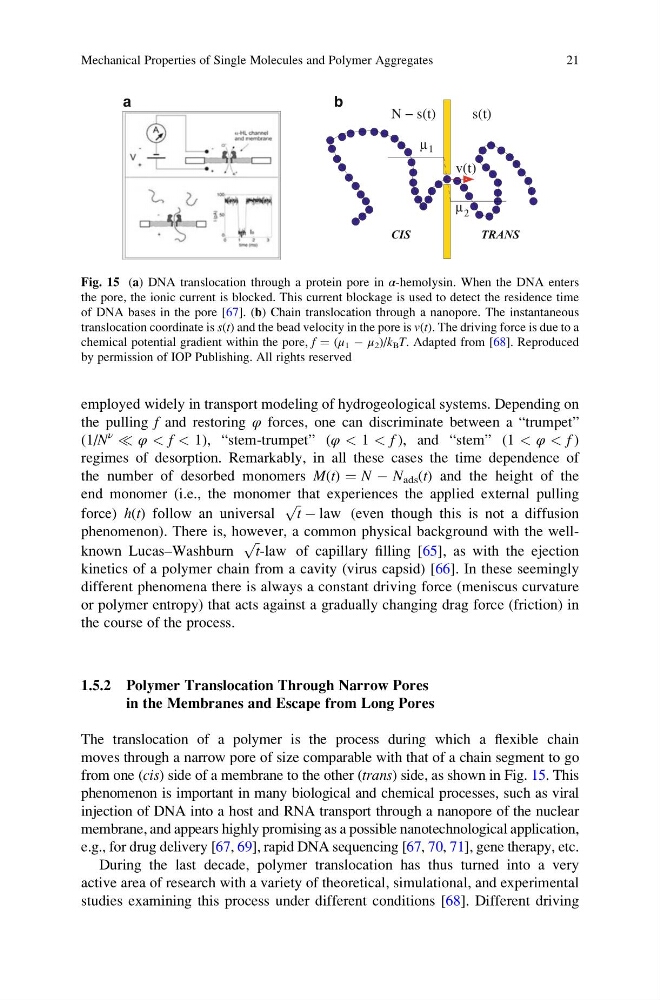
from one (cis) side of a membrane to the other (trans) side, as shown in Fig. 15. This
phenomenon is important in many biological and chemical processes, such as viral
injection of DNA into a host and RNA transport through a nanopore of the nuclear
membrane, and appears highly promising as a possible nanotechnological application,
e.g., for drug delivery [67, 69], rapid DNA sequencing [67, 70, 71], gene therapy, etc.
During the last decade, polymer translocation has thus turned into a very
active area of research with a variety of theoretical, simulational, and experimental
studies examining this process under different conditions [68]. Different driving
μ
μ
1
2
CIS
TRANS
N − s(t)
s(t)
v(t)
a
b
Fig. 15 (a) DNA translocation through a protein pore in α-hemolysin. When the DNA enters
the pore, the ionic current is blocked. This current blockage is used to detect the residence time
of DNA bases in the pore [67]. (b) Chain translocation through a nanopore. The instantaneous
translocation coordinate is s(t) and the bead velocity in the pore is v(t). The driving force is due to a
chemical potential gradient within the pore, f ¼ (μ 1 À μ 2 )/k B T. Adapted from [68]. Reproduced
by permission of IOP Publishing. All rights reserved
Mechanical Properties of Single Molecules and Polymer Aggregates
21
the pulling f and restoring φ forces, one can discriminate between a “trumpet”
(1/N
ν
( φ < f < 1), “stem-trumpet” (φ < 1 < f ), and “stem” (1 < φ < f )
regimes of desorption. Remarkably, in all these cases the time dependence of
the number of desorbed monomers M(t) ¼ N À N ads (t) and the height of the
end monomer (i.e., the monomer that experiences the applied external pulling
force) h(t) follow an universal
ffi ffi
t
p À law (even though this is not a diffusion
phenomenon). There is, however, a common physical background with the wellknown Lucas–Washburn
ffi ffi
t
p
-law of capillary filling [65], as with the ejection
kinetics of a polymer chain from a cavity (virus capsid) [66]. In these seemingly
different phenomena there is always a constant driving force (meniscus curvature
or polymer entropy) that acts against a gradually changing drag force (friction) in
the course of the process.
1.5.2 Polymer Translocation Through Narrow Pores
in the Membranes and Escape from Long Pores
The translocation of a polymer is the process during which a flexible chain
moves through a narrow pore of size comparable with that of a chain segment to go
from one (cis) side of a membrane to the other (trans) side, as shown in Fig. 15. This
phenomenon is important in many biological and chemical processes, such as viral
injection of DNA into a host and RNA transport through a nanopore of the nuclear
membrane, and appears highly promising as a possible nanotechnological application,
e.g., for drug delivery [67, 69], rapid DNA sequencing [67, 70, 71], gene therapy, etc.
During the last decade, polymer translocation has thus turned into a very
active area of research with a variety of theoretical, simulational, and experimental
studies examining this process under different conditions [68]. Different driving
μ
μ
1
2
CIS
TRANS
N − s(t)
s(t)
v(t)
a
b
Fig. 15 (a) DNA translocation through a protein pore in α-hemolysin. When the DNA enters
the pore, the ionic current is blocked. This current blockage is used to detect the residence time
of DNA bases in the pore [67]. (b) Chain translocation through a nanopore. The instantaneous
translocation coordinate is s(t) and the bead velocity in the pore is v(t). The driving force is due to a
chemical potential gradient within the pore, f ¼ (μ 1 À μ 2 )/k B T. Adapted from [68]. Reproduced
by permission of IOP Publishing. All rights reserved
Mechanical Properties of Single Molecules and Polymer Aggregates
21