

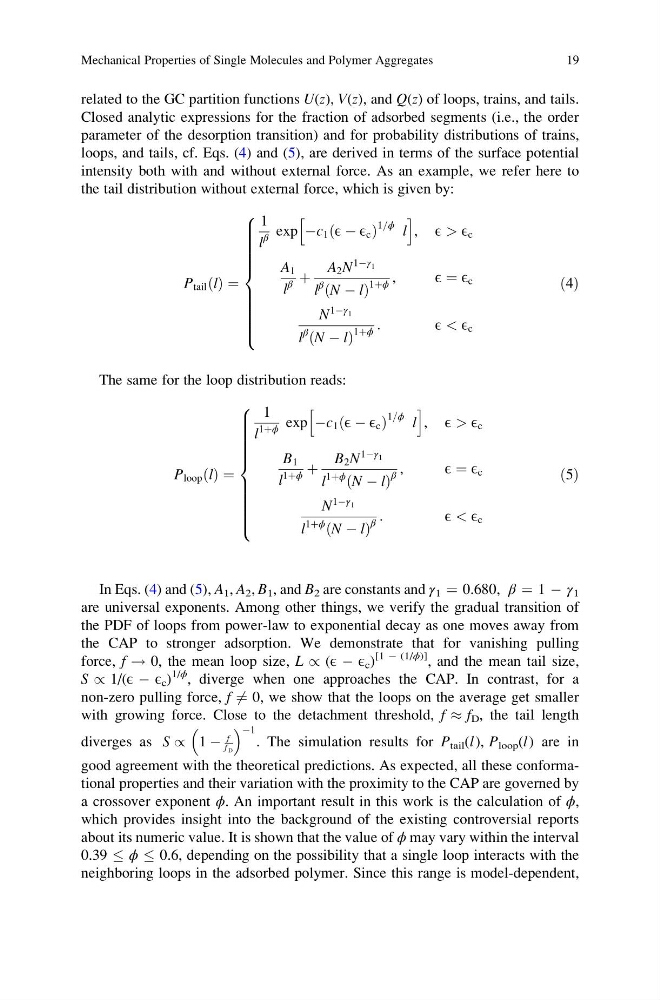
related to the GC partition functions U(z), V(z), and Q(z) of loops, trains, and tails.
Closed analytic expressions for the fraction of adsorbed segments (i.e., the order
parameter of the desorption transition) and for probability distributions of trains,
loops, and tails, cf. Eqs. (4) and (5), are derived in terms of the surface potential
intensity both with and without external force. As an example, we refer here to
the tail distribution without external force, which is given by:
P tail l
ð Þ ¼
1
l
β
exp Àc 1 E À E c
ð
Þ
1=ϕ l
h
i
, E > E c
A 1
l
β
þ
A 2 N
1Àγ 1
l
β N À l
ð
Þ
1þϕ
,
E ¼ E c
N
1Àγ 1
l
β N À l
ð
Þ
1þϕ
:
E < E c
8
> > > > > > > > > <
> > > > > > > > > :
ð4Þ
The same for the loop distribution reads:
P loop l
ð Þ ¼
1
l
1þϕ
exp Àc 1 E À E c
ð
Þ
1=ϕ l
h
i
, E > E c
B 1
l
1þϕ
þ
B 2 N
1Àγ 1
l
1þϕ N À l
ð
Þ
β
,
E ¼ E c
N
1Àγ 1
l
1þϕ N À l
ð
Þ
β
:
E < E c
8
> > > > > > > > > <
> > > > > > > > > :
ð5Þ
In Eqs. (4) and (5), A 1 , A 2 , B 1 , and B 2 are constants and γ 1 ¼ 0.680, β ¼ 1 À γ 1
are universal exponents. Among other things, we verify the gradual transition of
the PDF of loops from power-law to exponential decay as one moves away from
the CAP to stronger adsorption. We demonstrate that for vanishing pulling
force, f ! 0, the mean loop size, L / (E À E c )
[1 À (1/ϕ)] , and the mean tail size,
S / 1/(E À E c )
1/ϕ , diverge when one approaches the CAP. In contrast, for a
non-zero pulling force, f 6 ¼ 0, we show that the loops on the average get smaller
with growing force. Close to the detachment threshold, f % f D , the tail length
diverges as S / 1 À
f
f D
À1
. The simulation results for P tail (l ), P loop (l ) are in
good agreement with the theoretical predictions. As expected, all these conformational properties and their variation with the proximity to the CAP are governed by
a crossover exponent ϕ. An important result in this work is the calculation of ϕ,
which provides insight into the background of the existing controversial reports
about its numeric value. It is shown that the value of ϕ may vary within the interval
0.39 ϕ 0.6, depending on the possibility that a single loop interacts with the
neighboring loops in the adsorbed polymer. Since this range is model-dependent,
Mechanical Properties of Single Molecules and Polymer Aggregates
19
Closed analytic expressions for the fraction of adsorbed segments (i.e., the order
parameter of the desorption transition) and for probability distributions of trains,
loops, and tails, cf. Eqs. (4) and (5), are derived in terms of the surface potential
intensity both with and without external force. As an example, we refer here to
the tail distribution without external force, which is given by:
P tail l
ð Þ ¼
1
l
β
exp Àc 1 E À E c
ð
Þ
1=ϕ l
h
i
, E > E c
A 1
l
β
þ
A 2 N
1Àγ 1
l
β N À l
ð
Þ
1þϕ
,
E ¼ E c
N
1Àγ 1
l
β N À l
ð
Þ
1þϕ
:
E < E c
8
> > > > > > > > > <
> > > > > > > > > :
ð4Þ
The same for the loop distribution reads:
P loop l
ð Þ ¼
1
l
1þϕ
exp Àc 1 E À E c
ð
Þ
1=ϕ l
h
i
, E > E c
B 1
l
1þϕ
þ
B 2 N
1Àγ 1
l
1þϕ N À l
ð
Þ
β
,
E ¼ E c
N
1Àγ 1
l
1þϕ N À l
ð
Þ
β
:
E < E c
8
> > > > > > > > > <
> > > > > > > > > :
ð5Þ
In Eqs. (4) and (5), A 1 , A 2 , B 1 , and B 2 are constants and γ 1 ¼ 0.680, β ¼ 1 À γ 1
are universal exponents. Among other things, we verify the gradual transition of
the PDF of loops from power-law to exponential decay as one moves away from
the CAP to stronger adsorption. We demonstrate that for vanishing pulling
force, f ! 0, the mean loop size, L / (E À E c )
[1 À (1/ϕ)] , and the mean tail size,
S / 1/(E À E c )
1/ϕ , diverge when one approaches the CAP. In contrast, for a
non-zero pulling force, f 6 ¼ 0, we show that the loops on the average get smaller
with growing force. Close to the detachment threshold, f % f D , the tail length
diverges as S / 1 À
f
f D
À1
. The simulation results for P tail (l ), P loop (l ) are in
good agreement with the theoretical predictions. As expected, all these conformational properties and their variation with the proximity to the CAP are governed by
a crossover exponent ϕ. An important result in this work is the calculation of ϕ,
which provides insight into the background of the existing controversial reports
about its numeric value. It is shown that the value of ϕ may vary within the interval
0.39 ϕ 0.6, depending on the possibility that a single loop interacts with the
neighboring loops in the adsorbed polymer. Since this range is model-dependent,
Mechanical Properties of Single Molecules and Polymer Aggregates
19