

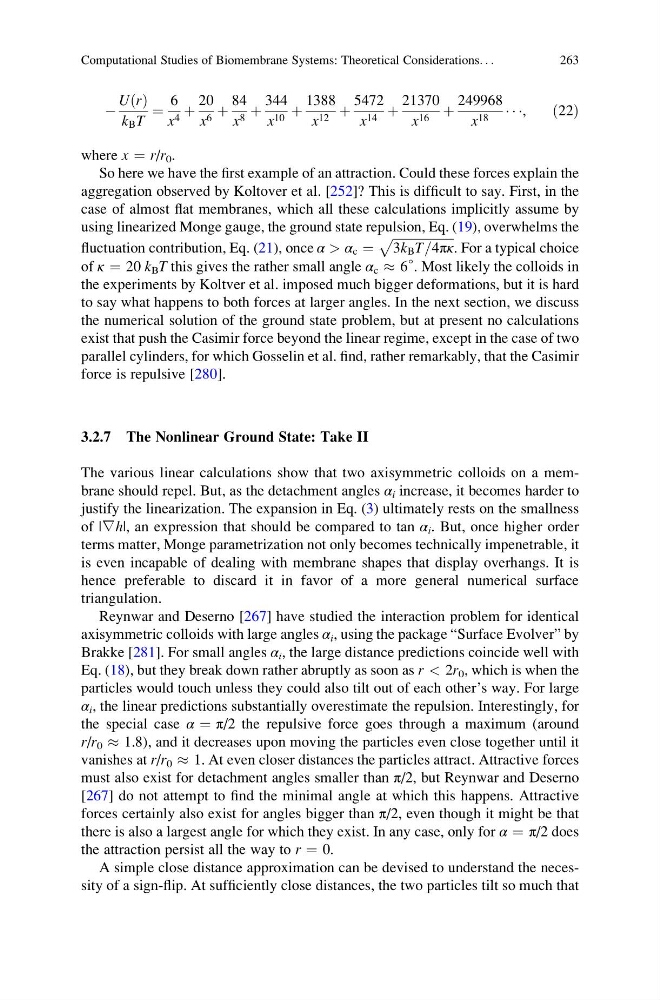
À
U r
ð Þ
k B T
¼
6
x 4 þ
20
x 6 þ
84
x 8 þ
344
x 10 þ
1388
x 12 þ
5472
x 14 þ
21370
x 16 þ
249968
x 18 Á Á Á,
ð22Þ
where x ¼ r/r 0 .
So here we have the first example of an attraction. Could these forces explain the
aggregation observed by Koltover et al. [252]? This is difficult to say. First, in the
case of almost flat membranes, which all these calculations implicitly assume by
using linearized Monge gauge, the ground state repulsion, Eq. (19), overwhelms the
fluctuation contribution, Eq. (21), once α > α c ¼
ffiffiffiffiffiffiffiffiffiffiffiffiffiffiffiffiffiffiffi ffi
3k B T=4πκ
p
. For a typical choice
of κ ¼ 20 k B T this gives the rather small angle α c % 6
∘ . Most likely the colloids in
the experiments by Koltver et al. imposed much bigger deformations, but it is hard
to say what happens to both forces at larger angles. In the next section, we discuss
the numerical solution of the ground state problem, but at present no calculations
exist that push the Casimir force beyond the linear regime, except in the case of two
parallel cylinders, for which Gosselin et al. find, rather remarkably, that the Casimir
force is repulsive [280].
3.2.7 The Nonlinear Ground State: Take II
The various linear calculations show that two axisymmetric colloids on a membrane should repel. But, as the detachment angles α i increase, it becomes harder to
justify the linearization. The expansion in Eq. (3) ultimately rests on the smallness
of |∇h|, an expression that should be compared to tan α i . But, once higher order
terms matter, Monge parametrization not only becomes technically impenetrable, it
is even incapable of dealing with membrane shapes that display overhangs. It is
hence preferable to discard it in favor of a more general numerical surface
triangulation.
Reynwar and Deserno [267] have studied the interaction problem for identical
axisymmetric colloids with large angles α i , using the package “Surface Evolver” by
Brakke [281]. For small angles α i , the large distance predictions coincide well with
Eq. (18), but they break down rather abruptly as soon as r < 2r 0 , which is when the
particles would touch unless they could also tilt out of each other’s way. For large
α i , the linear predictions substantially overestimate the repulsion. Interestingly, for
the special case α ¼ π/2 the repulsive force goes through a maximum (around
r/r 0 % 1.8), and it decreases upon moving the particles even close together until it
vanishes at r/r 0 % 1. At even closer distances the particles attract. Attractive forces
must also exist for detachment angles smaller than π/2, but Reynwar and Deserno
[267] do not attempt to find the minimal angle at which this happens. Attractive
forces certainly also exist for angles bigger than π/2, even though it might be that
there is also a largest angle for which they exist. In any case, only for α ¼ π/2 does
the attraction persist all the way to r ¼ 0.
A simple close distance approximation can be devised to understand the necessity of a sign-flip. At sufficiently close distances, the two particles tilt so much that
Computational Studies of Biomembrane Systems: Theoretical Considerations. . .
263
U r
ð Þ
k B T
¼
6
x 4 þ
20
x 6 þ
84
x 8 þ
344
x 10 þ
1388
x 12 þ
5472
x 14 þ
21370
x 16 þ
249968
x 18 Á Á Á,
ð22Þ
where x ¼ r/r 0 .
So here we have the first example of an attraction. Could these forces explain the
aggregation observed by Koltover et al. [252]? This is difficult to say. First, in the
case of almost flat membranes, which all these calculations implicitly assume by
using linearized Monge gauge, the ground state repulsion, Eq. (19), overwhelms the
fluctuation contribution, Eq. (21), once α > α c ¼
ffiffiffiffiffiffiffiffiffiffiffiffiffiffiffiffiffiffiffi ffi
3k B T=4πκ
p
. For a typical choice
of κ ¼ 20 k B T this gives the rather small angle α c % 6
∘ . Most likely the colloids in
the experiments by Koltver et al. imposed much bigger deformations, but it is hard
to say what happens to both forces at larger angles. In the next section, we discuss
the numerical solution of the ground state problem, but at present no calculations
exist that push the Casimir force beyond the linear regime, except in the case of two
parallel cylinders, for which Gosselin et al. find, rather remarkably, that the Casimir
force is repulsive [280].
3.2.7 The Nonlinear Ground State: Take II
The various linear calculations show that two axisymmetric colloids on a membrane should repel. But, as the detachment angles α i increase, it becomes harder to
justify the linearization. The expansion in Eq. (3) ultimately rests on the smallness
of |∇h|, an expression that should be compared to tan α i . But, once higher order
terms matter, Monge parametrization not only becomes technically impenetrable, it
is even incapable of dealing with membrane shapes that display overhangs. It is
hence preferable to discard it in favor of a more general numerical surface
triangulation.
Reynwar and Deserno [267] have studied the interaction problem for identical
axisymmetric colloids with large angles α i , using the package “Surface Evolver” by
Brakke [281]. For small angles α i , the large distance predictions coincide well with
Eq. (18), but they break down rather abruptly as soon as r < 2r 0 , which is when the
particles would touch unless they could also tilt out of each other’s way. For large
α i , the linear predictions substantially overestimate the repulsion. Interestingly, for
the special case α ¼ π/2 the repulsive force goes through a maximum (around
r/r 0 % 1.8), and it decreases upon moving the particles even close together until it
vanishes at r/r 0 % 1. At even closer distances the particles attract. Attractive forces
must also exist for detachment angles smaller than π/2, but Reynwar and Deserno
[267] do not attempt to find the minimal angle at which this happens. Attractive
forces certainly also exist for angles bigger than π/2, even though it might be that
there is also a largest angle for which they exist. In any case, only for α ¼ π/2 does
the attraction persist all the way to r ¼ 0.
A simple close distance approximation can be devised to understand the necessity of a sign-flip. At sufficiently close distances, the two particles tilt so much that
Computational Studies of Biomembrane Systems: Theoretical Considerations. . .
263