

polarizability C
ð1Þ
α , we must add the term
1
2 C
1
ð Þ
α h i r α
ð Þ
½
2 to the Hamiltonian, where the
index i is again a derivative. The energy increases quadratically with the gradient of
the local field – exactly as for a dipole polarizability. The only remaining question
is: where do we get the polarizabilities from? The answer is, just like in classical
electrostatics, by calculating the response of one particle in a suitably chosen
external field and comparing the full theory with the effective point particle theory.
This idea is an example of what is referred to as effective field theory [270], and
it has been used for a host of vastly diverse problems, ranging from black holes in
general relativity [271, 272] to finite-size radiation corrections in electrodynamics
[273]. The first application in the context of fluid soft surfaces was given by Yolcu
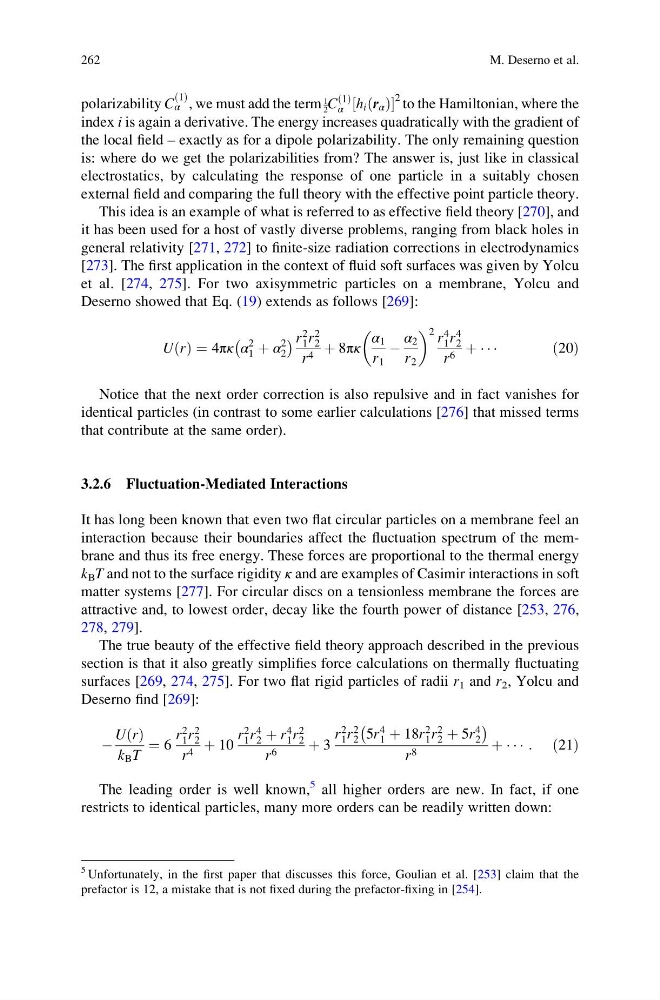
et al. [274, 275]. For two axisymmetric particles on a membrane, Yolcu and
Deserno showed that Eq. (19) extends as follows [269]:
U r
ð Þ ¼ 4πκ α
2
1 þ α
2
2
À
Á r
2
1 r
2
2
r 4 þ 8πκ
α 1
r 1
À
α 2
r 2
2 r
4
1 r
4
2
r 6 þ Á Á Á
ð20Þ
Notice that the next order correction is also repulsive and in fact vanishes for
identical particles (in contrast to some earlier calculations [276] that missed terms
that contribute at the same order).
3.2.6 Fluctuation-Mediated Interactions
It has long been known that even two flat circular particles on a membrane feel an
interaction because their boundaries affect the fluctuation spectrum of the membrane and thus its free energy. These forces are proportional to the thermal energy
k B T and not to the surface rigidity κ and are examples of Casimir interactions in soft
matter systems [277]. For circular discs on a tensionless membrane the forces are
attractive and, to lowest order, decay like the fourth power of distance [253, 276,
278, 279].
The true beauty of the effective field theory approach described in the previous
section is that it also greatly simplifies force calculations on thermally fluctuating
surfaces [269, 274, 275]. For two flat rigid particles of radii r 1 and r 2 , Yolcu and
Deserno find [269]:
À
U r
ð Þ
k B T
¼ 6
r
2
1 r
2
2
r 4 þ 10
r
2
1 r
4
2 þ r
4
1 r
2
2
r 6
þ 3
r
2
1 r
2
2 5r
4
1 þ 18r
2
1 r
2
2 þ 5r
4
2
À
Á
r 8
þ Á Á Á : ð21Þ
The leading order is well known,
5 all higher orders are new. In fact, if one
restricts to identical particles, many more orders can be readily written down:
5 Unfortunately, in the first paper that discusses this force, Goulian et al. [253] claim that the
prefactor is 12, a mistake that is not fixed during the prefactor-fixing in [254].
262
M. Deserno et al.
ð1Þ
α , we must add the term
1
2 C
1
ð Þ
α h i r α
ð Þ
½
2 to the Hamiltonian, where the
index i is again a derivative. The energy increases quadratically with the gradient of
the local field – exactly as for a dipole polarizability. The only remaining question
is: where do we get the polarizabilities from? The answer is, just like in classical
electrostatics, by calculating the response of one particle in a suitably chosen
external field and comparing the full theory with the effective point particle theory.
This idea is an example of what is referred to as effective field theory [270], and
it has been used for a host of vastly diverse problems, ranging from black holes in
general relativity [271, 272] to finite-size radiation corrections in electrodynamics
[273]. The first application in the context of fluid soft surfaces was given by Yolcu
et al. [274, 275]. For two axisymmetric particles on a membrane, Yolcu and
Deserno showed that Eq. (19) extends as follows [269]:
U r
ð Þ ¼ 4πκ α
2
1 þ α
2
2
À
Á r
2
1 r
2
2
r 4 þ 8πκ
α 1
r 1
À
α 2
r 2
2 r
4
1 r
4
2
r 6 þ Á Á Á
ð20Þ
Notice that the next order correction is also repulsive and in fact vanishes for
identical particles (in contrast to some earlier calculations [276] that missed terms
that contribute at the same order).
3.2.6 Fluctuation-Mediated Interactions
It has long been known that even two flat circular particles on a membrane feel an
interaction because their boundaries affect the fluctuation spectrum of the membrane and thus its free energy. These forces are proportional to the thermal energy
k B T and not to the surface rigidity κ and are examples of Casimir interactions in soft
matter systems [277]. For circular discs on a tensionless membrane the forces are
attractive and, to lowest order, decay like the fourth power of distance [253, 276,
278, 279].
The true beauty of the effective field theory approach described in the previous
section is that it also greatly simplifies force calculations on thermally fluctuating
surfaces [269, 274, 275]. For two flat rigid particles of radii r 1 and r 2 , Yolcu and
Deserno find [269]:
À
U r
ð Þ
k B T
¼ 6
r
2
1 r
2
2
r 4 þ 10
r
2
1 r
4
2 þ r
4
1 r
2
2
r 6
þ 3
r
2
1 r
2
2 5r
4
1 þ 18r
2
1 r
2
2 þ 5r
4
2
À
Á
r 8
þ Á Á Á : ð21Þ
The leading order is well known,
5 all higher orders are new. In fact, if one
restricts to identical particles, many more orders can be readily written down:
5 Unfortunately, in the first paper that discusses this force, Goulian et al. [253] claim that the
prefactor is 12, a mistake that is not fixed during the prefactor-fixing in [254].
262
M. Deserno et al.