

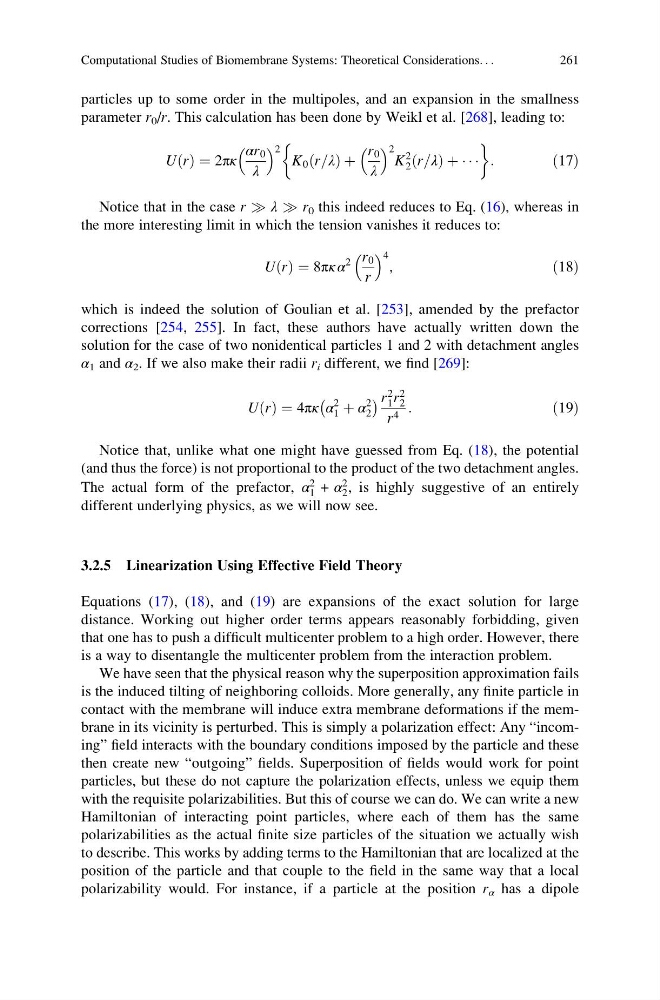
particles up to some order in the multipoles, and an expansion in the smallness
parameter r 0 /r. This calculation has been done by Weikl et al. [268], leading to:
U r
ð Þ ¼ 2πκ
αr 0
λ
2
K 0 r=λ
ð Þþ
r 0
λ
2
K
2
2 r=λ
ð Þ þ Á Á Á
&
'
:
ð17Þ
Notice that in the case r ) λ ) r 0 this indeed reduces to Eq. (16), whereas in
the more interesting limit in which the tension vanishes it reduces to:
U r
ð Þ ¼ 8πκ α
2 r 0
r
4
,
ð18Þ
which is indeed the solution of Goulian et al. [253], amended by the prefactor
corrections [254, 255]. In fact, these authors have actually written down the
solution for the case of two nonidentical particles 1 and 2 with detachment angles
α 1 and α 2 . If we also make their radii r i different, we find [269]:
U r
ð Þ ¼ 4πκ α
2
1 þ α
2
2
À
Á r
2
1 r
2
2
r 4 :
ð19Þ
Notice that, unlike what one might have guessed from Eq. (18), the potential
(and thus the force) is not proportional to the product of the two detachment angles.
The actual form of the prefactor, α
2
1 + α
2
2 , is highly suggestive of an entirely
different underlying physics, as we will now see.
3.2.5 Linearization Using Effective Field Theory
Equations (17), (18), and (19) are expansions of the exact solution for large
distance. Working out higher order terms appears reasonably forbidding, given
that one has to push a difficult multicenter problem to a high order. However, there
is a way to disentangle the multicenter problem from the interaction problem.
We have seen that the physical reason why the superposition approximation fails
is the induced tilting of neighboring colloids. More generally, any finite particle in
contact with the membrane will induce extra membrane deformations if the membrane in its vicinity is perturbed. This is simply a polarization effect: Any “incoming” field interacts with the boundary conditions imposed by the particle and these
then create new “outgoing” fields. Superposition of fields would work for point
particles, but these do not capture the polarization effects, unless we equip them
with the requisite polarizabilities. But this of course we can do. We can write a new
Hamiltonian of interacting point particles, where each of them has the same
polarizabilities as the actual finite size particles of the situation we actually wish
to describe. This works by adding terms to the Hamiltonian that are localized at the
position of the particle and that couple to the field in the same way that a local
polarizability would. For instance, if a particle at the position r α has a dipole
Computational Studies of Biomembrane Systems: Theoretical Considerations. . .
261
parameter r 0 /r. This calculation has been done by Weikl et al. [268], leading to:
U r
ð Þ ¼ 2πκ
αr 0
λ
2
K 0 r=λ
ð Þþ
r 0
λ
2
K
2
2 r=λ
ð Þ þ Á Á Á
&
'
:
ð17Þ
Notice that in the case r ) λ ) r 0 this indeed reduces to Eq. (16), whereas in
the more interesting limit in which the tension vanishes it reduces to:
U r
ð Þ ¼ 8πκ α
2 r 0
r
4
,
ð18Þ
which is indeed the solution of Goulian et al. [253], amended by the prefactor
corrections [254, 255]. In fact, these authors have actually written down the
solution for the case of two nonidentical particles 1 and 2 with detachment angles
α 1 and α 2 . If we also make their radii r i different, we find [269]:
U r
ð Þ ¼ 4πκ α
2
1 þ α
2
2
À
Á r
2
1 r
2
2
r 4 :
ð19Þ
Notice that, unlike what one might have guessed from Eq. (18), the potential
(and thus the force) is not proportional to the product of the two detachment angles.
The actual form of the prefactor, α
2
1 + α
2
2 , is highly suggestive of an entirely
different underlying physics, as we will now see.
3.2.5 Linearization Using Effective Field Theory
Equations (17), (18), and (19) are expansions of the exact solution for large
distance. Working out higher order terms appears reasonably forbidding, given
that one has to push a difficult multicenter problem to a high order. However, there
is a way to disentangle the multicenter problem from the interaction problem.
We have seen that the physical reason why the superposition approximation fails
is the induced tilting of neighboring colloids. More generally, any finite particle in
contact with the membrane will induce extra membrane deformations if the membrane in its vicinity is perturbed. This is simply a polarization effect: Any “incoming” field interacts with the boundary conditions imposed by the particle and these
then create new “outgoing” fields. Superposition of fields would work for point
particles, but these do not capture the polarization effects, unless we equip them
with the requisite polarizabilities. But this of course we can do. We can write a new
Hamiltonian of interacting point particles, where each of them has the same
polarizabilities as the actual finite size particles of the situation we actually wish
to describe. This works by adding terms to the Hamiltonian that are localized at the
position of the particle and that couple to the field in the same way that a local
polarizability would. For instance, if a particle at the position r α has a dipole
Computational Studies of Biomembrane Systems: Theoretical Considerations. . .
261