

3.2.3 Linearization and Superposition Approximation
Linearizing the nonlinear geometric functional means restricting to the first term in
the integrand of Eq. (3). If we add a surface tension Γ, this means looking at the
energy density
1
2 Γ ∇h
ð Þ
2 þ
1
2 κ Δh
ð Þ
2 , where ∇ and Δ are the two-dimensional (flat!)
surface gradient and Laplacian, respectively. A functional variation yields:
ÀΓΔ þ κΔΔ
½
h r
ð Þ ¼ 0 :
ð15Þ
This shape equation is of fourth order, but it is linear. Unfortunately, in the
present context we must solve it for a two-particle problem with finite-sized
particles, and therein lies the rub: the operator in square brackets is not separable
in any simple coordinate system, so we have to deal with the fact that this equation
is indeed a partial differential equation.
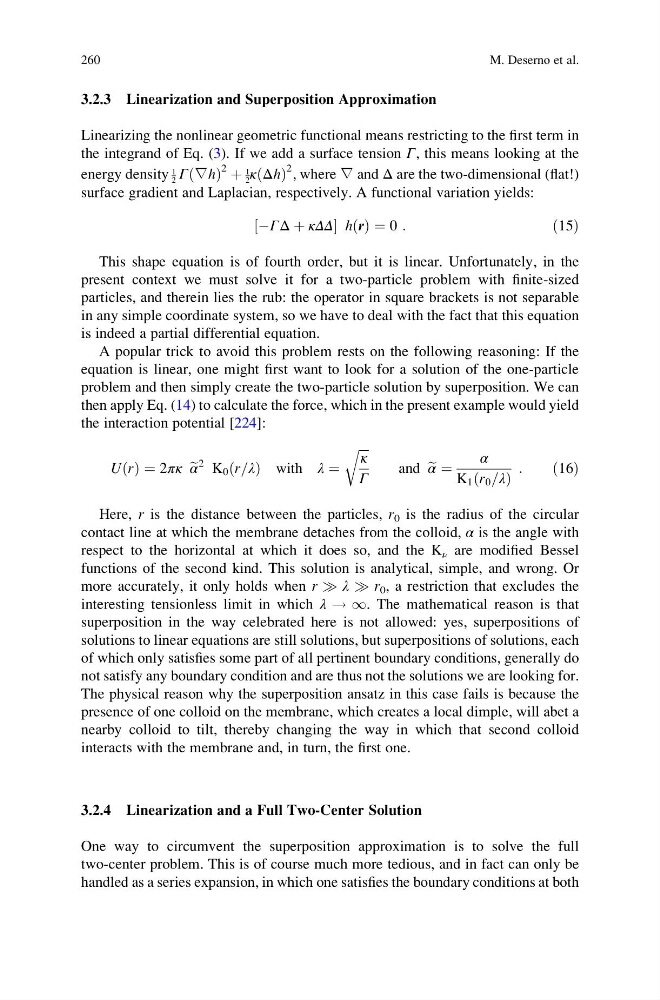
A popular trick to avoid this problem rests on the following reasoning: If the
equation is linear, one might first want to look for a solution of the one-particle
problem and then simply create the two-particle solution by superposition. We can
then apply Eq. (14) to calculate the force, which in the present example would yield
the interaction potential [224]:
U r
ð Þ ¼ 2πκ e
α
2 K 0 r=λ
ð Þ with λ ¼
ffiffiffi ffi
κ
Γ
r
and e
α ¼
α
K 1 r 0 =λ
ð
Þ
:
ð16Þ
Here, r is the distance between the particles, r 0 is the radius of the circular
contact line at which the membrane detaches from the colloid, α is the angle with
respect to the horizontal at which it does so, and the K ν are modified Bessel
functions of the second kind. This solution is analytical, simple, and wrong. Or
more accurately, it only holds when r ) λ ) r 0 , a restriction that excludes the
interesting tensionless limit in which λ ! 1. The mathematical reason is that
superposition in the way celebrated here is not allowed: yes, superpositions of
solutions to linear equations are still solutions, but superpositions of solutions, each
of which only satisfies some part of all pertinent boundary conditions, generally do
not satisfy any boundary condition and are thus not the solutions we are looking for.
The physical reason why the superposition ansatz in this case fails is because the
presence of one colloid on the membrane, which creates a local dimple, will abet a
nearby colloid to tilt, thereby changing the way in which that second colloid
interacts with the membrane and, in turn, the first one.
3.2.4 Linearization and a Full Two-Center Solution
One way to circumvent the superposition approximation is to solve the full
two-center problem. This is of course much more tedious, and in fact can only be
handled as a series expansion, in which one satisfies the boundary conditions at both
260
M. Deserno et al.
Linearizing the nonlinear geometric functional means restricting to the first term in
the integrand of Eq. (3). If we add a surface tension Γ, this means looking at the
energy density
1
2 Γ ∇h
ð Þ
2 þ
1
2 κ Δh
ð Þ
2 , where ∇ and Δ are the two-dimensional (flat!)
surface gradient and Laplacian, respectively. A functional variation yields:
ÀΓΔ þ κΔΔ
½
h r
ð Þ ¼ 0 :
ð15Þ
This shape equation is of fourth order, but it is linear. Unfortunately, in the
present context we must solve it for a two-particle problem with finite-sized
particles, and therein lies the rub: the operator in square brackets is not separable
in any simple coordinate system, so we have to deal with the fact that this equation
is indeed a partial differential equation.
A popular trick to avoid this problem rests on the following reasoning: If the
equation is linear, one might first want to look for a solution of the one-particle
problem and then simply create the two-particle solution by superposition. We can
then apply Eq. (14) to calculate the force, which in the present example would yield
the interaction potential [224]:
U r
ð Þ ¼ 2πκ e
α
2 K 0 r=λ
ð Þ with λ ¼
ffiffiffi ffi
κ
Γ
r
and e
α ¼
α
K 1 r 0 =λ
ð
Þ
:
ð16Þ
Here, r is the distance between the particles, r 0 is the radius of the circular
contact line at which the membrane detaches from the colloid, α is the angle with
respect to the horizontal at which it does so, and the K ν are modified Bessel
functions of the second kind. This solution is analytical, simple, and wrong. Or
more accurately, it only holds when r ) λ ) r 0 , a restriction that excludes the
interesting tensionless limit in which λ ! 1. The mathematical reason is that
superposition in the way celebrated here is not allowed: yes, superpositions of
solutions to linear equations are still solutions, but superpositions of solutions, each
of which only satisfies some part of all pertinent boundary conditions, generally do
not satisfy any boundary condition and are thus not the solutions we are looking for.
The physical reason why the superposition ansatz in this case fails is because the
presence of one colloid on the membrane, which creates a local dimple, will abet a
nearby colloid to tilt, thereby changing the way in which that second colloid
interacts with the membrane and, in turn, the first one.
3.2.4 Linearization and a Full Two-Center Solution
One way to circumvent the superposition approximation is to solve the full
two-center problem. This is of course much more tedious, and in fact can only be
handled as a series expansion, in which one satisfies the boundary conditions at both
260
M. Deserno et al.