

they almost face each other and the membrane between them assumes a shape
similar to a cylinder, which is capable of transmitting tensile forces as we have seen
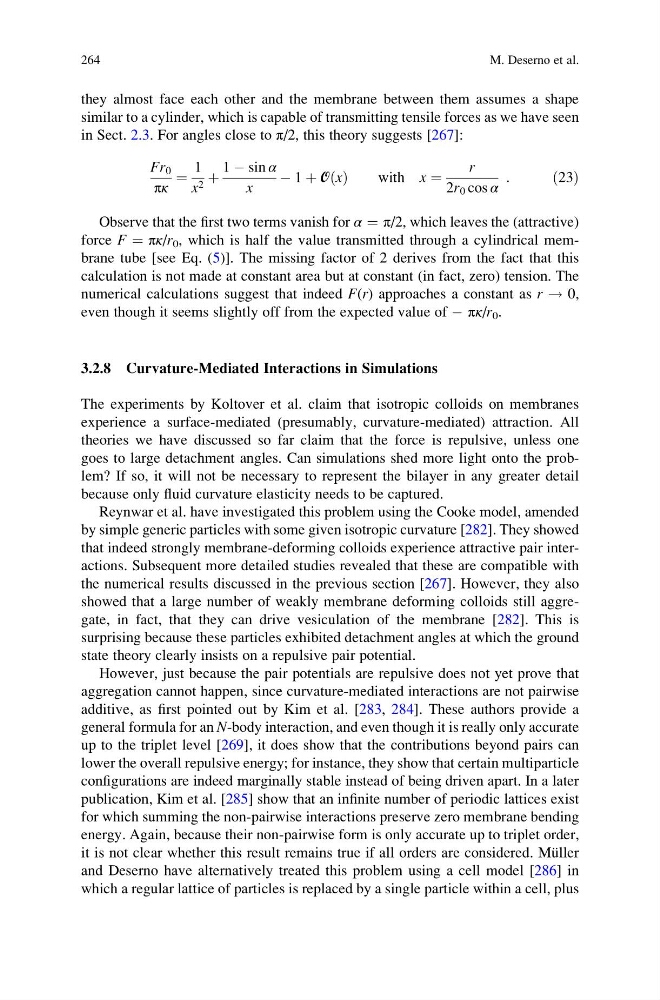
in Sect. 2.3. For angles close to π/2, this theory suggests [267]:
Fr 0
πκ
¼
1
x 2 þ
1 À sin α
x
À 1 þ O x
ð Þ
with x ¼
r
2r 0 cos α
:
ð23Þ
Observe that the first two terms vanish for α ¼ π/2, which leaves the (attractive)
force F ¼ πκ/r 0 , which is half the value transmitted through a cylindrical membrane tube [see Eq. (5)]. The missing factor of 2 derives from the fact that this
calculation is not made at constant area but at constant (in fact, zero) tension. The
numerical calculations suggest that indeed F(r) approaches a constant as r ! 0,
even though it seems slightly off from the expected value of À πκ/r 0 .
3.2.8 Curvature-Mediated Interactions in Simulations
The experiments by Koltover et al. claim that isotropic colloids on membranes
experience a surface-mediated (presumably, curvature-mediated) attraction. All
theories we have discussed so far claim that the force is repulsive, unless one
goes to large detachment angles. Can simulations shed more light onto the problem? If so, it will not be necessary to represent the bilayer in any greater detail
because only fluid curvature elasticity needs to be captured.
Reynwar et al. have investigated this problem using the Cooke model, amended
by simple generic particles with some given isotropic curvature [282]. They showed
that indeed strongly membrane-deforming colloids experience attractive pair interactions. Subsequent more detailed studies revealed that these are compatible with
the numerical results discussed in the previous section [267]. However, they also
showed that a large number of weakly membrane deforming colloids still aggregate, in fact, that they can drive vesiculation of the membrane [282]. This is
surprising because these particles exhibited detachment angles at which the ground
state theory clearly insists on a repulsive pair potential.
However, just because the pair potentials are repulsive does not yet prove that
aggregation cannot happen, since curvature-mediated interactions are not pairwise
additive, as first pointed out by Kim et al. [283, 284]. These authors provide a
general formula for an N-body interaction, and even though it is really only accurate
up to the triplet level [269], it does show that the contributions beyond pairs can
lower the overall repulsive energy; for instance, they show that certain multiparticle
configurations are indeed marginally stable instead of being driven apart. In a later
publication, Kim et al. [285] show that an infinite number of periodic lattices exist
for which summing the non-pairwise interactions preserve zero membrane bending
energy. Again, because their non-pairwise form is only accurate up to triplet order,
it is not clear whether this result remains true if all orders are considered. Mu ¨ller
and Deserno have alternatively treated this problem using a cell model [286] in
which a regular lattice of particles is replaced by a single particle within a cell, plus
264
M. Deserno et al.
similar to a cylinder, which is capable of transmitting tensile forces as we have seen
in Sect. 2.3. For angles close to π/2, this theory suggests [267]:
Fr 0
πκ
¼
1
x 2 þ
1 À sin α
x
À 1 þ O x
ð Þ
with x ¼
r
2r 0 cos α
:
ð23Þ
Observe that the first two terms vanish for α ¼ π/2, which leaves the (attractive)
force F ¼ πκ/r 0 , which is half the value transmitted through a cylindrical membrane tube [see Eq. (5)]. The missing factor of 2 derives from the fact that this
calculation is not made at constant area but at constant (in fact, zero) tension. The
numerical calculations suggest that indeed F(r) approaches a constant as r ! 0,
even though it seems slightly off from the expected value of À πκ/r 0 .
3.2.8 Curvature-Mediated Interactions in Simulations
The experiments by Koltover et al. claim that isotropic colloids on membranes
experience a surface-mediated (presumably, curvature-mediated) attraction. All
theories we have discussed so far claim that the force is repulsive, unless one
goes to large detachment angles. Can simulations shed more light onto the problem? If so, it will not be necessary to represent the bilayer in any greater detail
because only fluid curvature elasticity needs to be captured.
Reynwar et al. have investigated this problem using the Cooke model, amended
by simple generic particles with some given isotropic curvature [282]. They showed
that indeed strongly membrane-deforming colloids experience attractive pair interactions. Subsequent more detailed studies revealed that these are compatible with
the numerical results discussed in the previous section [267]. However, they also
showed that a large number of weakly membrane deforming colloids still aggregate, in fact, that they can drive vesiculation of the membrane [282]. This is
surprising because these particles exhibited detachment angles at which the ground
state theory clearly insists on a repulsive pair potential.
However, just because the pair potentials are repulsive does not yet prove that
aggregation cannot happen, since curvature-mediated interactions are not pairwise
additive, as first pointed out by Kim et al. [283, 284]. These authors provide a
general formula for an N-body interaction, and even though it is really only accurate
up to the triplet level [269], it does show that the contributions beyond pairs can
lower the overall repulsive energy; for instance, they show that certain multiparticle
configurations are indeed marginally stable instead of being driven apart. In a later
publication, Kim et al. [285] show that an infinite number of periodic lattices exist
for which summing the non-pairwise interactions preserve zero membrane bending
energy. Again, because their non-pairwise form is only accurate up to triplet order,
it is not clear whether this result remains true if all orders are considered. Mu ¨ller
and Deserno have alternatively treated this problem using a cell model [286] in
which a regular lattice of particles is replaced by a single particle within a cell, plus
264
M. Deserno et al.