

these two-component membranes phase-separate on the nanoscale, while remaining
homogeneous on the global scale, and that they thus feature many of the intriguing
properties attributed to rafts.
Second, the characteristic length scale of the rafts is similar to the wavelength of
the ripple state in one-component bilayers in the transition region between the fluid
and the tilted gel L β 0 state [199, 200]. Experimentally [201, 202] and in computer
simulations [80, 203–207], modulated phases are observed in lipid bilayers that
exhibit a tilted gel state, and they are not observed in lipid bilayers with an untilted
gel state L β [201–203, 208]. For example, in the Lenz model, rippled states occur in
the standard setup with a mismatch between head and tail size [80], but they
disappear if the head size is reduced such that the tilt in the gel phase
vanishes [208].
Meinhardt et al. [81] have proposed a joint theoretical explanation for these
findings, which is based on the coupled monolayer model (see Sect. 2.1.3). They
assumed that monolayers exhibit local phase separation into two phases with
different order parameter (composition or other), and that the spontaneous curvature of the monolayer depends on the local order parameter. In the strong segregation limit where different phases are separated by narrow interfaces, they showed
that the line tension is reduced in the presence of a mismatch ΔK 0 between the
spontaneous curvatures of the two phases. This is because monolayers with a
spontaneous curvature, which are forced into being planar by the apposing monolayer, experience elastic stress, and some of that stress can be released at the domain
boundaries. The resulting negative contribution to the line tension scales with
κ (ΔK 0 )
2 and should be present wherever ΔK 0 is nonzero. A more detailed calculation shows that the elastic energy is minimized for circular or stripe domains of a
specific size, which is of the order of a few nanometers. This elastic mechanism
could thus stabilize rafts of finite size for sufficiently large spontaneous curvature
mismatch.
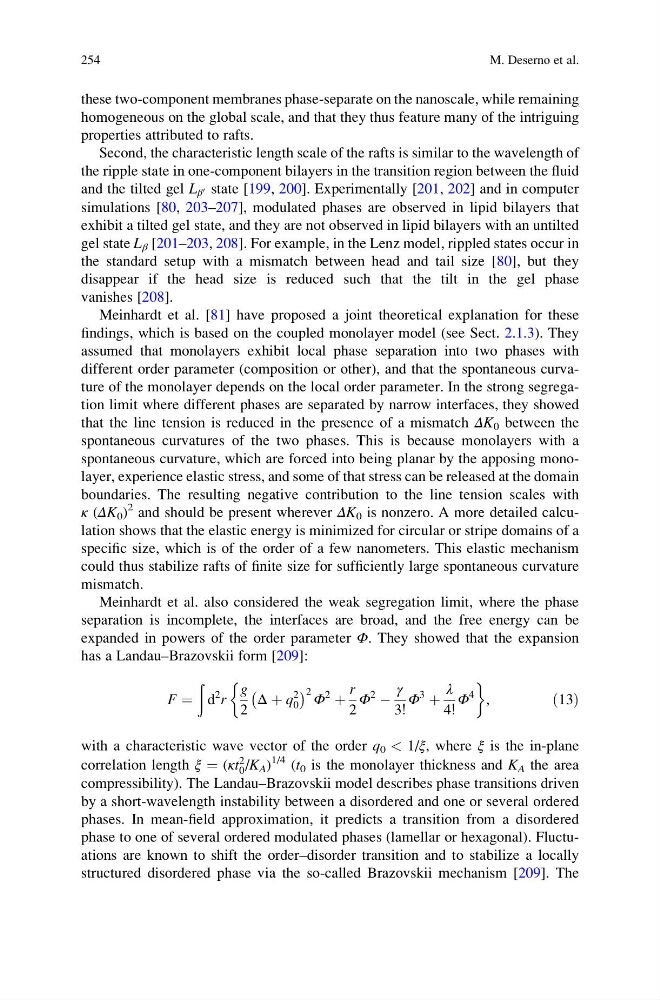
Meinhardt et al. also considered the weak segregation limit, where the phase
separation is incomplete, the interfaces are broad, and the free energy can be
expanded in powers of the order parameter Φ. They showed that the expansion
has a Landau–Brazovskii form [209]:
F ¼
ð
d
2 r
g
2
Δ þ q
2
0
À
Á 2 Φ
2
þ
r
2
Φ
2
À
γ
3!
Φ
3
þ
λ
4!
Φ
4
&
'
,
ð13Þ
with a characteristic wave vector of the order q 0 < 1/ξ, where ξ is the in-plane
correlation length ξ ¼ (κt
2
0 /K A )
1/4 (t 0 is the monolayer thickness and K A the area
compressibility). The Landau–Brazovskii model describes phase transitions driven
by a short-wavelength instability between a disordered and one or several ordered
phases. In mean-field approximation, it predicts a transition from a disordered
phase to one of several ordered modulated phases (lamellar or hexagonal). Fluctuations are known to shift the order–disorder transition and to stabilize a locally
structured disordered phase via the so-called Brazovskii mechanism [209]. The
254
M. Deserno et al.
homogeneous on the global scale, and that they thus feature many of the intriguing
properties attributed to rafts.
Second, the characteristic length scale of the rafts is similar to the wavelength of
the ripple state in one-component bilayers in the transition region between the fluid
and the tilted gel L β 0 state [199, 200]. Experimentally [201, 202] and in computer
simulations [80, 203–207], modulated phases are observed in lipid bilayers that
exhibit a tilted gel state, and they are not observed in lipid bilayers with an untilted
gel state L β [201–203, 208]. For example, in the Lenz model, rippled states occur in
the standard setup with a mismatch between head and tail size [80], but they
disappear if the head size is reduced such that the tilt in the gel phase
vanishes [208].
Meinhardt et al. [81] have proposed a joint theoretical explanation for these
findings, which is based on the coupled monolayer model (see Sect. 2.1.3). They
assumed that monolayers exhibit local phase separation into two phases with
different order parameter (composition or other), and that the spontaneous curvature of the monolayer depends on the local order parameter. In the strong segregation limit where different phases are separated by narrow interfaces, they showed
that the line tension is reduced in the presence of a mismatch ΔK 0 between the
spontaneous curvatures of the two phases. This is because monolayers with a
spontaneous curvature, which are forced into being planar by the apposing monolayer, experience elastic stress, and some of that stress can be released at the domain
boundaries. The resulting negative contribution to the line tension scales with
κ (ΔK 0 )
2 and should be present wherever ΔK 0 is nonzero. A more detailed calculation shows that the elastic energy is minimized for circular or stripe domains of a
specific size, which is of the order of a few nanometers. This elastic mechanism
could thus stabilize rafts of finite size for sufficiently large spontaneous curvature
mismatch.
Meinhardt et al. also considered the weak segregation limit, where the phase
separation is incomplete, the interfaces are broad, and the free energy can be
expanded in powers of the order parameter Φ. They showed that the expansion
has a Landau–Brazovskii form [209]:
F ¼
ð
d
2 r
g
2
Δ þ q
2
0
À
Á 2 Φ
2
þ
r
2
Φ
2
À
γ
3!
Φ
3
þ
λ
4!
Φ
4
&
'
,
ð13Þ
with a characteristic wave vector of the order q 0 < 1/ξ, where ξ is the in-plane
correlation length ξ ¼ (κt
2
0 /K A )
1/4 (t 0 is the monolayer thickness and K A the area
compressibility). The Landau–Brazovskii model describes phase transitions driven
by a short-wavelength instability between a disordered and one or several ordered
phases. In mean-field approximation, it predicts a transition from a disordered
phase to one of several ordered modulated phases (lamellar or hexagonal). Fluctuations are known to shift the order–disorder transition and to stabilize a locally
structured disordered phase via the so-called Brazovskii mechanism [209]. The
254
M. Deserno et al.