

might simply be a signature of critical fluctuations in the vicinity of critical points
[195, 196].
Whether a thermodynamically stable nanostructured raft state could exist in
simple multicomponent membranes that do not contain special line-active additives
has remained unclear until recently. This theoretical question mark could be
removed by recent simulations of the two-component Lenz model by Meinhardt
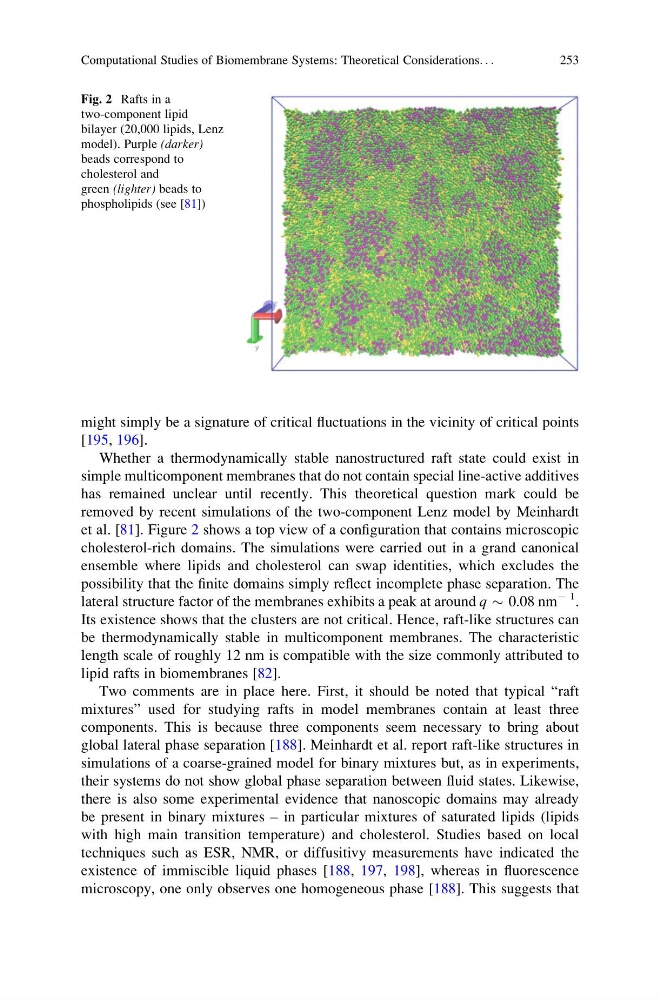
et al. [81]. Figure 2 shows a top view of a configuration that contains microscopic
cholesterol-rich domains. The simulations were carried out in a grand canonical
ensemble where lipids and cholesterol can swap identities, which excludes the
possibility that the finite domains simply reflect incomplete phase separation. The
lateral structure factor of the membranes exhibits a peak at around q $ 0.08 nm
À 1 .
Its existence shows that the clusters are not critical. Hence, raft-like structures can
be thermodynamically stable in multicomponent membranes. The characteristic
length scale of roughly 12 nm is compatible with the size commonly attributed to
lipid rafts in biomembranes [82].
Two comments are in place here. First, it should be noted that typical “raft
mixtures” used for studying rafts in model membranes contain at least three
components. This is because three components seem necessary to bring about
global lateral phase separation [188]. Meinhardt et al. report raft-like structures in
simulations of a coarse-grained model for binary mixtures but, as in experiments,
their systems do not show global phase separation between fluid states. Likewise,
there is also some experimental evidence that nanoscopic domains may already
be present in binary mixtures – in particular mixtures of saturated lipids (lipids
with high main transition temperature) and cholesterol. Studies based on local
techniques such as ESR, NMR, or diffusitivy measurements have indicated the
existence of immiscible liquid phases [188, 197, 198], whereas in fluorescence
microscopy, one only observes one homogeneous phase [188]. This suggests that
Fig. 2 Rafts in a
two-component lipid
bilayer (20,000 lipids, Lenz
model). Purple (darker)
beads correspond to
cholesterol and
green (lighter) beads to
phospholipids (see [81])
Computational Studies of Biomembrane Systems: Theoretical Considerations. . .
253
[195, 196].
Whether a thermodynamically stable nanostructured raft state could exist in
simple multicomponent membranes that do not contain special line-active additives
has remained unclear until recently. This theoretical question mark could be
removed by recent simulations of the two-component Lenz model by Meinhardt
et al. [81]. Figure 2 shows a top view of a configuration that contains microscopic
cholesterol-rich domains. The simulations were carried out in a grand canonical
ensemble where lipids and cholesterol can swap identities, which excludes the
possibility that the finite domains simply reflect incomplete phase separation. The
lateral structure factor of the membranes exhibits a peak at around q $ 0.08 nm
À 1 .
Its existence shows that the clusters are not critical. Hence, raft-like structures can
be thermodynamically stable in multicomponent membranes. The characteristic
length scale of roughly 12 nm is compatible with the size commonly attributed to
lipid rafts in biomembranes [82].
Two comments are in place here. First, it should be noted that typical “raft
mixtures” used for studying rafts in model membranes contain at least three
components. This is because three components seem necessary to bring about
global lateral phase separation [188]. Meinhardt et al. report raft-like structures in
simulations of a coarse-grained model for binary mixtures but, as in experiments,
their systems do not show global phase separation between fluid states. Likewise,
there is also some experimental evidence that nanoscopic domains may already
be present in binary mixtures – in particular mixtures of saturated lipids (lipids
with high main transition temperature) and cholesterol. Studies based on local
techniques such as ESR, NMR, or diffusitivy measurements have indicated the
existence of immiscible liquid phases [188, 197, 198], whereas in fluorescence
microscopy, one only observes one homogeneous phase [188]. This suggests that
Fig. 2 Rafts in a
two-component lipid
bilayer (20,000 lipids, Lenz
model). Purple (darker)
beads correspond to
cholesterol and
green (lighter) beads to
phospholipids (see [81])
Computational Studies of Biomembrane Systems: Theoretical Considerations. . .
253