

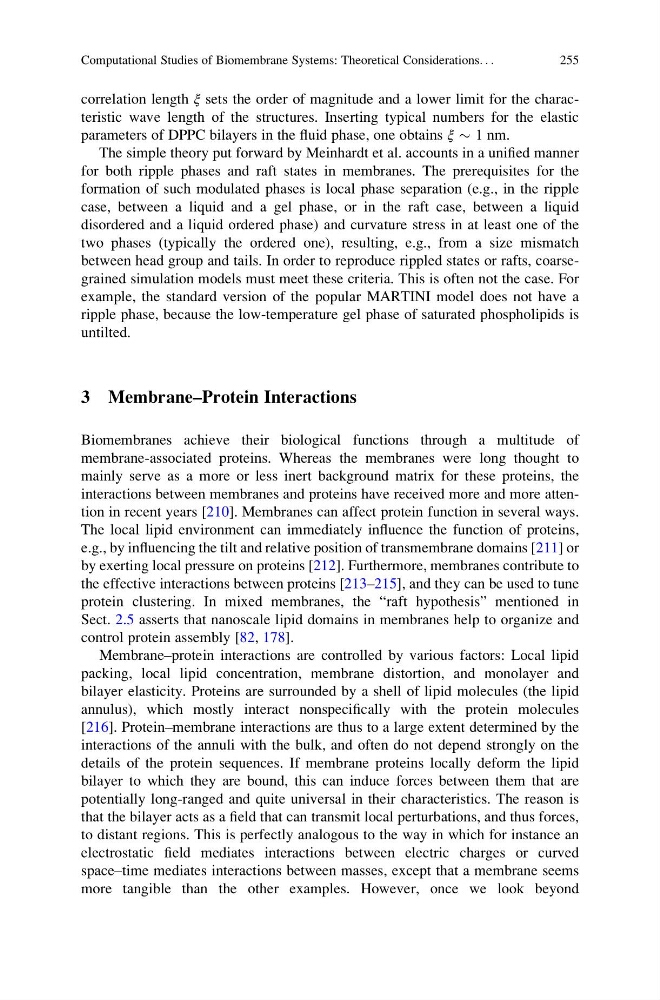
correlation length ξ sets the order of magnitude and a lower limit for the characteristic wave length of the structures. Inserting typical numbers for the elastic
parameters of DPPC bilayers in the fluid phase, one obtains ξ $ 1 nm.
The simple theory put forward by Meinhardt et al. accounts in a unified manner
for both ripple phases and raft states in membranes. The prerequisites for the
formation of such modulated phases is local phase separation (e.g., in the ripple
case, between a liquid and a gel phase, or in the raft case, between a liquid
disordered and a liquid ordered phase) and curvature stress in at least one of the
two phases (typically the ordered one), resulting, e.g., from a size mismatch
between head group and tails. In order to reproduce rippled states or rafts, coarsegrained simulation models must meet these criteria. This is often not the case. For
example, the standard version of the popular MARTINI model does not have a
ripple phase, because the low-temperature gel phase of saturated phospholipids is
untilted.
3 Membrane–Protein Interactions
Biomembranes achieve their biological functions through a multitude of
membrane-associated proteins. Whereas the membranes were long thought to
mainly serve as a more or less inert background matrix for these proteins, the
interactions between membranes and proteins have received more and more attention in recent years [210]. Membranes can affect protein function in several ways.
The local lipid environment can immediately influence the function of proteins,
e.g., by influencing the tilt and relative position of transmembrane domains [211] or
by exerting local pressure on proteins [212]. Furthermore, membranes contribute to
the effective interactions between proteins [213–215], and they can be used to tune
protein clustering. In mixed membranes, the “raft hypothesis” mentioned in
Sect. 2.5 asserts that nanoscale lipid domains in membranes help to organize and
control protein assembly [82, 178].
Membrane–protein interactions are controlled by various factors: Local lipid
packing, local lipid concentration, membrane distortion, and monolayer and
bilayer elasticity. Proteins are surrounded by a shell of lipid molecules (the lipid
annulus), which mostly interact nonspecifically with the protein molecules
[216]. Protein–membrane interactions are thus to a large extent determined by the
interactions of the annuli with the bulk, and often do not depend strongly on the
details of the protein sequences. If membrane proteins locally deform the lipid
bilayer to which they are bound, this can induce forces between them that are
potentially long-ranged and quite universal in their characteristics. The reason is
that the bilayer acts as a field that can transmit local perturbations, and thus forces,
to distant regions. This is perfectly analogous to the way in which for instance an
electrostatic field mediates interactions between electric charges or curved
space–time mediates interactions between masses, except that a membrane seems
more tangible than the other examples. However, once we look beyond
Computational Studies of Biomembrane Systems: Theoretical Considerations. . .
255
parameters of DPPC bilayers in the fluid phase, one obtains ξ $ 1 nm.
The simple theory put forward by Meinhardt et al. accounts in a unified manner
for both ripple phases and raft states in membranes. The prerequisites for the
formation of such modulated phases is local phase separation (e.g., in the ripple
case, between a liquid and a gel phase, or in the raft case, between a liquid
disordered and a liquid ordered phase) and curvature stress in at least one of the
two phases (typically the ordered one), resulting, e.g., from a size mismatch
between head group and tails. In order to reproduce rippled states or rafts, coarsegrained simulation models must meet these criteria. This is often not the case. For
example, the standard version of the popular MARTINI model does not have a
ripple phase, because the low-temperature gel phase of saturated phospholipids is
untilted.
3 Membrane–Protein Interactions
Biomembranes achieve their biological functions through a multitude of
membrane-associated proteins. Whereas the membranes were long thought to
mainly serve as a more or less inert background matrix for these proteins, the
interactions between membranes and proteins have received more and more attention in recent years [210]. Membranes can affect protein function in several ways.
The local lipid environment can immediately influence the function of proteins,
e.g., by influencing the tilt and relative position of transmembrane domains [211] or
by exerting local pressure on proteins [212]. Furthermore, membranes contribute to
the effective interactions between proteins [213–215], and they can be used to tune
protein clustering. In mixed membranes, the “raft hypothesis” mentioned in
Sect. 2.5 asserts that nanoscale lipid domains in membranes help to organize and
control protein assembly [82, 178].
Membrane–protein interactions are controlled by various factors: Local lipid
packing, local lipid concentration, membrane distortion, and monolayer and
bilayer elasticity. Proteins are surrounded by a shell of lipid molecules (the lipid
annulus), which mostly interact nonspecifically with the protein molecules
[216]. Protein–membrane interactions are thus to a large extent determined by the
interactions of the annuli with the bulk, and often do not depend strongly on the
details of the protein sequences. If membrane proteins locally deform the lipid
bilayer to which they are bound, this can induce forces between them that are
potentially long-ranged and quite universal in their characteristics. The reason is
that the bilayer acts as a field that can transmit local perturbations, and thus forces,
to distant regions. This is perfectly analogous to the way in which for instance an
electrostatic field mediates interactions between electric charges or curved
space–time mediates interactions between masses, except that a membrane seems
more tangible than the other examples. However, once we look beyond
Computational Studies of Biomembrane Systems: Theoretical Considerations. . .
255