

membranes in the following. A thoughtful analysis of the vesicle case has recently
been carried out by Diamant [153].
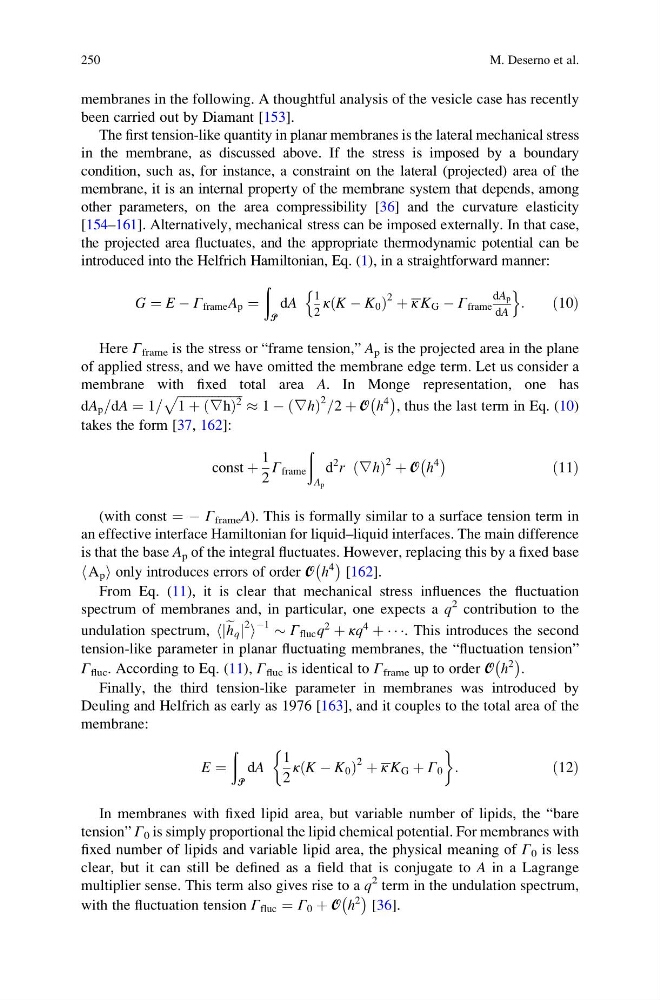
The first tension-like quantity in planar membranes is the lateral mechanical stress
in the membrane, as discussed above. If the stress is imposed by a boundary
condition, such as, for instance, a constraint on the lateral (projected) area of the
membrane, it is an internal property of the membrane system that depends, among
other parameters, on the area compressibility [36] and the curvature elasticity
[154–161]. Alternatively, mechanical stress can be imposed externally. In that case,
the projected area fluctuates, and the appropriate thermodynamic potential can be
introduced into the Helfrich Hamiltonian, Eq. (1), in a straightforward manner:
G ¼ E À Γ frame A p ¼
ð
P
dA
1
2
κ K À K 0
ð
Þ
2 þ κ K G À Γ frame
dA p
dA
n
o
:
ð10Þ
Here Γ frame is the stress or “frame tension,” A p is the projected area in the plane
of applied stress, and we have omitted the membrane edge term. Let us consider a
membrane with fixed total area A. In Monge representation, one has
dA p =dA ¼ 1=
ffiffiffiffiffiffiffiffiffiffiffiffiffiffiffiffiffiffiffiffiffi
1 þ ∇h
ð Þ
2
p
% 1 À ∇h
ð Þ
2 =2 þ O h
4
À Á
, thus the last term in Eq. (10)
takes the form [37, 162]:
const þ
1
2
Γ frame
ð
A p
d
2 r ∇h
ð Þ
2 þ O h
4
À Á
ð11Þ
(with const ¼ À Γ frame A). This is formally similar to a surface tension term in
an effective interface Hamiltonian for liquid–liquid interfaces. The main difference
is that the base A p of the integral fluctuates. However, replacing this by a fixed base
hA p i only introduces errors of order O h
4
À Á
[162].
From Eq. (11), it is clear that mechanical stress influences the fluctuation
spectrum of membranes and, in particular, one expects a q
2 contribution to the
undulation spectrum, hj e h q j
2 i
À1 $ Γ fluc q
2
þ κq
4
þ Á Á Á. This introduces the second
tension-like parameter in planar fluctuating membranes, the “fluctuation tension”
Γ fluc . According to Eq. (11), Γ fluc is identical to Γ frame up to order O h
2
À Á
.
Finally, the third tension-like parameter in membranes was introduced by
Deuling and Helfrich as early as 1976 [163], and it couples to the total area of the
membrane:
E ¼
ð
P
dA
1
2
κ K À K 0
ð
Þ
2 þ κ K G þ Γ 0
&
'
:
ð12Þ
In membranes with fixed lipid area, but variable number of lipids, the “bare
tension” Γ 0 is simply proportional the lipid chemical potential. For membranes with
fixed number of lipids and variable lipid area, the physical meaning of Γ 0 is less
clear, but it can still be defined as a field that is conjugate to A in a Lagrange
multiplier sense. This term also gives rise to a q
2 term in the undulation spectrum,
with the fluctuation tension Γ fluc ¼ Γ 0 þ O h
2
À Á
[36].
250
M. Deserno et al.
been carried out by Diamant [153].
The first tension-like quantity in planar membranes is the lateral mechanical stress
in the membrane, as discussed above. If the stress is imposed by a boundary
condition, such as, for instance, a constraint on the lateral (projected) area of the
membrane, it is an internal property of the membrane system that depends, among
other parameters, on the area compressibility [36] and the curvature elasticity
[154–161]. Alternatively, mechanical stress can be imposed externally. In that case,
the projected area fluctuates, and the appropriate thermodynamic potential can be
introduced into the Helfrich Hamiltonian, Eq. (1), in a straightforward manner:
G ¼ E À Γ frame A p ¼
ð
P
dA
1
2
κ K À K 0
ð
Þ
2 þ κ K G À Γ frame
dA p
dA
n
o
:
ð10Þ
Here Γ frame is the stress or “frame tension,” A p is the projected area in the plane
of applied stress, and we have omitted the membrane edge term. Let us consider a
membrane with fixed total area A. In Monge representation, one has
dA p =dA ¼ 1=
ffiffiffiffiffiffiffiffiffiffiffiffiffiffiffiffiffiffiffiffiffi
1 þ ∇h
ð Þ
2
p
% 1 À ∇h
ð Þ
2 =2 þ O h
4
À Á
, thus the last term in Eq. (10)
takes the form [37, 162]:
const þ
1
2
Γ frame
ð
A p
d
2 r ∇h
ð Þ
2 þ O h
4
À Á
ð11Þ
(with const ¼ À Γ frame A). This is formally similar to a surface tension term in
an effective interface Hamiltonian for liquid–liquid interfaces. The main difference
is that the base A p of the integral fluctuates. However, replacing this by a fixed base
hA p i only introduces errors of order O h
4
À Á
[162].
From Eq. (11), it is clear that mechanical stress influences the fluctuation
spectrum of membranes and, in particular, one expects a q
2 contribution to the
undulation spectrum, hj e h q j
2 i
À1 $ Γ fluc q
2
þ κq
4
þ Á Á Á. This introduces the second
tension-like parameter in planar fluctuating membranes, the “fluctuation tension”
Γ fluc . According to Eq. (11), Γ fluc is identical to Γ frame up to order O h
2
À Á
.
Finally, the third tension-like parameter in membranes was introduced by
Deuling and Helfrich as early as 1976 [163], and it couples to the total area of the
membrane:
E ¼
ð
P
dA
1
2
κ K À K 0
ð
Þ
2 þ κ K G þ Γ 0
&
'
:
ð12Þ
In membranes with fixed lipid area, but variable number of lipids, the “bare
tension” Γ 0 is simply proportional the lipid chemical potential. For membranes with
fixed number of lipids and variable lipid area, the physical meaning of Γ 0 is less
clear, but it can still be defined as a field that is conjugate to A in a Lagrange
multiplier sense. This term also gives rise to a q
2 term in the undulation spectrum,
with the fluctuation tension Γ fluc ¼ Γ 0 þ O h
2
À Á
[36].
250
M. Deserno et al.