

probability for either outcome can be computed if ΔE is known [147] and so κ ends
up being found through a series of patch-closure experiments.
The results of such simulations show that κ =κ is close to À1, both for the Cooke
model and for MARTINI DMPC (see Sect. 2.2 for a further discussion of these
models).
4 This is compatible with experiments [117–122] but disagrees with the
only other method that has been suggested for getting the Gaussian modulus. As
first pointed out by Helfrich [148], quite general considerations suggest that the
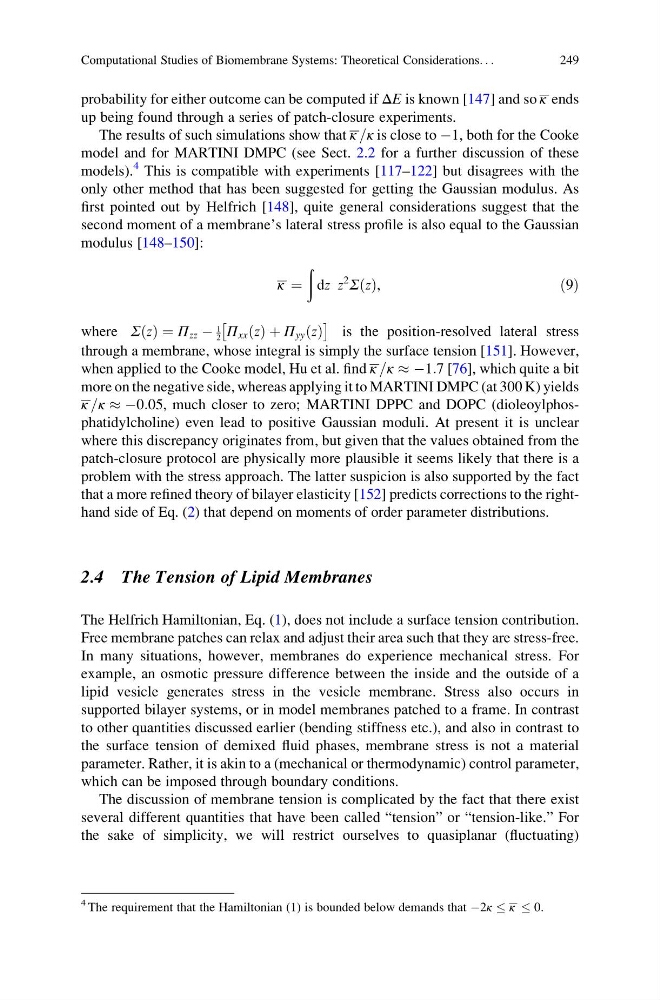
second moment of a membrane’s lateral stress profile is also equal to the Gaussian
modulus [148–150]:
κ ¼
ð
dz z
2
Σ z
ð Þ,
ð9Þ
where Σ z
ð Þ ¼ Π zz À
1
2 Π xx z
ð Þ þ Π yy z
ð Þ
Â
Ã
is the position-resolved lateral stress
through a membrane, whose integral is simply the surface tension [151]. However,
when applied to the Cooke model, Hu et al. find κ =κ % À1:7 [76], which quite a bit
more on the negative side, whereas applying it to MARTINI DMPC (at 300 K) yields
κ =κ % À0:05, much closer to zero; MARTINI DPPC and DOPC (dioleoylphosphatidylcholine) even lead to positive Gaussian moduli. At present it is unclear
where this discrepancy originates from, but given that the values obtained from the
patch-closure protocol are physically more plausible it seems likely that there is a
problem with the stress approach. The latter suspicion is also supported by the fact
that a more refined theory of bilayer elasticity [152] predicts corrections to the righthand side of Eq. (2) that depend on moments of order parameter distributions.
2.4 The Tension of Lipid Membranes
The Helfrich Hamiltonian, Eq. (1), does not include a surface tension contribution.
Free membrane patches can relax and adjust their area such that they are stress-free.
In many situations, however, membranes do experience mechanical stress. For
example, an osmotic pressure difference between the inside and the outside of a
lipid vesicle generates stress in the vesicle membrane. Stress also occurs in
supported bilayer systems, or in model membranes patched to a frame. In contrast
to other quantities discussed earlier (bending stiffness etc.), and also in contrast to
the surface tension of demixed fluid phases, membrane stress is not a material
parameter. Rather, it is akin to a (mechanical or thermodynamic) control parameter,
which can be imposed through boundary conditions.
The discussion of membrane tension is complicated by the fact that there exist
several different quantities that have been called “tension” or “tension-like.” For
the sake of simplicity, we will restrict ourselves to quasiplanar (fluctuating)
4 The requirement that the Hamiltonian (1) is bounded below demands that À2κ κ
0.
Computational Studies of Biomembrane Systems: Theoretical Considerations. . .
249
up being found through a series of patch-closure experiments.
The results of such simulations show that κ =κ is close to À1, both for the Cooke
model and for MARTINI DMPC (see Sect. 2.2 for a further discussion of these
models).
4 This is compatible with experiments [117–122] but disagrees with the
only other method that has been suggested for getting the Gaussian modulus. As
first pointed out by Helfrich [148], quite general considerations suggest that the
second moment of a membrane’s lateral stress profile is also equal to the Gaussian
modulus [148–150]:
κ ¼
ð
dz z
2
Σ z
ð Þ,
ð9Þ
where Σ z
ð Þ ¼ Π zz À
1
2 Π xx z
ð Þ þ Π yy z
ð Þ
Â
Ã
is the position-resolved lateral stress
through a membrane, whose integral is simply the surface tension [151]. However,
when applied to the Cooke model, Hu et al. find κ =κ % À1:7 [76], which quite a bit
more on the negative side, whereas applying it to MARTINI DMPC (at 300 K) yields
κ =κ % À0:05, much closer to zero; MARTINI DPPC and DOPC (dioleoylphosphatidylcholine) even lead to positive Gaussian moduli. At present it is unclear
where this discrepancy originates from, but given that the values obtained from the
patch-closure protocol are physically more plausible it seems likely that there is a
problem with the stress approach. The latter suspicion is also supported by the fact
that a more refined theory of bilayer elasticity [152] predicts corrections to the righthand side of Eq. (2) that depend on moments of order parameter distributions.
2.4 The Tension of Lipid Membranes
The Helfrich Hamiltonian, Eq. (1), does not include a surface tension contribution.
Free membrane patches can relax and adjust their area such that they are stress-free.
In many situations, however, membranes do experience mechanical stress. For
example, an osmotic pressure difference between the inside and the outside of a
lipid vesicle generates stress in the vesicle membrane. Stress also occurs in
supported bilayer systems, or in model membranes patched to a frame. In contrast
to other quantities discussed earlier (bending stiffness etc.), and also in contrast to
the surface tension of demixed fluid phases, membrane stress is not a material
parameter. Rather, it is akin to a (mechanical or thermodynamic) control parameter,
which can be imposed through boundary conditions.
The discussion of membrane tension is complicated by the fact that there exist
several different quantities that have been called “tension” or “tension-like.” For
the sake of simplicity, we will restrict ourselves to quasiplanar (fluctuating)
4 The requirement that the Hamiltonian (1) is bounded below demands that À2κ κ
0.
Computational Studies of Biomembrane Systems: Theoretical Considerations. . .
249