

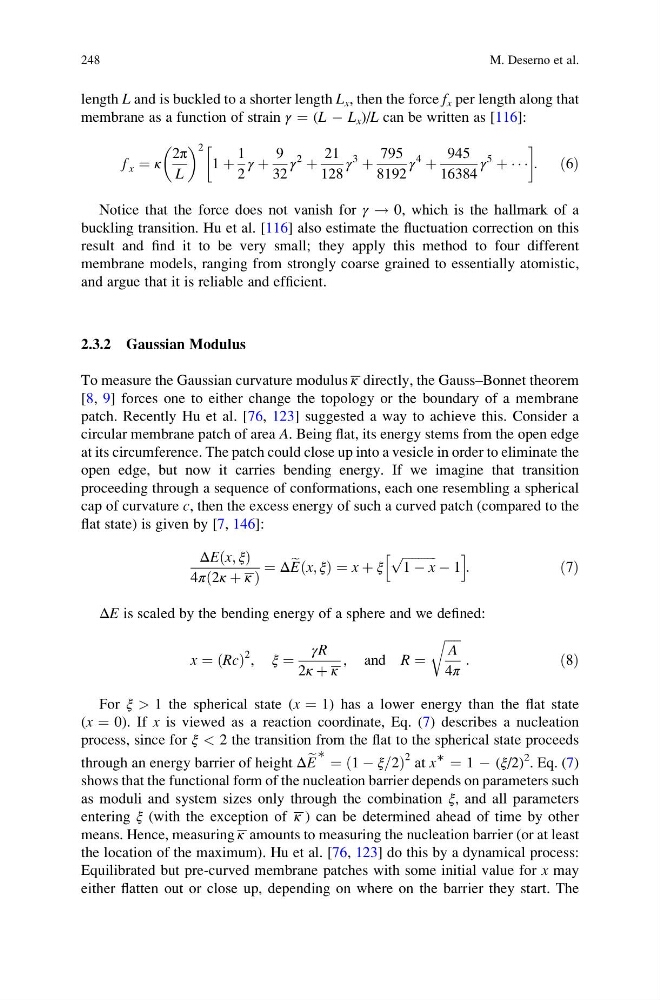
length L and is buckled to a shorter length L x , then the force f x per length along that
membrane as a function of strain γ ¼ (L À L x )/L can be written as [116]:
f x ¼ κ
2π
L
2
1 þ
1
2
γ þ
9
32
γ
2
þ
21
128
γ
3
þ
795
8192
γ
4
þ
945
16384
γ
5
þ Á Á Á
!
:
ð6Þ
Notice that the force does not vanish for γ ! 0, which is the hallmark of a
buckling transition. Hu et al. [116] also estimate the fluctuation correction on this
result and find it to be very small; they apply this method to four different
membrane models, ranging from strongly coarse grained to essentially atomistic,
and argue that it is reliable and efficient.
2.3.2 Gaussian Modulus
To measure the Gaussian curvature modulus κ directly, the Gauss–Bonnet theorem
[8, 9] forces one to either change the topology or the boundary of a membrane
patch. Recently Hu et al. [76, 123] suggested a way to achieve this. Consider a
circular membrane patch of area A. Being flat, its energy stems from the open edge
at its circumference. The patch could close up into a vesicle in order to eliminate the
open edge, but now it carries bending energy. If we imagine that transition
proceeding through a sequence of conformations, each one resembling a spherical
cap of curvature c, then the excess energy of such a curved patch (compared to the
flat state) is given by [7, 146]:
ΔE x; ξ
ð Þ
4π 2κ þ κ
ð
Þ
¼ Δ e
E x; ξ
ð Þ ¼ x þ ξ
ffiffiffiffiffiffiffiffiffiffi ffi
1 À x
p
À 1
h
i
:
ð7Þ
ΔE is scaled by the bending energy of a sphere and we defined:
x ¼ Rc
ð Þ
2 , ξ ¼
γR
2κ þ κ
, and R ¼
ffiffiffiffiffi
A
4π
r
:
ð8Þ
For ξ > 1 the spherical state (x ¼ 1) has a lower energy than the flat state
(x ¼ 0). If x is viewed as a reaction coordinate, Eq. (7) describes a nucleation
process, since for ξ < 2 the transition from the flat to the spherical state proceeds
through an energy barrier of height Δ e
E
∗ ¼ 1 À ξ=2
ð
Þ
2 at x
∗
¼ 1 À (ξ/2)
2 . Eq. (7)
shows that the functional form of the nucleation barrier depends on parameters such
as moduli and system sizes only through the combination ξ, and all parameters
entering ξ (with the exception of κ ) can be determined ahead of time by other
means. Hence, measuring κ amounts to measuring the nucleation barrier (or at least
the location of the maximum). Hu et al. [76, 123] do this by a dynamical process:
Equilibrated but pre-curved membrane patches with some initial value for x may
either flatten out or close up, depending on where on the barrier they start. The
248
M. Deserno et al.
membrane as a function of strain γ ¼ (L À L x )/L can be written as [116]:
f x ¼ κ
2π
L
2
1 þ
1
2
γ þ
9
32
γ
2
þ
21
128
γ
3
þ
795
8192
γ
4
þ
945
16384
γ
5
þ Á Á Á
!
:
ð6Þ
Notice that the force does not vanish for γ ! 0, which is the hallmark of a
buckling transition. Hu et al. [116] also estimate the fluctuation correction on this
result and find it to be very small; they apply this method to four different
membrane models, ranging from strongly coarse grained to essentially atomistic,
and argue that it is reliable and efficient.
2.3.2 Gaussian Modulus
To measure the Gaussian curvature modulus κ directly, the Gauss–Bonnet theorem
[8, 9] forces one to either change the topology or the boundary of a membrane
patch. Recently Hu et al. [76, 123] suggested a way to achieve this. Consider a
circular membrane patch of area A. Being flat, its energy stems from the open edge
at its circumference. The patch could close up into a vesicle in order to eliminate the
open edge, but now it carries bending energy. If we imagine that transition
proceeding through a sequence of conformations, each one resembling a spherical
cap of curvature c, then the excess energy of such a curved patch (compared to the
flat state) is given by [7, 146]:
ΔE x; ξ
ð Þ
4π 2κ þ κ
ð
Þ
¼ Δ e
E x; ξ
ð Þ ¼ x þ ξ
ffiffiffiffiffiffiffiffiffiffi ffi
1 À x
p
À 1
h
i
:
ð7Þ
ΔE is scaled by the bending energy of a sphere and we defined:
x ¼ Rc
ð Þ
2 , ξ ¼
γR
2κ þ κ
, and R ¼
ffiffiffiffiffi
A
4π
r
:
ð8Þ
For ξ > 1 the spherical state (x ¼ 1) has a lower energy than the flat state
(x ¼ 0). If x is viewed as a reaction coordinate, Eq. (7) describes a nucleation
process, since for ξ < 2 the transition from the flat to the spherical state proceeds
through an energy barrier of height Δ e
E
∗ ¼ 1 À ξ=2
ð
Þ
2 at x
∗
¼ 1 À (ξ/2)
2 . Eq. (7)
shows that the functional form of the nucleation barrier depends on parameters such
as moduli and system sizes only through the combination ξ, and all parameters
entering ξ (with the exception of κ ) can be determined ahead of time by other
means. Hence, measuring κ amounts to measuring the nucleation barrier (or at least
the location of the maximum). Hu et al. [76, 123] do this by a dynamical process:
Equilibrated but pre-curved membrane patches with some initial value for x may
either flatten out or close up, depending on where on the barrier they start. The
248
M. Deserno et al.