

The cylinder stretching protocol appears to work very well for simple solventfree membrane models [111, 113, 114], but with more refined models this method
suffers from two drawbacks, both related to the equilibration of a chemical potential. First, the cylinder separates the simulation volume into an “inside” and an
“outside.” If solvent is present, its chemical potential must be the same in these two
regions, but for more highly resolved models the solvent permeability through the
bilayer is usually too low to ensure automatic relaxation. Second, the chemical
potential of lipids also has to be the same in the two bilayer leaflets, and again for
more refined models the lipid flip-flop rate tends to be too low for this to happen
spontaneously.
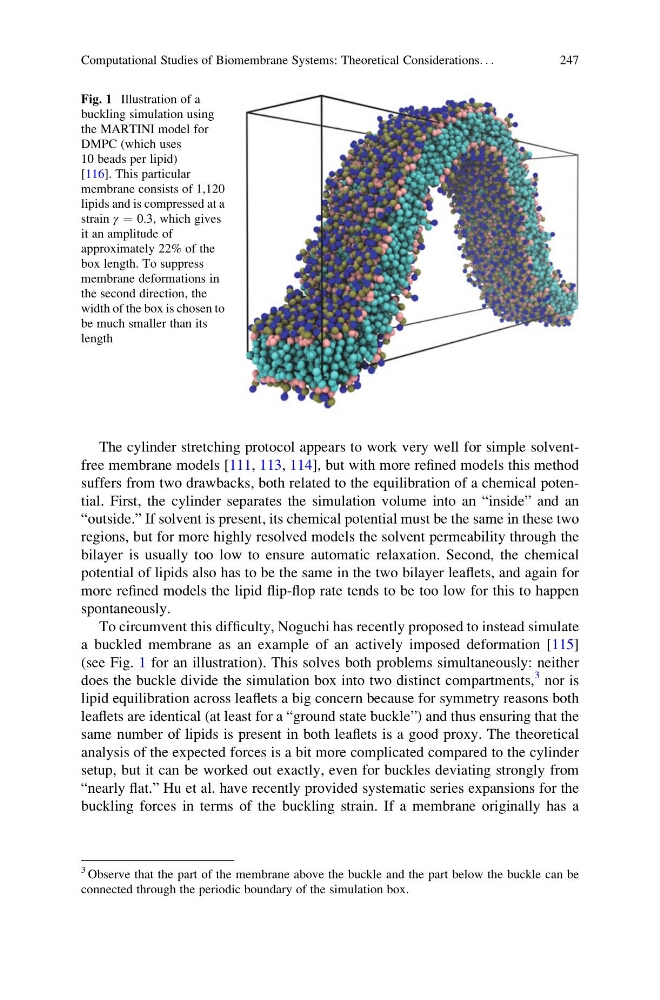
To circumvent this difficulty, Noguchi has recently proposed to instead simulate
a buckled membrane as an example of an actively imposed deformation [115]
(see Fig. 1 for an illustration). This solves both problems simultaneously: neither
does the buckle divide the simulation box into two distinct compartments,
3 nor is
lipid equilibration across leaflets a big concern because for symmetry reasons both
leaflets are identical (at least for a “ground state buckle”) and thus ensuring that the
same number of lipids is present in both leaflets is a good proxy. The theoretical
analysis of the expected forces is a bit more complicated compared to the cylinder
setup, but it can be worked out exactly, even for buckles deviating strongly from
“nearly flat.” Hu et al. have recently provided systematic series expansions for the
buckling forces in terms of the buckling strain. If a membrane originally has a
Fig. 1 Illustration of a
buckling simulation using
the MARTINI model for
DMPC (which uses
10 beads per lipid)
[116]. This particular
membrane consists of 1,120
lipids and is compressed at a
strain γ ¼ 0.3, which gives
it an amplitude of
approximately 22% of the
box length. To suppress
membrane deformations in
the second direction, the
width of the box is chosen to
be much smaller than its
length
3 Observe that the part of the membrane above the buckle and the part below the buckle can be
connected through the periodic boundary of the simulation box.
Computational Studies of Biomembrane Systems: Theoretical Considerations. . .
247
suffers from two drawbacks, both related to the equilibration of a chemical potential. First, the cylinder separates the simulation volume into an “inside” and an
“outside.” If solvent is present, its chemical potential must be the same in these two
regions, but for more highly resolved models the solvent permeability through the
bilayer is usually too low to ensure automatic relaxation. Second, the chemical
potential of lipids also has to be the same in the two bilayer leaflets, and again for
more refined models the lipid flip-flop rate tends to be too low for this to happen
spontaneously.
To circumvent this difficulty, Noguchi has recently proposed to instead simulate
a buckled membrane as an example of an actively imposed deformation [115]
(see Fig. 1 for an illustration). This solves both problems simultaneously: neither
does the buckle divide the simulation box into two distinct compartments,
3 nor is
lipid equilibration across leaflets a big concern because for symmetry reasons both
leaflets are identical (at least for a “ground state buckle”) and thus ensuring that the
same number of lipids is present in both leaflets is a good proxy. The theoretical
analysis of the expected forces is a bit more complicated compared to the cylinder
setup, but it can be worked out exactly, even for buckles deviating strongly from
“nearly flat.” Hu et al. have recently provided systematic series expansions for the
buckling forces in terms of the buckling strain. If a membrane originally has a
Fig. 1 Illustration of a
buckling simulation using
the MARTINI model for
DMPC (which uses
10 beads per lipid)
[116]. This particular
membrane consists of 1,120
lipids and is compressed at a
strain γ ¼ 0.3, which gives
it an amplitude of
approximately 22% of the
box length. To suppress
membrane deformations in
the second direction, the
width of the box is chosen to
be much smaller than its
length
3 Observe that the part of the membrane above the buckle and the part below the buckle can be
connected through the periodic boundary of the simulation box.
Computational Studies of Biomembrane Systems: Theoretical Considerations. . .
247