

ζ 0 N
dR g⊥
dt
¼ À
χ 1 N
R g⊥
þ
Na
1=ν
R
1=νþ1
g⊥
, ζ 0 N
dR gjj
dt
¼
vN
2
R
3
gjj R g⊥
À
R gjj
aN
ð3Þ
where the second equation in Eq. (3) describes the horizontal (or parallel to
the interface) spreading due to steric repulsion (excluded volume effects), and
ζ 0 denotes the monomer friction. One may find solutions for the set of equations
of motion (3) and determine the characteristic times for relaxation perpendicular
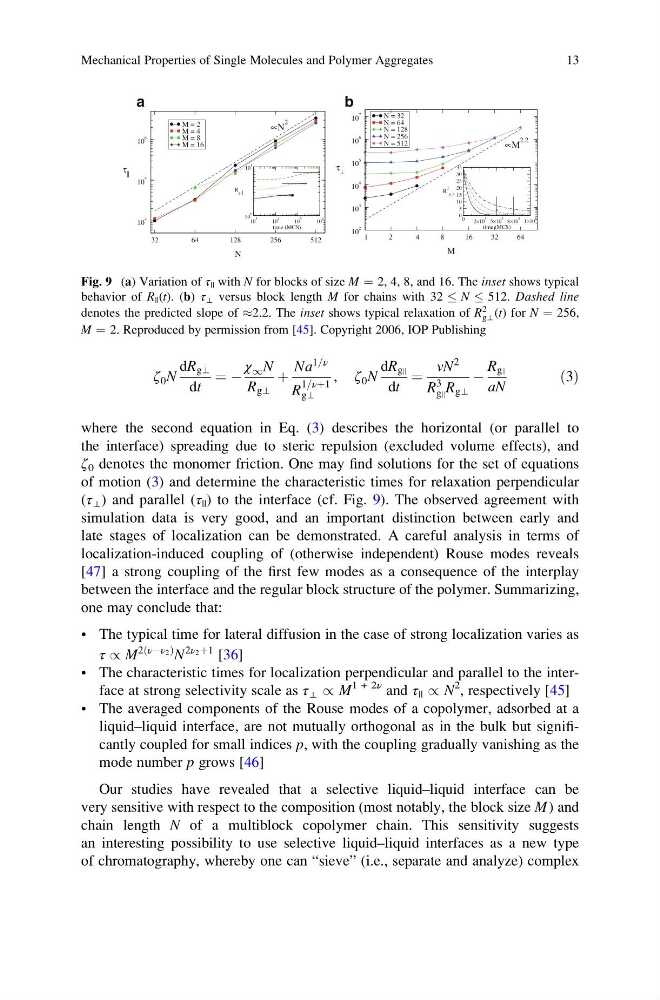
(τ ⊥ ) and parallel (τ || ) to the interface (cf. Fig. 9). The observed agreement with
simulation data is very good, and an important distinction between early and
late stages of localization can be demonstrated. A careful analysis in terms of
localization-induced coupling of (otherwise independent) Rouse modes reveals
[47] a strong coupling of the first few modes as a consequence of the interplay
between the interface and the regular block structure of the polymer. Summarizing,
one may conclude that:
• The typical time for lateral diffusion in the case of strong localization varies as
τ / M
2 νÀν 2
ð
Þ N
2ν 2 þ1 [36]
• The characteristic times for localization perpendicular and parallel to the interface at strong selectivity scale as τ ⊥ / M
1 + 2ν and τ || / N
2 , respectively [45]
• The averaged components of the Rouse modes of a copolymer, adsorbed at a
liquid–liquid interface, are not mutually orthogonal as in the bulk but significantly coupled for small indices p, with the coupling gradually vanishing as the
mode number p grows [46]
Our studies have revealed that a selective liquid–liquid interface can be
very sensitive with respect to the composition (most notably, the block size M ) and
chain length N of a multiblock copolymer chain. This sensitivity suggests
an interesting possibility to use selective liquid–liquid interfaces as a new type
of chromatography, whereby one can “sieve” (i.e., separate and analyze) complex
32
64
128
256
512
N
τ ||
M = 2
M = 4
M = 8
M = 16
10
3
10
4
10
5
10
6
time (MCS)
10
0
10
1
R g,||
∝N
2
1
2
4
8
16
32
64
M
10 2
10 3
10 4
10 5
10 6
10 4
10 5
10 6
10 7
τ ⊥
N = 32
N = 64
N = 128
N = 256
N = 512
0
2×10
5 5×10
5 8×10
5 1×10
6
time (MCS)
0
5
10
15
20
25
30
35
R
2
g,⊥
∝M
2.2
a
b
Fig. 9 (a) Variation of τ || with N for blocks of size M ¼ 2, 4, 8, and 16. The inset shows typical
behavior of R || (t). (b) τ ⊥ versus block length M for chains with 32 N 512. Dashed line
denotes the predicted slope of %2.2. The inset shows typical relaxation of R
2
g⊥ (t) for N ¼ 256,
M ¼ 2. Reproduced by permission from [45]. Copyright 2006, IOP Publishing
Mechanical Properties of Single Molecules and Polymer Aggregates
13
dR g⊥
dt
¼ À
χ 1 N
R g⊥
þ
Na
1=ν
R
1=νþ1
g⊥
, ζ 0 N
dR gjj
dt
¼
vN
2
R
3
gjj R g⊥
À
R gjj
aN
ð3Þ
where the second equation in Eq. (3) describes the horizontal (or parallel to
the interface) spreading due to steric repulsion (excluded volume effects), and
ζ 0 denotes the monomer friction. One may find solutions for the set of equations
of motion (3) and determine the characteristic times for relaxation perpendicular
(τ ⊥ ) and parallel (τ || ) to the interface (cf. Fig. 9). The observed agreement with
simulation data is very good, and an important distinction between early and
late stages of localization can be demonstrated. A careful analysis in terms of
localization-induced coupling of (otherwise independent) Rouse modes reveals
[47] a strong coupling of the first few modes as a consequence of the interplay
between the interface and the regular block structure of the polymer. Summarizing,
one may conclude that:
• The typical time for lateral diffusion in the case of strong localization varies as
τ / M
2 νÀν 2
ð
Þ N
2ν 2 þ1 [36]
• The characteristic times for localization perpendicular and parallel to the interface at strong selectivity scale as τ ⊥ / M
1 + 2ν and τ || / N
2 , respectively [45]
• The averaged components of the Rouse modes of a copolymer, adsorbed at a
liquid–liquid interface, are not mutually orthogonal as in the bulk but significantly coupled for small indices p, with the coupling gradually vanishing as the
mode number p grows [46]
Our studies have revealed that a selective liquid–liquid interface can be
very sensitive with respect to the composition (most notably, the block size M ) and
chain length N of a multiblock copolymer chain. This sensitivity suggests
an interesting possibility to use selective liquid–liquid interfaces as a new type
of chromatography, whereby one can “sieve” (i.e., separate and analyze) complex
32
64
128
256
512
N
τ ||
M = 2
M = 4
M = 8
M = 16
10
3
10
4
10
5
10
6
time (MCS)
10
0
10
1
R g,||
∝N
2
1
2
4
8
16
32
64
M
10 2
10 3
10 4
10 5
10 6
10 4
10 5
10 6
10 7
τ ⊥
N = 32
N = 64
N = 128
N = 256
N = 512
0
2×10
5 5×10
5 8×10
5 1×10
6
time (MCS)
0
5
10
15
20
25
30
35
R
2
g,⊥
∝M
2.2
a
b
Fig. 9 (a) Variation of τ || with N for blocks of size M ¼ 2, 4, 8, and 16. The inset shows typical
behavior of R || (t). (b) τ ⊥ versus block length M for chains with 32 N 512. Dashed line
denotes the predicted slope of %2.2. The inset shows typical relaxation of R
2
g⊥ (t) for N ¼ 256,
M ¼ 2. Reproduced by permission from [45]. Copyright 2006, IOP Publishing
Mechanical Properties of Single Molecules and Polymer Aggregates
13