

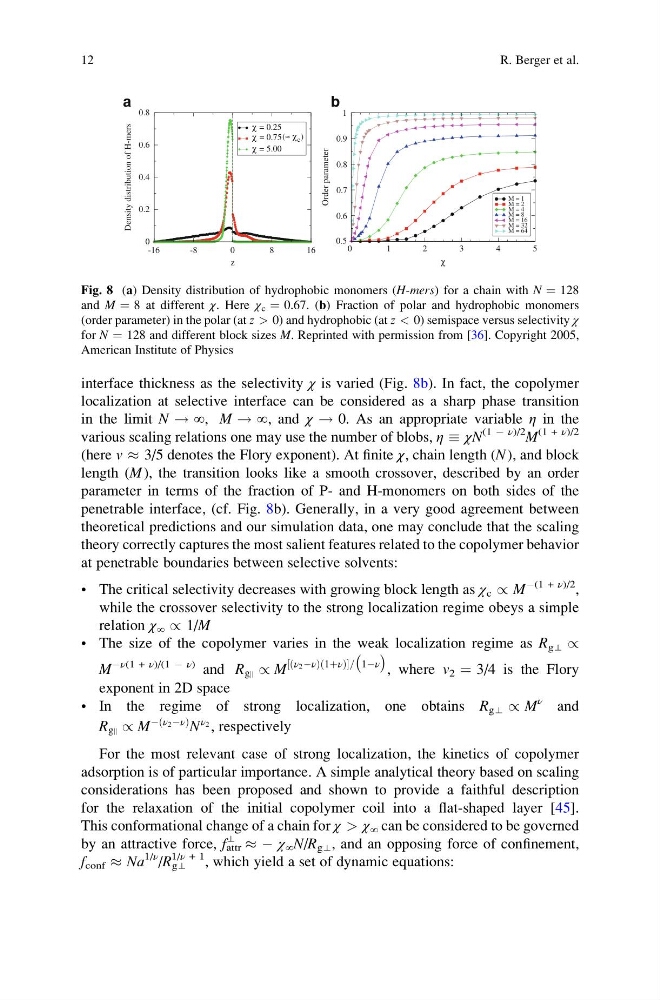
interface thickness as the selectivity χ is varied (Fig. 8b). In fact, the copolymer
localization at selective interface can be considered as a sharp phase transition
in the limit N ! ∞, M ! ∞, and χ ! 0. As an appropriate variable η in the
various scaling relations one may use the number of blobs, η χN
(1 À ν)/2 M
(1 + ν)/2
(here v % 3/5 denotes the Flory exponent). At finite χ, chain length (N ), and block
length (M ), the transition looks like a smooth crossover, described by an order
parameter in terms of the fraction of P- and H-monomers on both sides of the
penetrable interface, (cf. Fig. 8b). Generally, in a very good agreement between
theoretical predictions and our simulation data, one may conclude that the scaling
theory correctly captures the most salient features related to the copolymer behavior
at penetrable boundaries between selective solvents:
• The critical selectivity decreases with growing block length as χ c / M
À(1 + ν)/2 ,
while the crossover selectivity to the strong localization regime obeys a simple
relation χ ∞ / 1/M
• The size of the copolymer varies in the weak localization regime as R g⊥ /
M
Àν(1 + ν)/(1 À ν) and R gjj / M
ν 2 Àν
ð
Þ1þν ð
Þ
½
=
À
1Àν
Á
, where v 2 ¼ 3/4 is the Flory
exponent in 2D space
• In the regime of strong localization, one obtains R g⊥ / M
ν and
R gjj / M
À ν 2 Àν
ð
Þ N
ν 2 , respectively
For the most relevant case of strong localization, the kinetics of copolymer
adsorption is of particular importance. A simple analytical theory based on scaling
considerations has been proposed and shown to provide a faithful description
for the relaxation of the initial copolymer coil into a flat-shaped layer [45].
This conformational change of a chain for χ > χ ∞ can be considered to be governed
by an attractive force, f attr
⊥
% À χ ∞ N/R g⊥ , and an opposing force of confinement,
f conf % Na
1/ν /R g⊥
1/ν + 1 , which yield a set of dynamic equations:
-16
-8
0
16
z
0
0.2
0.4
0.6
0.8
Density distribution of H-mers
χ = 0.25
χ = 0.75
χ = 5.00
1
3
4
5
χ
0.5
0.6
0.7
0.8
0.9
1
Order parameter
M = 1
M = 2
M = 4
M = 8
M = 16
M = 32
M = 64
8
0
2
a
b
(≈ χ c )
Fig. 8 (a) Density distribution of hydrophobic monomers (H-mers) for a chain with N ¼ 128
and M ¼ 8 at different χ. Here χ c ¼ 0.67. (b) Fraction of polar and hydrophobic monomers
(order parameter) in the polar (at z > 0) and hydrophobic (at z < 0) semispace versus selectivity χ
for N ¼ 128 and different block sizes M. Reprinted with permission from [36]. Copyright 2005,
American Institute of Physics
12
R. Berger et al.
localization at selective interface can be considered as a sharp phase transition
in the limit N ! ∞, M ! ∞, and χ ! 0. As an appropriate variable η in the
various scaling relations one may use the number of blobs, η χN
(1 À ν)/2 M
(1 + ν)/2
(here v % 3/5 denotes the Flory exponent). At finite χ, chain length (N ), and block
length (M ), the transition looks like a smooth crossover, described by an order
parameter in terms of the fraction of P- and H-monomers on both sides of the
penetrable interface, (cf. Fig. 8b). Generally, in a very good agreement between
theoretical predictions and our simulation data, one may conclude that the scaling
theory correctly captures the most salient features related to the copolymer behavior
at penetrable boundaries between selective solvents:
• The critical selectivity decreases with growing block length as χ c / M
À(1 + ν)/2 ,
while the crossover selectivity to the strong localization regime obeys a simple
relation χ ∞ / 1/M
• The size of the copolymer varies in the weak localization regime as R g⊥ /
M
Àν(1 + ν)/(1 À ν) and R gjj / M
ν 2 Àν
ð
Þ1þν ð
Þ
½
=
À
1Àν
Á
, where v 2 ¼ 3/4 is the Flory
exponent in 2D space
• In the regime of strong localization, one obtains R g⊥ / M
ν and
R gjj / M
À ν 2 Àν
ð
Þ N
ν 2 , respectively
For the most relevant case of strong localization, the kinetics of copolymer
adsorption is of particular importance. A simple analytical theory based on scaling
considerations has been proposed and shown to provide a faithful description
for the relaxation of the initial copolymer coil into a flat-shaped layer [45].
This conformational change of a chain for χ > χ ∞ can be considered to be governed
by an attractive force, f attr
⊥
% À χ ∞ N/R g⊥ , and an opposing force of confinement,
f conf % Na
1/ν /R g⊥
1/ν + 1 , which yield a set of dynamic equations:
-16
-8
0
16
z
0
0.2
0.4
0.6
0.8
Density distribution of H-mers
χ = 0.25
χ = 0.75
χ = 5.00
1
3
4
5
χ
0.5
0.6
0.7
0.8
0.9
1
Order parameter
M = 1
M = 2
M = 4
M = 8
M = 16
M = 32
M = 64
8
0
2
a
b
(≈ χ c )
Fig. 8 (a) Density distribution of hydrophobic monomers (H-mers) for a chain with N ¼ 128
and M ¼ 8 at different χ. Here χ c ¼ 0.67. (b) Fraction of polar and hydrophobic monomers
(order parameter) in the polar (at z > 0) and hydrophobic (at z < 0) semispace versus selectivity χ
for N ¼ 128 and different block sizes M. Reprinted with permission from [36]. Copyright 2005,
American Institute of Physics
12
R. Berger et al.