

N (the number of repeating units in the chain) and the block size M (the number of
consecutive monomers of the same kind) as well as the selectivity parameter χ, that
is, the energy gained by a monomer when in the more favorable solvent.
Our scaling description is based on the idea that a multiblock copolymer can be
treated as a “coarsened” homopolymer where a single HP-diblock plays the role of
an effective segment. All such diblocks try to keep their H- and P-segments in the
corresponding preferred environment. This leads to the diblock “polarization” at
the interface and to a free energy gain, which produces an effective attraction
energy E. This means that the energy gain χ (i.e., the selectivity parameter) for a
P-monomer in its own (polar) environment is equal to the corresponding energy
gain for a H-monomer, provided the latter stays in the hydrophobic environment.
An estimate for the effective attraction energy per diblock of length 2M in the
symmetric case yields E / À χ
2 M
2 [47], where the energy is measured in units of
k B T, k B denoting the Boltzmann constant. In terms of the selectivity parameter,
there are three adsorption regimes that can be distinguished:
For χ smaller than a critical value χ c , the interface is too weak to affect the polymer
so that the macromolecule conformation is identical to that in the absence of an
interface
For χ ’ χ c , the copolymer is captured by the interface yet is not strongly deformed
(weak localization)
For χ ’ χ ∞ > χ c , the interface is strong enough to induce a perfect flattening
of the copolymer so that all the monomers are in their preferred environment
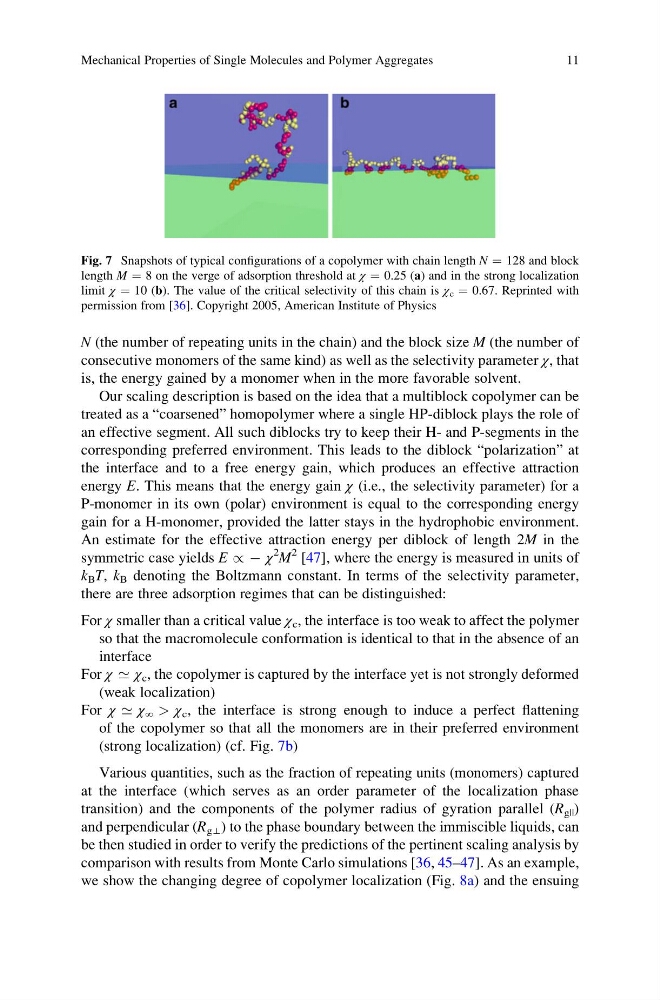
(strong localization) (cf. Fig. 7b)
Various quantities, such as the fraction of repeating units (monomers) captured
at the interface (which serves as an order parameter of the localization phase
transition) and the components of the polymer radius of gyration parallel (R g|| )
and perpendicular (R g⊥ ) to the phase boundary between the immiscible liquids, can
be then studied in order to verify the predictions of the pertinent scaling analysis by
comparison with results from Monte Carlo simulations [36, 45–47]. As an example,
we show the changing degree of copolymer localization (Fig. 8a) and the ensuing
Fig. 7 Snapshots of typical configurations of a copolymer with chain length N ¼ 128 and block
length M ¼ 8 on the verge of adsorption threshold at χ ¼ 0.25 (a) and in the strong localization
limit χ ¼ 10 (b). The value of the critical selectivity of this chain is χ c ¼ 0.67. Reprinted with
permission from [36]. Copyright 2005, American Institute of Physics
Mechanical Properties of Single Molecules and Polymer Aggregates
11
consecutive monomers of the same kind) as well as the selectivity parameter χ, that
is, the energy gained by a monomer when in the more favorable solvent.
Our scaling description is based on the idea that a multiblock copolymer can be
treated as a “coarsened” homopolymer where a single HP-diblock plays the role of
an effective segment. All such diblocks try to keep their H- and P-segments in the
corresponding preferred environment. This leads to the diblock “polarization” at
the interface and to a free energy gain, which produces an effective attraction
energy E. This means that the energy gain χ (i.e., the selectivity parameter) for a
P-monomer in its own (polar) environment is equal to the corresponding energy
gain for a H-monomer, provided the latter stays in the hydrophobic environment.
An estimate for the effective attraction energy per diblock of length 2M in the
symmetric case yields E / À χ
2 M
2 [47], where the energy is measured in units of
k B T, k B denoting the Boltzmann constant. In terms of the selectivity parameter,
there are three adsorption regimes that can be distinguished:
For χ smaller than a critical value χ c , the interface is too weak to affect the polymer
so that the macromolecule conformation is identical to that in the absence of an
interface
For χ ’ χ c , the copolymer is captured by the interface yet is not strongly deformed
(weak localization)
For χ ’ χ ∞ > χ c , the interface is strong enough to induce a perfect flattening
of the copolymer so that all the monomers are in their preferred environment
(strong localization) (cf. Fig. 7b)
Various quantities, such as the fraction of repeating units (monomers) captured
at the interface (which serves as an order parameter of the localization phase
transition) and the components of the polymer radius of gyration parallel (R g|| )
and perpendicular (R g⊥ ) to the phase boundary between the immiscible liquids, can
be then studied in order to verify the predictions of the pertinent scaling analysis by
comparison with results from Monte Carlo simulations [36, 45–47]. As an example,
we show the changing degree of copolymer localization (Fig. 8a) and the ensuing
Fig. 7 Snapshots of typical configurations of a copolymer with chain length N ¼ 128 and block
length M ¼ 8 on the verge of adsorption threshold at χ ¼ 0.25 (a) and in the strong localization
limit χ ¼ 10 (b). The value of the critical selectivity of this chain is χ c ¼ 0.67. Reprinted with
permission from [36]. Copyright 2005, American Institute of Physics
Mechanical Properties of Single Molecules and Polymer Aggregates
11