

mixtures of copolymers with respect to block size and chain length. Thus, a chain
may be driven from an initial configuration, some distance away from the interface,
into the other half of the container whereby it will pass through the penetrable
interface. Depending on their length and composition, different chains will then
be temporarily trapped at the plane separating the two solvents. One might expect
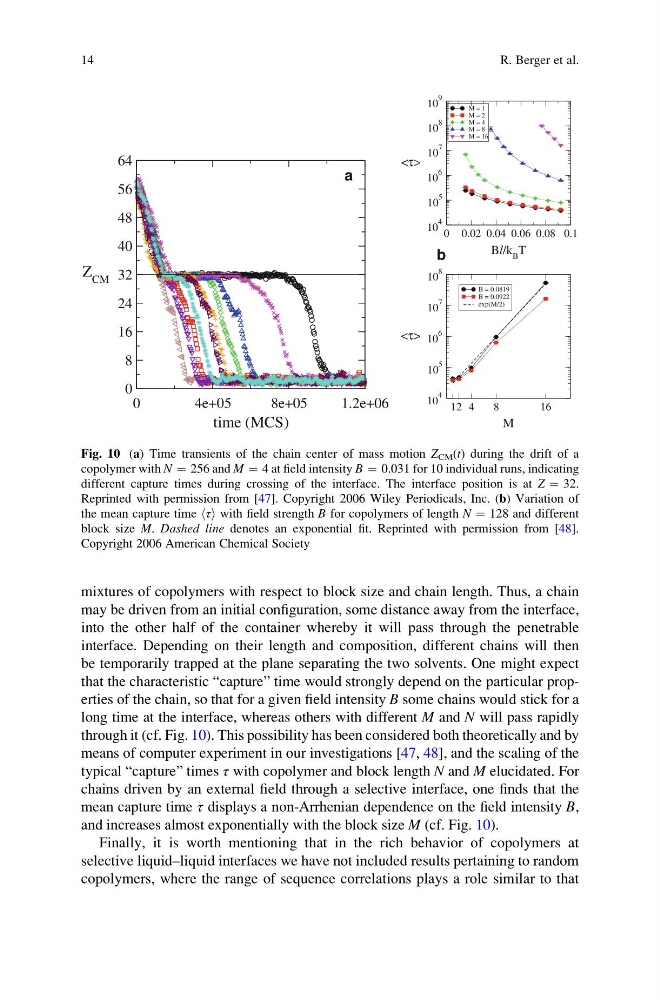
that the characteristic “capture” time would strongly depend on the particular properties of the chain, so that for a given field intensity B some chains would stick for a
long time at the interface, whereas others with different M and N will pass rapidly
through it (cf. Fig. 10). This possibility has been considered both theoretically and by
means of computer experiment in our investigations [47, 48], and the scaling of the
typical “capture” times τ with copolymer and block length N and M elucidated. For
chains driven by an external field through a selective interface, one finds that the
mean capture time τ displays a non-Arrhenian dependence on the field intensity B,
and increases almost exponentially with the block size M (cf. Fig. 10).
Finally, it is worth mentioning that in the rich behavior of copolymers at
selective liquid–liquid interfaces we have not included results pertaining to random
copolymers, where the range of sequence correlations plays a role similar to that
0
4e+05
8e+05
1.2e+06
time (MCS)
0
8
16
24
32
40
48
56
64
Z CM
0 0.02 0.04 0.06 0.08 0.1
Bl/k B T
10
4
10
5
10
6
10
7
10
8
10
9
<τ>
M = 1
M = 2
M = 4
M = 8
M = 16
12 4
8
16
M
10
4
10
5
10
6
10
7
10
8
<τ>
B = 0.0819
B = 0.0922
exp(M/2)
b
a
Fig. 10 (a) Time transients of the chain center of mass motion Z CM (t) during the drift of a
copolymer with N ¼ 256 and M ¼ 4 at field intensity B ¼ 0.031 for 10 individual runs, indicating
different capture times during crossing of the interface. The interface position is at Z ¼ 32.
Reprinted with permission from [47]. Copyright 2006 Wiley Periodicals, Inc. (b) Variation of
the mean capture time hτi with field strength B for copolymers of length N ¼ 128 and different
block size M. Dashed line denotes an exponential fit. Reprinted with permission from [48].
Copyright 2006 American Chemical Society
14
R. Berger et al.
may be driven from an initial configuration, some distance away from the interface,
into the other half of the container whereby it will pass through the penetrable
interface. Depending on their length and composition, different chains will then
be temporarily trapped at the plane separating the two solvents. One might expect
that the characteristic “capture” time would strongly depend on the particular properties of the chain, so that for a given field intensity B some chains would stick for a
long time at the interface, whereas others with different M and N will pass rapidly
through it (cf. Fig. 10). This possibility has been considered both theoretically and by
means of computer experiment in our investigations [47, 48], and the scaling of the
typical “capture” times τ with copolymer and block length N and M elucidated. For
chains driven by an external field through a selective interface, one finds that the
mean capture time τ displays a non-Arrhenian dependence on the field intensity B,
and increases almost exponentially with the block size M (cf. Fig. 10).
Finally, it is worth mentioning that in the rich behavior of copolymers at
selective liquid–liquid interfaces we have not included results pertaining to random
copolymers, where the range of sequence correlations plays a role similar to that
0
4e+05
8e+05
1.2e+06
time (MCS)
0
8
16
24
32
40
48
56
64
Z CM
0 0.02 0.04 0.06 0.08 0.1
Bl/k B T
10
4
10
5
10
6
10
7
10
8
10
9
<τ>
M = 1
M = 2
M = 4
M = 8
M = 16
12 4
8
16
M
10
4
10
5
10
6
10
7
10
8
<τ>
B = 0.0819
B = 0.0922
exp(M/2)
b
a
Fig. 10 (a) Time transients of the chain center of mass motion Z CM (t) during the drift of a
copolymer with N ¼ 256 and M ¼ 4 at field intensity B ¼ 0.031 for 10 individual runs, indicating
different capture times during crossing of the interface. The interface position is at Z ¼ 32.
Reprinted with permission from [47]. Copyright 2006 Wiley Periodicals, Inc. (b) Variation of
the mean capture time hτi with field strength B for copolymers of length N ¼ 128 and different
block size M. Dashed line denotes an exponential fit. Reprinted with permission from [48].
Copyright 2006 American Chemical Society
14
R. Berger et al.