

The other structures seen can be easily understood by considering the binding
possibilities of DISA. As shown in Fig. 70d, the zigzag structure is not the only
possible linkage. This explains why the zigzag structure is not the only pattern that
exists on the surface after annealing. With these results, we demonstrate that even
shape control can be achieved by choosing rationally designed monomer building
blocks.
6.3 Towards Hierarchical Structure Formation:
Exploring Two-Step Reactions
After having demonstrated a proof-of-concept covalent linking reaction in ultrahigh
vacuum [290], an important next step for creating complex structures is exploring
strategies for including hierarchical control. Up to now, the structural complexity of
the structures achieved by on-surface synthesis has been limited to single-step
processes. Increasing the structural complexity of the resulting structures requires
utmost control, with the ability to selectively induce sequential linking reactions in
a hierarchical manner. This has recently been demonstrated using halide-substituted
porphyrin derivatives on a Au(111) surface [300], elegantly exploiting the specific
dissociation energies of the bromine–phenyl and iodine–phenyl bonds. Because the
dissociation energies are associated with different activation temperatures, the
linking reactions can be performed in a site-specific and sequential manner. Thus,
reaction sites and sequence are encoded in the structure of the precursor molecules.
The latter results have, however, been obtained on a metallic substrate, again
limiting the applicability of these structures with regard to molecular electronics.
Based on the results obtained, we chose a molecule for demonstrating a sitespecific and selective two-step linking process on a bulk insulator surface in
ultrahigh vacuum [298]. Bromophenyl and chlorophenyl groups were chosen for
inducing site-specific and sequential covalent linking based on homolytic cleavage
of the halide–phenyl bonds, having dissociation energies of 336 kJ/mol (Br-C 6 H 5 )
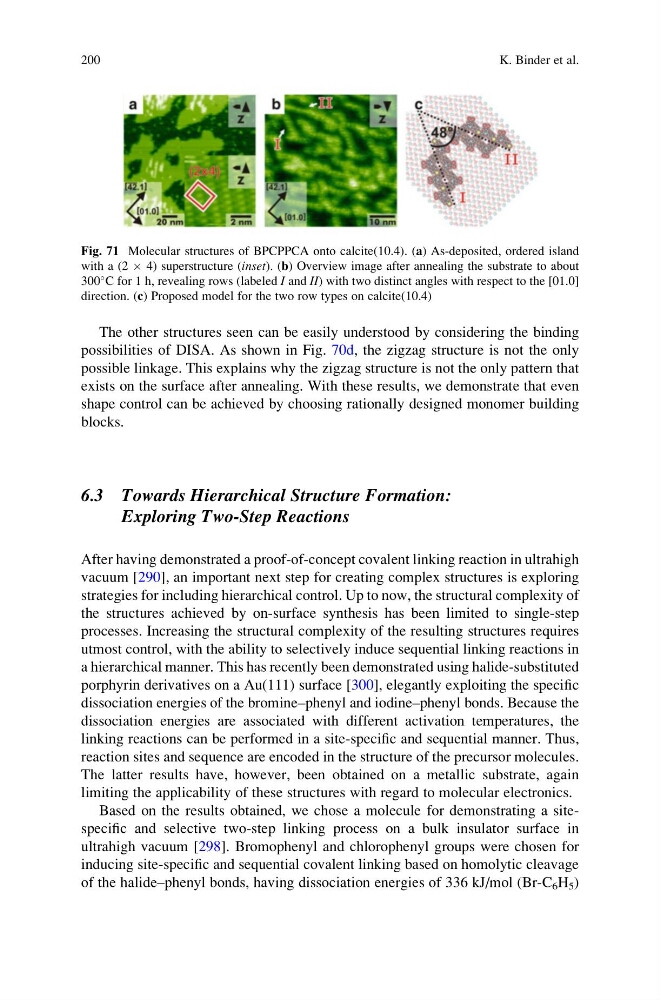
Fig. 71 Molecular structures of BPCPPCA onto calcite(10.4). (a) As-deposited, ordered island
with a (2 Â 4) superstructure (inset). (b) Overview image after annealing the substrate to about
300
C for 1 h, revealing rows (labeled I and II) with two distinct angles with respect to the [01.0]
direction. (c) Proposed model for the two row types on calcite(10.4)
200
K. Binder et al.
possibilities of DISA. As shown in Fig. 70d, the zigzag structure is not the only
possible linkage. This explains why the zigzag structure is not the only pattern that
exists on the surface after annealing. With these results, we demonstrate that even
shape control can be achieved by choosing rationally designed monomer building
blocks.
6.3 Towards Hierarchical Structure Formation:
Exploring Two-Step Reactions
After having demonstrated a proof-of-concept covalent linking reaction in ultrahigh
vacuum [290], an important next step for creating complex structures is exploring
strategies for including hierarchical control. Up to now, the structural complexity of
the structures achieved by on-surface synthesis has been limited to single-step
processes. Increasing the structural complexity of the resulting structures requires
utmost control, with the ability to selectively induce sequential linking reactions in
a hierarchical manner. This has recently been demonstrated using halide-substituted
porphyrin derivatives on a Au(111) surface [300], elegantly exploiting the specific
dissociation energies of the bromine–phenyl and iodine–phenyl bonds. Because the
dissociation energies are associated with different activation temperatures, the
linking reactions can be performed in a site-specific and sequential manner. Thus,
reaction sites and sequence are encoded in the structure of the precursor molecules.
The latter results have, however, been obtained on a metallic substrate, again
limiting the applicability of these structures with regard to molecular electronics.
Based on the results obtained, we chose a molecule for demonstrating a sitespecific and selective two-step linking process on a bulk insulator surface in
ultrahigh vacuum [298]. Bromophenyl and chlorophenyl groups were chosen for
inducing site-specific and sequential covalent linking based on homolytic cleavage
of the halide–phenyl bonds, having dissociation energies of 336 kJ/mol (Br-C 6 H 5 )
Fig. 71 Molecular structures of BPCPPCA onto calcite(10.4). (a) As-deposited, ordered island
with a (2 Â 4) superstructure (inset). (b) Overview image after annealing the substrate to about
300
C for 1 h, revealing rows (labeled I and II) with two distinct angles with respect to the [01.0]
direction. (c) Proposed model for the two row types on calcite(10.4)
200
K. Binder et al.