

and 399 kJ/mol (Cl-C 6 H 5 ), respectively [299]. Again, a carboxylic acid moiety was
chosen to provide sufficient anchoring towards the calcite surface.
When depositing a submonolayer of BPCPPCA onto the calcite(10.4) surface at
room temperature, ordered islands of a (2 Â 4) superstructure are formed, as shown
in Fig. 71a.
A first distinct change in the molecular structure is induced upon annealing to
300
C, which can be assigned to the homolytic cleavage of the bromine–phenyl bond
and subsequent covalent linking of the resulting radicals, resulting in molecular
dimers. A representative image is given in Fig. 71b. Instead of ordered islands,
rows are formed on the surface. Although the overall ordering is poor compared to
the islands, two main orientations of the rows can be identified that span an angle of
49 Æ 3
. A dimer structure that is covalently linked at the former bromine position,
6,6
0 -[(1,1
0 -biphenyl)-4,4
0 -diyl]bis[2-(4-chloro- phenyl)isonicotinic acid], exhibits
either a U- or an S-like shape. A stacking model for the S-form is given in
Fig. 71c. Optimizing the intermolecular distance to allow for halogen–π interaction
can be understood as the driving force behind the lateral shift of the molecules
perpendicular to the row direction. This readily results in a molecular chain that
forms an angle of either +66
or À66
with respect to the [42 :1] mirror direction,
resulting in an opening angle of 48
, in excellent agreement with the experimentally
observed opening angle.
To induce the second reaction step, we annealed the surface to 340
C. The
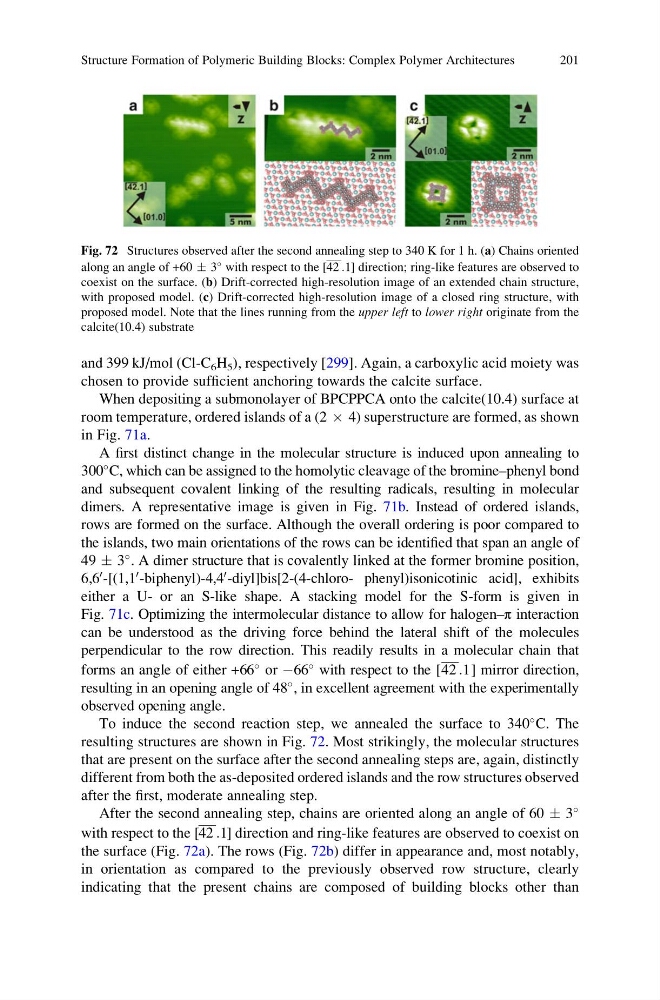
resulting structures are shown in Fig. 72. Most strikingly, the molecular structures
that are present on the surface after the second annealing steps are, again, distinctly
different from both the as-deposited ordered islands and the row structures observed
after the first, moderate annealing step.
After the second annealing step, chains are oriented along an angle of 60 Æ 3
with respect to the [42 :1] direction and ring-like features are observed to coexist on
the surface (Fig. 72a). The rows (Fig. 72b) differ in appearance and, most notably,
in orientation as compared to the previously observed row structure, clearly
indicating that the present chains are composed of building blocks other than
Fig. 72 Structures observed after the second annealing step to 340 K for 1 h. (a) Chains oriented
along an angle of +60 Æ 3
with respect to the [42 :1] direction; ring-like features are observed to
coexist on the surface. (b) Drift-corrected high-resolution image of an extended chain structure,
with proposed model. (c) Drift-corrected high-resolution image of a closed ring structure, with
proposed model. Note that the lines running from the upper left to lower right originate from the
calcite(10.4) substrate
Structure Formation of Polymeric Building Blocks: Complex Polymer Architectures
201
chosen to provide sufficient anchoring towards the calcite surface.
When depositing a submonolayer of BPCPPCA onto the calcite(10.4) surface at
room temperature, ordered islands of a (2 Â 4) superstructure are formed, as shown
in Fig. 71a.
A first distinct change in the molecular structure is induced upon annealing to
300
C, which can be assigned to the homolytic cleavage of the bromine–phenyl bond
and subsequent covalent linking of the resulting radicals, resulting in molecular
dimers. A representative image is given in Fig. 71b. Instead of ordered islands,
rows are formed on the surface. Although the overall ordering is poor compared to
the islands, two main orientations of the rows can be identified that span an angle of
49 Æ 3
. A dimer structure that is covalently linked at the former bromine position,
6,6
0 -[(1,1
0 -biphenyl)-4,4
0 -diyl]bis[2-(4-chloro- phenyl)isonicotinic acid], exhibits
either a U- or an S-like shape. A stacking model for the S-form is given in
Fig. 71c. Optimizing the intermolecular distance to allow for halogen–π interaction
can be understood as the driving force behind the lateral shift of the molecules
perpendicular to the row direction. This readily results in a molecular chain that
forms an angle of either +66
or À66
with respect to the [42 :1] mirror direction,
resulting in an opening angle of 48
, in excellent agreement with the experimentally
observed opening angle.
To induce the second reaction step, we annealed the surface to 340
C. The
resulting structures are shown in Fig. 72. Most strikingly, the molecular structures
that are present on the surface after the second annealing steps are, again, distinctly
different from both the as-deposited ordered islands and the row structures observed
after the first, moderate annealing step.
After the second annealing step, chains are oriented along an angle of 60 Æ 3
with respect to the [42 :1] direction and ring-like features are observed to coexist on
the surface (Fig. 72a). The rows (Fig. 72b) differ in appearance and, most notably,
in orientation as compared to the previously observed row structure, clearly
indicating that the present chains are composed of building blocks other than
Fig. 72 Structures observed after the second annealing step to 340 K for 1 h. (a) Chains oriented
along an angle of +60 Æ 3
with respect to the [42 :1] direction; ring-like features are observed to
coexist on the surface. (b) Drift-corrected high-resolution image of an extended chain structure,
with proposed model. (c) Drift-corrected high-resolution image of a closed ring structure, with
proposed model. Note that the lines running from the upper left to lower right originate from the
calcite(10.4) substrate
Structure Formation of Polymeric Building Blocks: Complex Polymer Architectures
201