

change only occurred when annealing above 295
C, which is, indeed, higher than
needed for DIBA.
To explore the possibility of controlling the resulting polymer shape, we next
changed the monomer building block with the idea that zigzag structures would be
obtained instead of straight polymeric chains. This could be realized by changing
the substitution position from para to meta. Because 3,5-diiodo benzoic acid was
not available for this study, 3,5-diiodo salicylic acid (DISA) was used instead,
having a pK A of 2.07. Again, based on this pK A , we expect the molecules to be
deprotonated at room temperature.
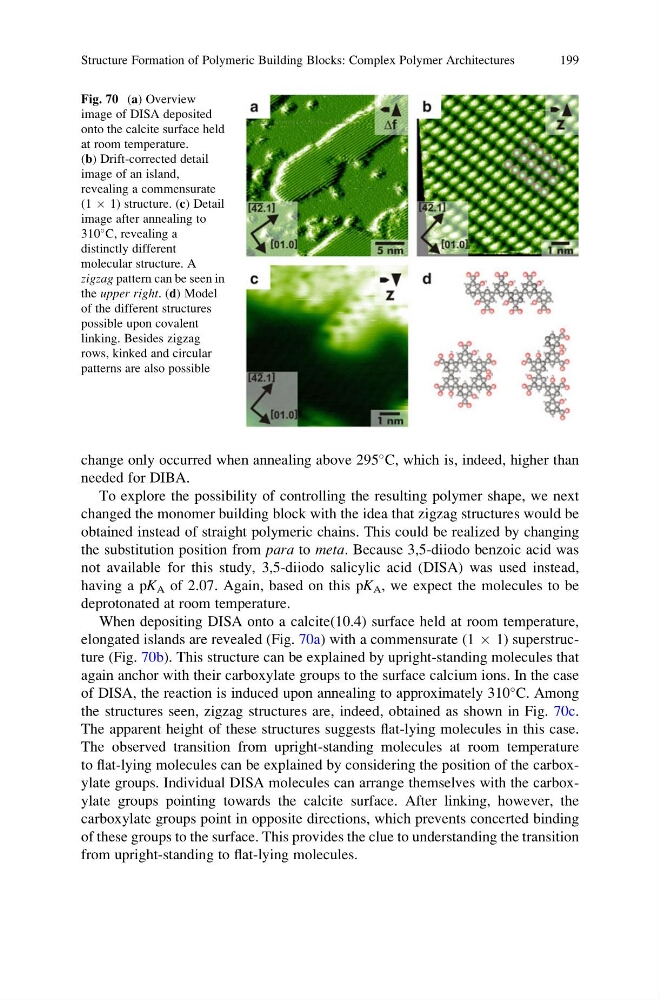
When depositing DISA onto a calcite(10.4) surface held at room temperature,
elongated islands are revealed (Fig. 70a) with a commensurate (1 Â 1) superstructure (Fig. 70b). This structure can be explained by upright-standing molecules that
again anchor with their carboxylate groups to the surface calcium ions. In the case
of DISA, the reaction is induced upon annealing to approximately 310
C. Among
the structures seen, zigzag structures are, indeed, obtained as shown in Fig. 70c.
The apparent height of these structures suggests flat-lying molecules in this case.
The observed transition from upright-standing molecules at room temperature
to flat-lying molecules can be explained by considering the position of the carboxylate groups. Individual DISA molecules can arrange themselves with the carboxylate groups pointing towards the calcite surface. After linking, however, the
carboxylate groups point in opposite directions, which prevents concerted binding
of these groups to the surface. This provides the clue to understanding the transition
from upright-standing to flat-lying molecules.
Fig. 70 (a) Overview
image of DISA deposited
onto the calcite surface held
at room temperature.
(b) Drift-corrected detail
image of an island,
revealing a commensurate
(1 Â 1) structure. (c) Detail
image after annealing to
310
C, revealing a
distinctly different
molecular structure. A
zigzag pattern can be seen in
the upper right. (d) Model
of the different structures
possible upon covalent
linking. Besides zigzag
rows, kinked and circular
patterns are also possible
Structure Formation of Polymeric Building Blocks: Complex Polymer Architectures
199
C, which is, indeed, higher than
needed for DIBA.
To explore the possibility of controlling the resulting polymer shape, we next
changed the monomer building block with the idea that zigzag structures would be
obtained instead of straight polymeric chains. This could be realized by changing
the substitution position from para to meta. Because 3,5-diiodo benzoic acid was
not available for this study, 3,5-diiodo salicylic acid (DISA) was used instead,
having a pK A of 2.07. Again, based on this pK A , we expect the molecules to be
deprotonated at room temperature.
When depositing DISA onto a calcite(10.4) surface held at room temperature,
elongated islands are revealed (Fig. 70a) with a commensurate (1 Â 1) superstructure (Fig. 70b). This structure can be explained by upright-standing molecules that
again anchor with their carboxylate groups to the surface calcium ions. In the case
of DISA, the reaction is induced upon annealing to approximately 310
C. Among
the structures seen, zigzag structures are, indeed, obtained as shown in Fig. 70c.
The apparent height of these structures suggests flat-lying molecules in this case.
The observed transition from upright-standing molecules at room temperature
to flat-lying molecules can be explained by considering the position of the carboxylate groups. Individual DISA molecules can arrange themselves with the carboxylate groups pointing towards the calcite surface. After linking, however, the
carboxylate groups point in opposite directions, which prevents concerted binding
of these groups to the surface. This provides the clue to understanding the transition
from upright-standing to flat-lying molecules.
Fig. 70 (a) Overview
image of DISA deposited
onto the calcite surface held
at room temperature.
(b) Drift-corrected detail
image of an island,
revealing a commensurate
(1 Â 1) structure. (c) Detail
image after annealing to
310
C, revealing a
distinctly different
molecular structure. A
zigzag pattern can be seen in
the upper right. (d) Model
of the different structures
possible upon covalent
linking. Besides zigzag
rows, kinked and circular
patterns are also possible
Structure Formation of Polymeric Building Blocks: Complex Polymer Architectures
199