

dimer species in the case of IBA monomer units constitutes the first indication of a
successful covalent coupling reaction.
To arrive at extended polymeric structures, we next changed the monomer
building block from having only one halide substitution to two halide atoms in
para position. This should result in straight lines upon covalent coupling. To test
this assumption, we investigated the structures observed upon deposition of DIBA.
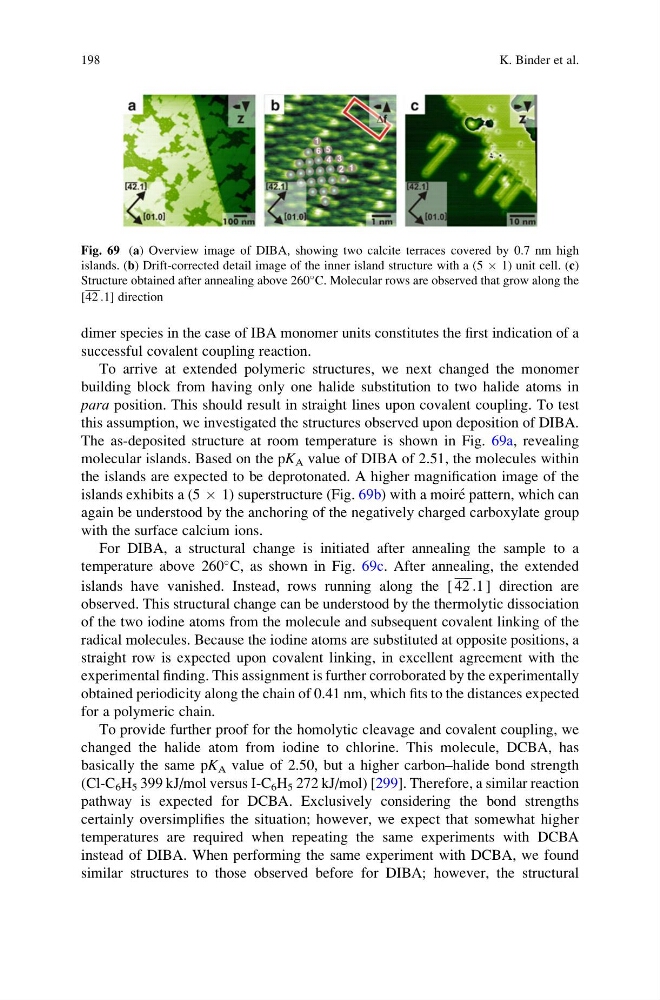
The as-deposited structure at room temperature is shown in Fig. 69a, revealing
molecular islands. Based on the pK A value of DIBA of 2.51, the molecules within
the islands are expected to be deprotonated. A higher magnification image of the
islands exhibits a (5 Â 1) superstructure (Fig. 69b) with a moire ´ pattern, which can
again be understood by the anchoring of the negatively charged carboxylate group
with the surface calcium ions.
For DIBA, a structural change is initiated after annealing the sample to a
temperature above 260
C, as shown in Fig. 69c. After annealing, the extended
islands have vanished. Instead, rows running along the [ 42 :1 ] direction are
observed. This structural change can be understood by the thermolytic dissociation
of the two iodine atoms from the molecule and subsequent covalent linking of the
radical molecules. Because the iodine atoms are substituted at opposite positions, a
straight row is expected upon covalent linking, in excellent agreement with the
experimental finding. This assignment is further corroborated by the experimentally
obtained periodicity along the chain of 0.41 nm, which fits to the distances expected
for a polymeric chain.
To provide further proof for the homolytic cleavage and covalent coupling, we
changed the halide atom from iodine to chlorine. This molecule, DCBA, has
basically the same pK A value of 2.50, but a higher carbon–halide bond strength
(Cl-C 6 H 5 399 kJ/mol versus I-C 6 H 5 272 kJ/mol) [299]. Therefore, a similar reaction
pathway is expected for DCBA. Exclusively considering the bond strengths
certainly oversimplifies the situation; however, we expect that somewhat higher
temperatures are required when repeating the same experiments with DCBA
instead of DIBA. When performing the same experiment with DCBA, we found
similar structures to those observed before for DIBA; however, the structural
Fig. 69 (a) Overview image of DIBA, showing two calcite terraces covered by 0.7 nm high
islands. (b) Drift-corrected detail image of the inner island structure with a (5 Â 1) unit cell. (c)
Structure obtained after annealing above 260
C. Molecular rows are observed that grow along the
[42 :1] direction
198
K. Binder et al.
successful covalent coupling reaction.
To arrive at extended polymeric structures, we next changed the monomer
building block from having only one halide substitution to two halide atoms in
para position. This should result in straight lines upon covalent coupling. To test
this assumption, we investigated the structures observed upon deposition of DIBA.
The as-deposited structure at room temperature is shown in Fig. 69a, revealing
molecular islands. Based on the pK A value of DIBA of 2.51, the molecules within
the islands are expected to be deprotonated. A higher magnification image of the
islands exhibits a (5 Â 1) superstructure (Fig. 69b) with a moire ´ pattern, which can
again be understood by the anchoring of the negatively charged carboxylate group
with the surface calcium ions.
For DIBA, a structural change is initiated after annealing the sample to a
temperature above 260
C, as shown in Fig. 69c. After annealing, the extended
islands have vanished. Instead, rows running along the [ 42 :1 ] direction are
observed. This structural change can be understood by the thermolytic dissociation
of the two iodine atoms from the molecule and subsequent covalent linking of the
radical molecules. Because the iodine atoms are substituted at opposite positions, a
straight row is expected upon covalent linking, in excellent agreement with the
experimental finding. This assignment is further corroborated by the experimentally
obtained periodicity along the chain of 0.41 nm, which fits to the distances expected
for a polymeric chain.
To provide further proof for the homolytic cleavage and covalent coupling, we
changed the halide atom from iodine to chlorine. This molecule, DCBA, has
basically the same pK A value of 2.50, but a higher carbon–halide bond strength
(Cl-C 6 H 5 399 kJ/mol versus I-C 6 H 5 272 kJ/mol) [299]. Therefore, a similar reaction
pathway is expected for DCBA. Exclusively considering the bond strengths
certainly oversimplifies the situation; however, we expect that somewhat higher
temperatures are required when repeating the same experiments with DCBA
instead of DIBA. When performing the same experiment with DCBA, we found
similar structures to those observed before for DIBA; however, the structural
Fig. 69 (a) Overview image of DIBA, showing two calcite terraces covered by 0.7 nm high
islands. (b) Drift-corrected detail image of the inner island structure with a (5 Â 1) unit cell. (c)
Structure obtained after annealing above 260
C. Molecular rows are observed that grow along the
[42 :1] direction
198
K. Binder et al.