

value of IBA of 4.02, we expect the molecules to remain protonated when deposited
onto calcite(10.4) held at room temperature. This is, indeed, the case as can be
deduced from two structural transitions that are observed upon annealing. Upon
deposition at room temperature, the molecules appear to be mobile. No indication is
obtained for island formation on the plane terraces. Molecular islands can only be
found at step edges (not shown). After a first, moderate annealing step at around
250
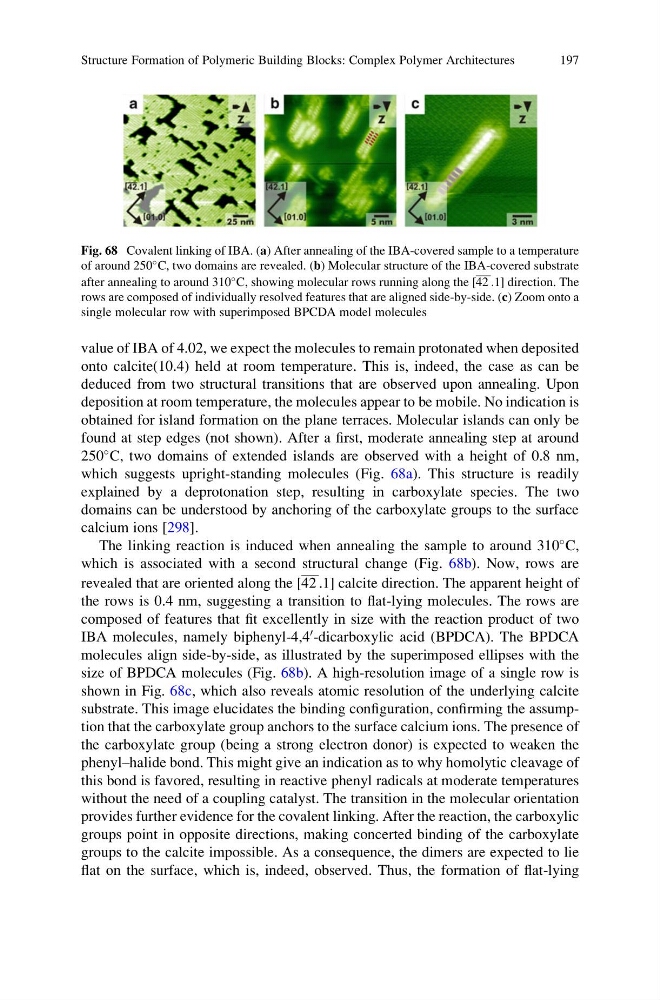
C, two domains of extended islands are observed with a height of 0.8 nm,
which suggests upright-standing molecules (Fig. 68a). This structure is readily
explained by a deprotonation step, resulting in carboxylate species. The two
domains can be understood by anchoring of the carboxylate groups to the surface
calcium ions [298].
The linking reaction is induced when annealing the sample to around 310
C,
which is associated with a second structural change (Fig. 68b). Now, rows are
revealed that are oriented along the [42 .1] calcite direction. The apparent height of
the rows is 0.4 nm, suggesting a transition to flat-lying molecules. The rows are
composed of features that fit excellently in size with the reaction product of two
IBA molecules, namely biphenyl-4,4
0 -dicarboxylic acid (BPDCA). The BPDCA
molecules align side-by-side, as illustrated by the superimposed ellipses with the
size of BPDCA molecules (Fig. 68b). A high-resolution image of a single row is
shown in Fig. 68c, which also reveals atomic resolution of the underlying calcite
substrate. This image elucidates the binding configuration, confirming the assumption that the carboxylate group anchors to the surface calcium ions. The presence of
the carboxylate group (being a strong electron donor) is expected to weaken the
phenyl–halide bond. This might give an indication as to why homolytic cleavage of
this bond is favored, resulting in reactive phenyl radicals at moderate temperatures
without the need of a coupling catalyst. The transition in the molecular orientation
provides further evidence for the covalent linking. After the reaction, the carboxylic
groups point in opposite directions, making concerted binding of the carboxylate
groups to the calcite impossible. As a consequence, the dimers are expected to lie
flat on the surface, which is, indeed, observed. Thus, the formation of flat-lying
Fig. 68 Covalent linking of IBA. (a) After annealing of the IBA-covered sample to a temperature
of around 250
C, two domains are revealed. (b) Molecular structure of the IBA-covered substrate
after annealing to around 310
C, showing molecular rows running along the [42 :1] direction. The
rows are composed of individually resolved features that are aligned side-by-side. (c) Zoom onto a
single molecular row with superimposed BPCDA model molecules
Structure Formation of Polymeric Building Blocks: Complex Polymer Architectures
197
onto calcite(10.4) held at room temperature. This is, indeed, the case as can be
deduced from two structural transitions that are observed upon annealing. Upon
deposition at room temperature, the molecules appear to be mobile. No indication is
obtained for island formation on the plane terraces. Molecular islands can only be
found at step edges (not shown). After a first, moderate annealing step at around
250
C, two domains of extended islands are observed with a height of 0.8 nm,
which suggests upright-standing molecules (Fig. 68a). This structure is readily
explained by a deprotonation step, resulting in carboxylate species. The two
domains can be understood by anchoring of the carboxylate groups to the surface
calcium ions [298].
The linking reaction is induced when annealing the sample to around 310
C,
which is associated with a second structural change (Fig. 68b). Now, rows are
revealed that are oriented along the [42 .1] calcite direction. The apparent height of
the rows is 0.4 nm, suggesting a transition to flat-lying molecules. The rows are
composed of features that fit excellently in size with the reaction product of two
IBA molecules, namely biphenyl-4,4
0 -dicarboxylic acid (BPDCA). The BPDCA
molecules align side-by-side, as illustrated by the superimposed ellipses with the
size of BPDCA molecules (Fig. 68b). A high-resolution image of a single row is
shown in Fig. 68c, which also reveals atomic resolution of the underlying calcite
substrate. This image elucidates the binding configuration, confirming the assumption that the carboxylate group anchors to the surface calcium ions. The presence of
the carboxylate group (being a strong electron donor) is expected to weaken the
phenyl–halide bond. This might give an indication as to why homolytic cleavage of
this bond is favored, resulting in reactive phenyl radicals at moderate temperatures
without the need of a coupling catalyst. The transition in the molecular orientation
provides further evidence for the covalent linking. After the reaction, the carboxylic
groups point in opposite directions, making concerted binding of the carboxylate
groups to the calcite impossible. As a consequence, the dimers are expected to lie
flat on the surface, which is, indeed, observed. Thus, the formation of flat-lying
Fig. 68 Covalent linking of IBA. (a) After annealing of the IBA-covered sample to a temperature
of around 250
C, two domains are revealed. (b) Molecular structure of the IBA-covered substrate
after annealing to around 310
C, showing molecular rows running along the [42 :1] direction. The
rows are composed of individually resolved features that are aligned side-by-side. (c) Zoom onto a
single molecular row with superimposed BPCDA model molecules
Structure Formation of Polymeric Building Blocks: Complex Polymer Architectures
197