

surface concentration can be determined. For the onion-like particles, the surface
consists of 87.1% PMMA.
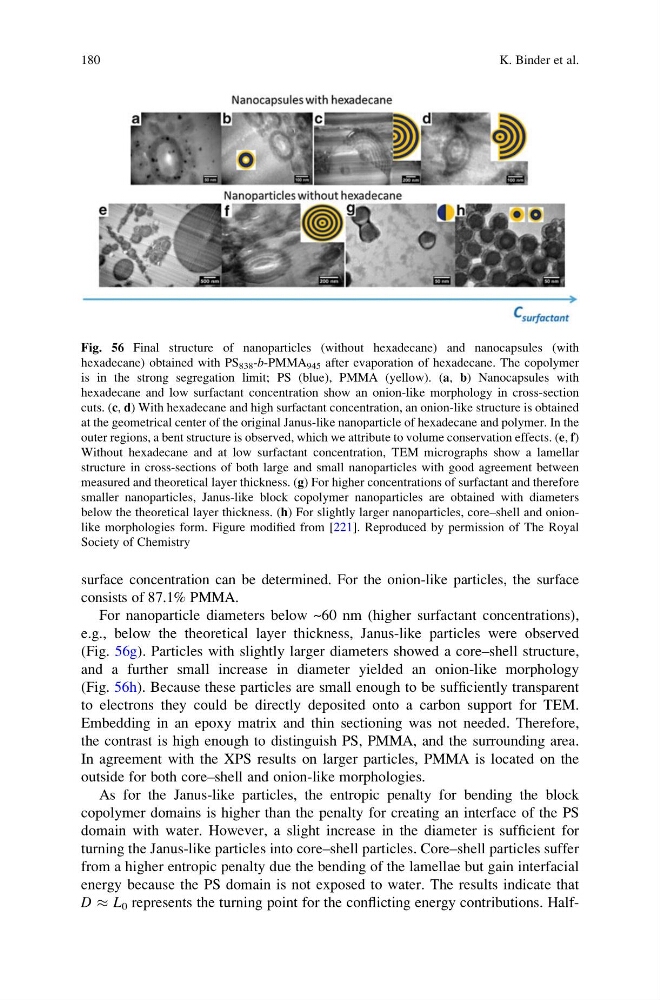
For nanoparticle diameters below ~60 nm (higher surfactant concentrations),
e.g., below the theoretical layer thickness, Janus-like particles were observed
(Fig. 56g). Particles with slightly larger diameters showed a core–shell structure,
and a further small increase in diameter yielded an onion-like morphology
(Fig. 56h). Because these particles are small enough to be sufficiently transparent
to electrons they could be directly deposited onto a carbon support for TEM.
Embedding in an epoxy matrix and thin sectioning was not needed. Therefore,
the contrast is high enough to distinguish PS, PMMA, and the surrounding area.
In agreement with the XPS results on larger particles, PMMA is located on the
outside for both core–shell and onion-like morphologies.
As for the Janus-like particles, the entropic penalty for bending the block
copolymer domains is higher than the penalty for creating an interface of the PS
domain with water. However, a slight increase in the diameter is sufficient for
turning the Janus-like particles into core–shell particles. Core–shell particles suffer
from a higher entropic penalty due the bending of the lamellae but gain interfacial
energy because the PS domain is not exposed to water. The results indicate that
D % L 0 represents the turning point for the conflicting energy contributions. HalfFig. 56 Final structure of nanoparticles (without hexadecane) and nanocapsules (with
hexadecane) obtained with PS 838 -b-PMMA 945 after evaporation of hexadecane. The copolymer
is in the strong segregation limit; PS (blue), PMMA (yellow). (a, b) Nanocapsules with
hexadecane and low surfactant concentration show an onion-like morphology in cross-section
cuts. (c, d) With hexadecane and high surfactant concentration, an onion-like structure is obtained
at the geometrical center of the original Janus-like nanoparticle of hexadecane and polymer. In the
outer regions, a bent structure is observed, which we attribute to volume conservation effects. (e, f)
Without hexadecane and at low surfactant concentration, TEM micrographs show a lamellar
structure in cross-sections of both large and small nanoparticles with good agreement between
measured and theoretical layer thickness. (g) For higher concentrations of surfactant and therefore
smaller nanoparticles, Janus-like block copolymer nanoparticles are obtained with diameters
below the theoretical layer thickness. (h) For slightly larger nanoparticles, core–shell and onionlike morphologies form. Figure modified from [221]. Reproduced by permission of The Royal
Society of Chemistry
180
K. Binder et al.
consists of 87.1% PMMA.
For nanoparticle diameters below ~60 nm (higher surfactant concentrations),
e.g., below the theoretical layer thickness, Janus-like particles were observed
(Fig. 56g). Particles with slightly larger diameters showed a core–shell structure,
and a further small increase in diameter yielded an onion-like morphology
(Fig. 56h). Because these particles are small enough to be sufficiently transparent
to electrons they could be directly deposited onto a carbon support for TEM.
Embedding in an epoxy matrix and thin sectioning was not needed. Therefore,
the contrast is high enough to distinguish PS, PMMA, and the surrounding area.
In agreement with the XPS results on larger particles, PMMA is located on the
outside for both core–shell and onion-like morphologies.
As for the Janus-like particles, the entropic penalty for bending the block
copolymer domains is higher than the penalty for creating an interface of the PS
domain with water. However, a slight increase in the diameter is sufficient for
turning the Janus-like particles into core–shell particles. Core–shell particles suffer
from a higher entropic penalty due the bending of the lamellae but gain interfacial
energy because the PS domain is not exposed to water. The results indicate that
D % L 0 represents the turning point for the conflicting energy contributions. HalfFig. 56 Final structure of nanoparticles (without hexadecane) and nanocapsules (with
hexadecane) obtained with PS 838 -b-PMMA 945 after evaporation of hexadecane. The copolymer
is in the strong segregation limit; PS (blue), PMMA (yellow). (a, b) Nanocapsules with
hexadecane and low surfactant concentration show an onion-like morphology in cross-section
cuts. (c, d) With hexadecane and high surfactant concentration, an onion-like structure is obtained
at the geometrical center of the original Janus-like nanoparticle of hexadecane and polymer. In the
outer regions, a bent structure is observed, which we attribute to volume conservation effects. (e, f)
Without hexadecane and at low surfactant concentration, TEM micrographs show a lamellar
structure in cross-sections of both large and small nanoparticles with good agreement between
measured and theoretical layer thickness. (g) For higher concentrations of surfactant and therefore
smaller nanoparticles, Janus-like block copolymer nanoparticles are obtained with diameters
below the theoretical layer thickness. (h) For slightly larger nanoparticles, core–shell and onionlike morphologies form. Figure modified from [221]. Reproduced by permission of The Royal
Society of Chemistry
180
K. Binder et al.