

increasing amount of surfactant (0.17–3.33 wt% compared to the dispersed phase)
from about 250 nm down to 80 nm. For the nanocapsules with the same block
copolymer, but additionally with hexadecane, the diameter of the nanocapsules was
in the range of 470 nm (for the lowest amount of surfactant of 0.17 wt%) down to
200 nm (with a high concentration of SDS of 3.33 wt%). For the lower molecular
weight block copolymer PS 76 -b-PMMA 79 , a decrease of the diameter from about
260 to 100 nm upon the same increase in SDS was observed. Since the diameter of
the droplet determines the size of the particle or capsule obtained after solvent
evaporation, the particle diameter is directly related to the amount of surfactant. For
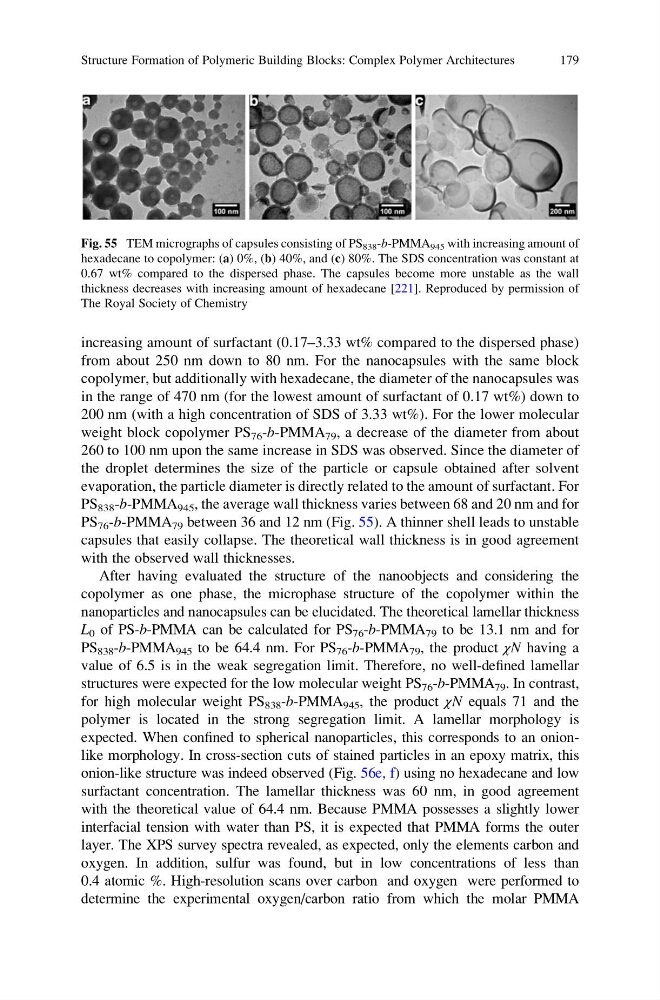
PS 838 -b-PMMA 945 , the average wall thickness varies between 68 and 20 nm and for
PS 76 -b-PMMA 79 between 36 and 12 nm (Fig. 55). A thinner shell leads to unstable
capsules that easily collapse. The theoretical wall thickness is in good agreement
with the observed wall thicknesses.
After having evaluated the structure of the nanoobjects and considering the
copolymer as one phase, the microphase structure of the copolymer within the
nanoparticles and nanocapsules can be elucidated. The theoretical lamellar thickness
L 0 of PS-b-PMMA can be calculated for PS 76 -b-PMMA 79 to be 13.1 nm and for
PS 838 -b-PMMA 945 to be 64.4 nm. For PS 76 -b-PMMA 79 , the product χN having a
value of 6.5 is in the weak segregation limit. Therefore, no well-defined lamellar
structures were expected for the low molecular weight PS 76 -b-PMMA 79 . In contrast,
for high molecular weight PS 838 -b-PMMA 945 , the product χN equals 71 and the
polymer is located in the strong segregation limit. A lamellar morphology is
expected. When confined to spherical nanoparticles, this corresponds to an onionlike morphology. In cross-section cuts of stained particles in an epoxy matrix, this
onion-like structure was indeed observed (Fig. 56e, f) using no hexadecane and low
surfactant concentration. The lamellar thickness was 60 nm, in good agreement
with the theoretical value of 64.4 nm. Because PMMA possesses a slightly lower
interfacial tension with water than PS, it is expected that PMMA forms the outer
layer. The XPS survey spectra revealed, as expected, only the elements carbon and
oxygen. In addition, sulfur was found, but in low concentrations of less than
0.4 atomic %. High-resolution scans over carbon and oxygen were performed to
determine the experimental oxygen/carbon ratio from which the molar PMMA
Fig. 55 TEM micrographs of capsules consisting of PS 838 -b-PMMA 945 with increasing amount of
hexadecane to copolymer: (a) 0%, (b) 40%, and (c) 80%. The SDS concentration was constant at
0.67 wt% compared to the dispersed phase. The capsules become more unstable as the wall
thickness decreases with increasing amount of hexadecane [221]. Reproduced by permission of
The Royal Society of Chemistry
Structure Formation of Polymeric Building Blocks: Complex Polymer Architectures
179
from about 250 nm down to 80 nm. For the nanocapsules with the same block
copolymer, but additionally with hexadecane, the diameter of the nanocapsules was
in the range of 470 nm (for the lowest amount of surfactant of 0.17 wt%) down to
200 nm (with a high concentration of SDS of 3.33 wt%). For the lower molecular
weight block copolymer PS 76 -b-PMMA 79 , a decrease of the diameter from about
260 to 100 nm upon the same increase in SDS was observed. Since the diameter of
the droplet determines the size of the particle or capsule obtained after solvent
evaporation, the particle diameter is directly related to the amount of surfactant. For
PS 838 -b-PMMA 945 , the average wall thickness varies between 68 and 20 nm and for
PS 76 -b-PMMA 79 between 36 and 12 nm (Fig. 55). A thinner shell leads to unstable
capsules that easily collapse. The theoretical wall thickness is in good agreement
with the observed wall thicknesses.
After having evaluated the structure of the nanoobjects and considering the
copolymer as one phase, the microphase structure of the copolymer within the
nanoparticles and nanocapsules can be elucidated. The theoretical lamellar thickness
L 0 of PS-b-PMMA can be calculated for PS 76 -b-PMMA 79 to be 13.1 nm and for
PS 838 -b-PMMA 945 to be 64.4 nm. For PS 76 -b-PMMA 79 , the product χN having a
value of 6.5 is in the weak segregation limit. Therefore, no well-defined lamellar
structures were expected for the low molecular weight PS 76 -b-PMMA 79 . In contrast,
for high molecular weight PS 838 -b-PMMA 945 , the product χN equals 71 and the
polymer is located in the strong segregation limit. A lamellar morphology is
expected. When confined to spherical nanoparticles, this corresponds to an onionlike morphology. In cross-section cuts of stained particles in an epoxy matrix, this
onion-like structure was indeed observed (Fig. 56e, f) using no hexadecane and low
surfactant concentration. The lamellar thickness was 60 nm, in good agreement
with the theoretical value of 64.4 nm. Because PMMA possesses a slightly lower
interfacial tension with water than PS, it is expected that PMMA forms the outer
layer. The XPS survey spectra revealed, as expected, only the elements carbon and
oxygen. In addition, sulfur was found, but in low concentrations of less than
0.4 atomic %. High-resolution scans over carbon and oxygen were performed to
determine the experimental oxygen/carbon ratio from which the molar PMMA
Fig. 55 TEM micrographs of capsules consisting of PS 838 -b-PMMA 945 with increasing amount of
hexadecane to copolymer: (a) 0%, (b) 40%, and (c) 80%. The SDS concentration was constant at
0.67 wt% compared to the dispersed phase. The capsules become more unstable as the wall
thickness decreases with increasing amount of hexadecane [221]. Reproduced by permission of
The Royal Society of Chemistry
Structure Formation of Polymeric Building Blocks: Complex Polymer Architectures
179