

were obtained. Phase separation of the block copolymer took place during solvent
evaporation.
Nanocapsules consisting of the block copolymer as shell and with a liquid as
core could be obtained by adding hexadecane, which is a nonsolvent for the
copolymer. The block copolymer was dissolved in a mixture of chloroform and
hexadecane. During evaporation of the chloroform there is a phase separation of the
block copolymer and the hexadecane, and a microphase separation of the block
copolymer itself. For the successful formation of nanocapsules, the interfacial
tensions for the polymer/water and water/hexadecane interfaces are important.
The presence of the surfactant SDS influences nanocapsule formation in two
ways: With increasing SDS concentration, the nanocapsules become smaller. At the
same time, with decreasing size of the nanocapsule, the coverage of the nanoobjects
(before evaporation of the solvent, the nanodroplets; after the evaporation, the
nanoparticles or nanocapsules) by SDS increases, leading to a decrease in the
interfacial tension of droplet/water and copolymer/water. The interfacial tension
between copolymer and water (%0.035 N/m) without surfactant is considerably
smaller than the interfacial tension between hexadecane and water (% 0.054 N/m).
Thus, in the case of a low concentration of SDS and subsequent coverage of the
nanoobjects by SDS, the interfacial tension of the copolymer/water interface is
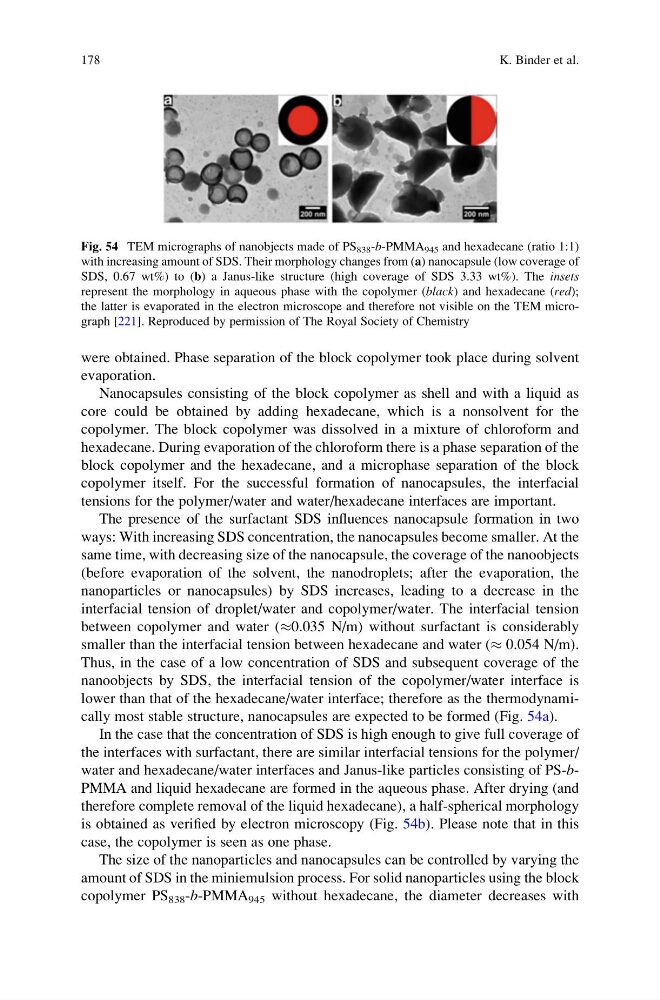
lower than that of the hexadecane/water interface; therefore as the thermodynamically most stable structure, nanocapsules are expected to be formed (Fig. 54a).
In the case that the concentration of SDS is high enough to give full coverage of
the interfaces with surfactant, there are similar interfacial tensions for the polymer/
water and hexadecane/water interfaces and Janus-like particles consisting of PS-bPMMA and liquid hexadecane are formed in the aqueous phase. After drying (and
therefore complete removal of the liquid hexadecane), a half-spherical morphology
is obtained as verified by electron microscopy (Fig. 54b). Please note that in this
case, the copolymer is seen as one phase.
The size of the nanoparticles and nanocapsules can be controlled by varying the
amount of SDS in the miniemulsion process. For solid nanoparticles using the block
copolymer PS 838 -b-PMMA 945 without hexadecane, the diameter decreases with
Fig. 54 TEM micrographs of nanobjects made of PS 838 -b-PMMA 945 and hexadecane (ratio 1:1)
with increasing amount of SDS. Their morphology changes from (a) nanocapsule (low coverage of
SDS, 0.67 wt%) to (b) a Janus-like structure (high coverage of SDS 3.33 wt%). The insets
represent the morphology in aqueous phase with the copolymer (black) and hexadecane (red);
the latter is evaporated in the electron microscope and therefore not visible on the TEM micrograph [221]. Reproduced by permission of The Royal Society of Chemistry
178
K. Binder et al.
evaporation.
Nanocapsules consisting of the block copolymer as shell and with a liquid as
core could be obtained by adding hexadecane, which is a nonsolvent for the
copolymer. The block copolymer was dissolved in a mixture of chloroform and
hexadecane. During evaporation of the chloroform there is a phase separation of the
block copolymer and the hexadecane, and a microphase separation of the block
copolymer itself. For the successful formation of nanocapsules, the interfacial
tensions for the polymer/water and water/hexadecane interfaces are important.
The presence of the surfactant SDS influences nanocapsule formation in two
ways: With increasing SDS concentration, the nanocapsules become smaller. At the
same time, with decreasing size of the nanocapsule, the coverage of the nanoobjects
(before evaporation of the solvent, the nanodroplets; after the evaporation, the
nanoparticles or nanocapsules) by SDS increases, leading to a decrease in the
interfacial tension of droplet/water and copolymer/water. The interfacial tension
between copolymer and water (%0.035 N/m) without surfactant is considerably
smaller than the interfacial tension between hexadecane and water (% 0.054 N/m).
Thus, in the case of a low concentration of SDS and subsequent coverage of the
nanoobjects by SDS, the interfacial tension of the copolymer/water interface is
lower than that of the hexadecane/water interface; therefore as the thermodynamically most stable structure, nanocapsules are expected to be formed (Fig. 54a).
In the case that the concentration of SDS is high enough to give full coverage of
the interfaces with surfactant, there are similar interfacial tensions for the polymer/
water and hexadecane/water interfaces and Janus-like particles consisting of PS-bPMMA and liquid hexadecane are formed in the aqueous phase. After drying (and
therefore complete removal of the liquid hexadecane), a half-spherical morphology
is obtained as verified by electron microscopy (Fig. 54b). Please note that in this
case, the copolymer is seen as one phase.
The size of the nanoparticles and nanocapsules can be controlled by varying the
amount of SDS in the miniemulsion process. For solid nanoparticles using the block
copolymer PS 838 -b-PMMA 945 without hexadecane, the diameter decreases with
Fig. 54 TEM micrographs of nanobjects made of PS 838 -b-PMMA 945 and hexadecane (ratio 1:1)
with increasing amount of SDS. Their morphology changes from (a) nanocapsule (low coverage of
SDS, 0.67 wt%) to (b) a Janus-like structure (high coverage of SDS 3.33 wt%). The insets
represent the morphology in aqueous phase with the copolymer (black) and hexadecane (red);
the latter is evaporated in the electron microscope and therefore not visible on the TEM micrograph [221]. Reproduced by permission of The Royal Society of Chemistry
178
K. Binder et al.