

spherical particles obtained from Janus-like particles of polymer and hexadecane
showed an onion-like morphology at the center of the particle, whereas the outside
of the particle consisted of bent lamellae.
Nanocapsules made of high molecular weight PS 838 -b-PMMA 945 and
hexadecane show an onion-like morphology (Fig. 55a, b). The PMMA located on
the outside of the capsules is not visible in the cross-section cuts, but XPS
measurements confirm that the surface is mainly PMMA (94.8%). Due to the
elongation of the capsules during the cutting process, the exact layer thickness is
difficult to estimate. However, it still corresponds well to the theoretical layer
thickness of about 60 nm but no clear conclusion can be drawn about whether
there is an increase in the lamellar thickness of the copolymer due to the strong
double confinement in the shell.
At higher concentrations of SDS and in the presence of hexadecane, an onionlike morphology was observed at the center of the nanoparticle, whereas the outside
of the nanoparticle consisted of bent lamellae (Fig. 56c, d). We attribute this to a
conservation of volume of the two polymer blocks: the volume can be conserved
quite easily by a slight change in lamellar thickness in the outer regions of the
nanoparticle, resulting in bent lamellae. In the center of the nanoparticle, the degree
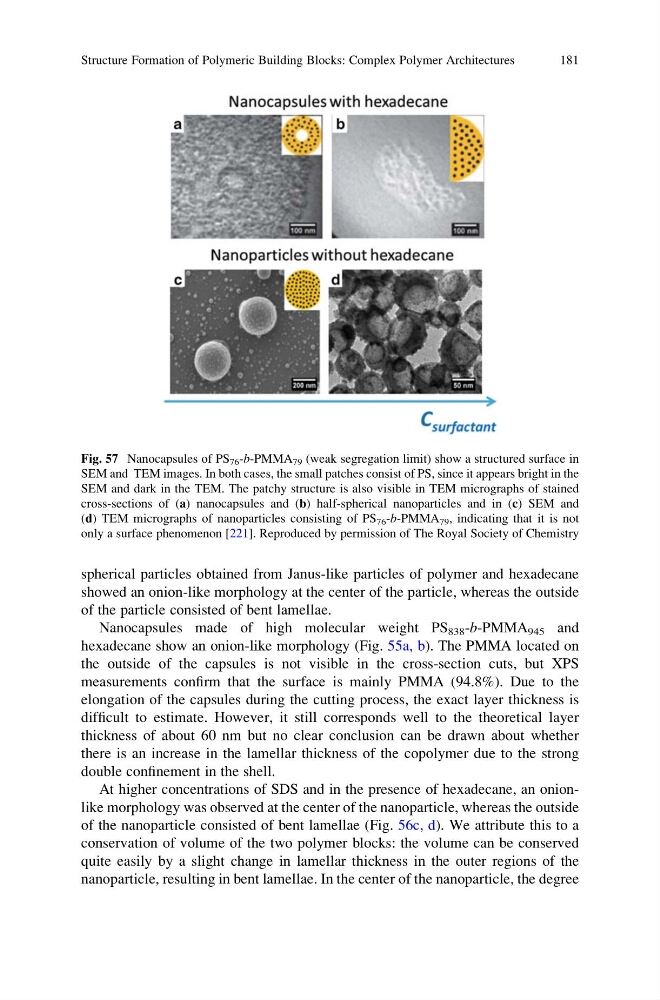
Fig. 57 Nanocapsules of PS 76 -b-PMMA 79 (weak segregation limit) show a structured surface in
SEM and TEM images. In both cases, the small patches consist of PS, since it appears bright in the
SEM and dark in the TEM. The patchy structure is also visible in TEM micrographs of stained
cross-sections of (a) nanocapsules and (b) half-spherical nanoparticles and in (c) SEM and
(d) TEM micrographs of nanoparticles consisting of PS 76 -b-PMMA 79 , indicating that it is not
only a surface phenomenon [221]. Reproduced by permission of The Royal Society of Chemistry
Structure Formation of Polymeric Building Blocks: Complex Polymer Architectures
181
showed an onion-like morphology at the center of the particle, whereas the outside
of the particle consisted of bent lamellae.
Nanocapsules made of high molecular weight PS 838 -b-PMMA 945 and
hexadecane show an onion-like morphology (Fig. 55a, b). The PMMA located on
the outside of the capsules is not visible in the cross-section cuts, but XPS
measurements confirm that the surface is mainly PMMA (94.8%). Due to the
elongation of the capsules during the cutting process, the exact layer thickness is
difficult to estimate. However, it still corresponds well to the theoretical layer
thickness of about 60 nm but no clear conclusion can be drawn about whether
there is an increase in the lamellar thickness of the copolymer due to the strong
double confinement in the shell.
At higher concentrations of SDS and in the presence of hexadecane, an onionlike morphology was observed at the center of the nanoparticle, whereas the outside
of the nanoparticle consisted of bent lamellae (Fig. 56c, d). We attribute this to a
conservation of volume of the two polymer blocks: the volume can be conserved
quite easily by a slight change in lamellar thickness in the outer regions of the
nanoparticle, resulting in bent lamellae. In the center of the nanoparticle, the degree
Fig. 57 Nanocapsules of PS 76 -b-PMMA 79 (weak segregation limit) show a structured surface in
SEM and TEM images. In both cases, the small patches consist of PS, since it appears bright in the
SEM and dark in the TEM. The patchy structure is also visible in TEM micrographs of stained
cross-sections of (a) nanocapsules and (b) half-spherical nanoparticles and in (c) SEM and
(d) TEM micrographs of nanoparticles consisting of PS 76 -b-PMMA 79 , indicating that it is not
only a surface phenomenon [221]. Reproduced by permission of The Royal Society of Chemistry
Structure Formation of Polymeric Building Blocks: Complex Polymer Architectures
181