

weakly adsorbed case, the chain in the pancake is an irregular sequence of “trains”
(strictly 2D pieces of the chain attached to the planar substrate) alternating with
“loops” (and “tails” at the chain ends) [123].
For the adsorption of macromolecules with complex architecture, such as bottle
brush polymers, it is an intriguing question how the above picture of polymer
adsorption changes; after all, most manipulations of macromolecules with external
devices (e.g., AFM tips) presuppose that the macromolecule is situated at a suitable
surface [156], rather than freely diffusing in the 3D space of a more or less dilute
polymer solution.
The coarse-grained view of a bottle brush in 3D space is often similar to the
wormlike chain model [59–61]: a more or less randomly bent cylinder with crosssectional radius R cs , contour length L along the contour axis, and persistence length
l p (meant to describe the local chain stiffness). Obviously, it is not completely clear
how such a structure changes when the macromolecule interacts with an adsorbing
surface. Do we expect a wormlike structure, where (like for a real living worm) the
local cross-section of the worm is still spherical? If so, only a few monomers on
the periphery of the bottle brush touch the substrate. However, it could also be that
the bottle brush becomes adsorbed to the surface somewhat more strongly, so its
local cross-section could look like a sphere cap rather than like a sphere. This
situation is analogous to droplets at walls under incomplete wetting conditions
[158]. If the picture of a sequence of trains and loops is still valid, the structure in
the trains and loops could well be different. Finally, when the adsorption strength
is very pronounced, the bottle brush can become forced into a quasi-2D flat
configuration attached to the substrate. Then locally it would look like a comb,
with spikes stretching away from the backbone at both sides. Given the fact that, in
reality, the chemical structure of the backbone will differ from the chemical
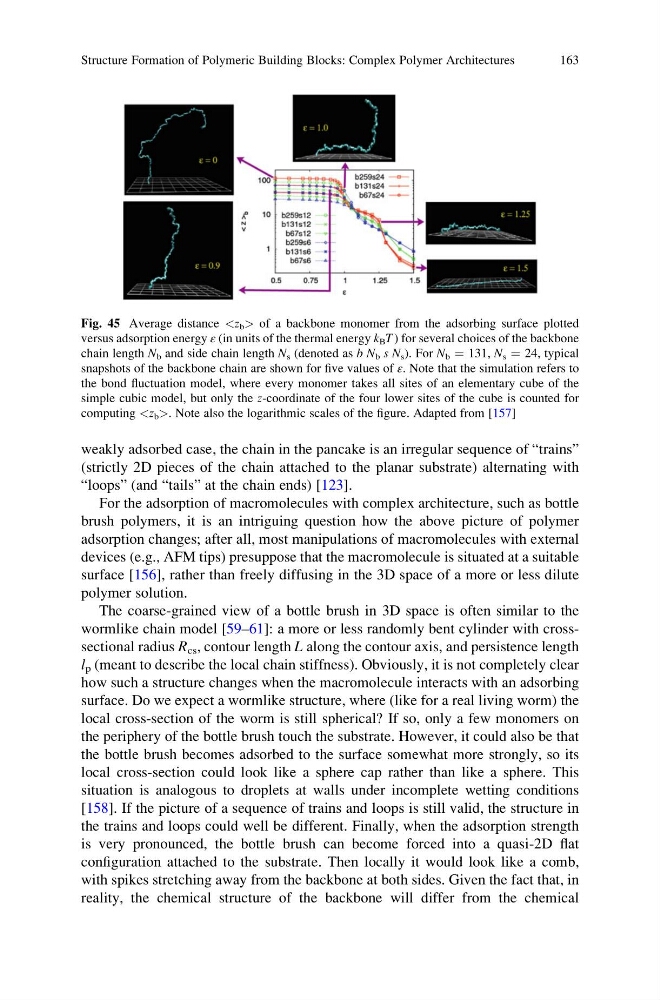
Fig. 45 Average distance of a backbone monomer from the adsorbing surface plotted
versus adsorption energy ε (in units of the thermal energy k B T ) for several choices of the backbone
chain length N b and side chain length N s (denoted as b N b s N s ). For N b ¼ 131, N s ¼ 24, typical
snapshots of the backbone chain are shown for five values of ε. Note that the simulation refers to
the bond fluctuation model, where every monomer takes all sites of an elementary cube of the
simple cubic model, but only the z-coordinate of the four lower sites of the cube is counted for
computing. Note also the logarithmic scales of the figure. Adapted from [157]
Structure Formation of Polymeric Building Blocks: Complex Polymer Architectures
163
(strictly 2D pieces of the chain attached to the planar substrate) alternating with
“loops” (and “tails” at the chain ends) [123].
For the adsorption of macromolecules with complex architecture, such as bottle
brush polymers, it is an intriguing question how the above picture of polymer
adsorption changes; after all, most manipulations of macromolecules with external
devices (e.g., AFM tips) presuppose that the macromolecule is situated at a suitable
surface [156], rather than freely diffusing in the 3D space of a more or less dilute
polymer solution.
The coarse-grained view of a bottle brush in 3D space is often similar to the
wormlike chain model [59–61]: a more or less randomly bent cylinder with crosssectional radius R cs , contour length L along the contour axis, and persistence length
l p (meant to describe the local chain stiffness). Obviously, it is not completely clear
how such a structure changes when the macromolecule interacts with an adsorbing
surface. Do we expect a wormlike structure, where (like for a real living worm) the
local cross-section of the worm is still spherical? If so, only a few monomers on
the periphery of the bottle brush touch the substrate. However, it could also be that
the bottle brush becomes adsorbed to the surface somewhat more strongly, so its
local cross-section could look like a sphere cap rather than like a sphere. This
situation is analogous to droplets at walls under incomplete wetting conditions
[158]. If the picture of a sequence of trains and loops is still valid, the structure in
the trains and loops could well be different. Finally, when the adsorption strength
is very pronounced, the bottle brush can become forced into a quasi-2D flat
configuration attached to the substrate. Then locally it would look like a comb,
with spikes stretching away from the backbone at both sides. Given the fact that, in
reality, the chemical structure of the backbone will differ from the chemical
Fig. 45 Average distance
versus adsorption energy ε (in units of the thermal energy k B T ) for several choices of the backbone
chain length N b and side chain length N s (denoted as b N b s N s ). For N b ¼ 131, N s ¼ 24, typical
snapshots of the backbone chain are shown for five values of ε. Note that the simulation refers to
the bond fluctuation model, where every monomer takes all sites of an elementary cube of the
simple cubic model, but only the z-coordinate of the four lower sites of the cube is counted for
computing
Structure Formation of Polymeric Building Blocks: Complex Polymer Architectures
163