

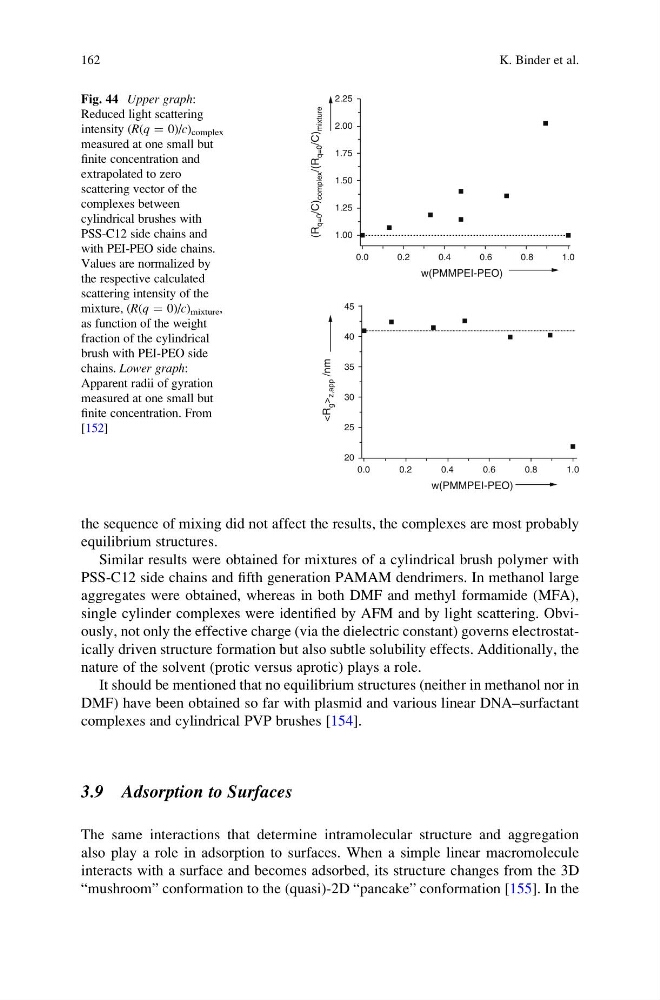
the sequence of mixing did not affect the results, the complexes are most probably
equilibrium structures.
Similar results were obtained for mixtures of a cylindrical brush polymer with
PSS-C12 side chains and fifth generation PAMAM dendrimers. In methanol large
aggregates were obtained, whereas in both DMF and methyl formamide (MFA),
single cylinder complexes were identified by AFM and by light scattering. Obviously, not only the effective charge (via the dielectric constant) governs electrostatically driven structure formation but also subtle solubility effects. Additionally, the
nature of the solvent (protic versus aprotic) plays a role.
It should be mentioned that no equilibrium structures (neither in methanol nor in
DMF) have been obtained so far with plasmid and various linear DNA–surfactant
complexes and cylindrical PVP brushes [154].
3.9 Adsorption to Surfaces
The same interactions that determine intramolecular structure and aggregation
also play a role in adsorption to surfaces. When a simple linear macromolecule
interacts with a surface and becomes adsorbed, its structure changes from the 3D
“mushroom” conformation to the (quasi)-2D “pancake” conformation [155]. In the
2.25
2.00
1.75
1.50
1.25
1.00
0.0
0.2
0.4
0.6
0.8
1.0
w(PMMPEI-PEO)
w(PMMPEI-PEO)
(R
q=0 /C)
complex /(R
q=0 /C)
mixture
45
40
35
30
25
20
0.0
0.2
0.4
0.6
0.8
1.0
z,app /nm
Fig. 44 Upper graph:
Reduced light scattering
intensity (R(q ¼ 0)/c) complex
measured at one small but
finite concentration and
extrapolated to zero
scattering vector of the
complexes between
cylindrical brushes with
PSS-C12 side chains and
with PEI-PEO side chains.
Values are normalized by
the respective calculated
scattering intensity of the
mixture, (R(q ¼ 0)/c) mixture ,
as function of the weight
fraction of the cylindrical
brush with PEI-PEO side
chains. Lower graph:
Apparent radii of gyration
measured at one small but
finite concentration. From
[152]
162
K. Binder et al.
equilibrium structures.
Similar results were obtained for mixtures of a cylindrical brush polymer with
PSS-C12 side chains and fifth generation PAMAM dendrimers. In methanol large
aggregates were obtained, whereas in both DMF and methyl formamide (MFA),
single cylinder complexes were identified by AFM and by light scattering. Obviously, not only the effective charge (via the dielectric constant) governs electrostatically driven structure formation but also subtle solubility effects. Additionally, the
nature of the solvent (protic versus aprotic) plays a role.
It should be mentioned that no equilibrium structures (neither in methanol nor in
DMF) have been obtained so far with plasmid and various linear DNA–surfactant
complexes and cylindrical PVP brushes [154].
3.9 Adsorption to Surfaces
The same interactions that determine intramolecular structure and aggregation
also play a role in adsorption to surfaces. When a simple linear macromolecule
interacts with a surface and becomes adsorbed, its structure changes from the 3D
“mushroom” conformation to the (quasi)-2D “pancake” conformation [155]. In the
2.25
2.00
1.75
1.50
1.25
1.00
0.0
0.2
0.4
0.6
0.8
1.0
w(PMMPEI-PEO)
w(PMMPEI-PEO)
(R
q=0 /C)
complex /(R
q=0 /C)
mixture
45
40
35
30
25
20
0.0
0.2
0.4
0.6
0.8
1.0
z,app /nm
Fig. 44 Upper graph:
Reduced light scattering
intensity (R(q ¼ 0)/c) complex
measured at one small but
finite concentration and
extrapolated to zero
scattering vector of the
complexes between
cylindrical brushes with
PSS-C12 side chains and
with PEI-PEO side chains.
Values are normalized by
the respective calculated
scattering intensity of the
mixture, (R(q ¼ 0)/c) mixture ,
as function of the weight
fraction of the cylindrical
brush with PEI-PEO side
chains. Lower graph:
Apparent radii of gyration
measured at one small but
finite concentration. From
[152]
162
K. Binder et al.