

plasmid and linear double-stranded DNA. It was speculated that strong electrostatic
interactions prohibit the formation of well-organized structures. Addition of salt did
not change much except that the complexes became larger and eventually unstable
due to the well-known salting-out phenomenon.
3.8 Complex Formation Between Weakly Charged
Polyelectrolytes in Organic Solvents
One strategy is to strongly reduce the ionic charges of the components. This was
accomplished by excluding water as the solvent due to solubility problems and
favoring solvents like alcohols, N,N-dimethylformamide (DMF), etc. Two
examples utilizing cylindrical brush polymers as templates for single brush
complexes have been successful so far [152, 153].
A polyelectrolyte/surfactant complex consisting of cylindrical brush polymers
with polystyrene sulfonate side chains and dodecyltrimethylammonium bromide
(DOTAB) was dissolved in DMF. In DMF some of the surfactant groups dissociate.
For the polymer/surfactant aggregate, this leads to slightly anionically charged
cylindrical brush polyions. The weak cation was a cylindrical brush with a PMA
main and PEI side chains. The side chains were grafted by six PEG2000 chains per
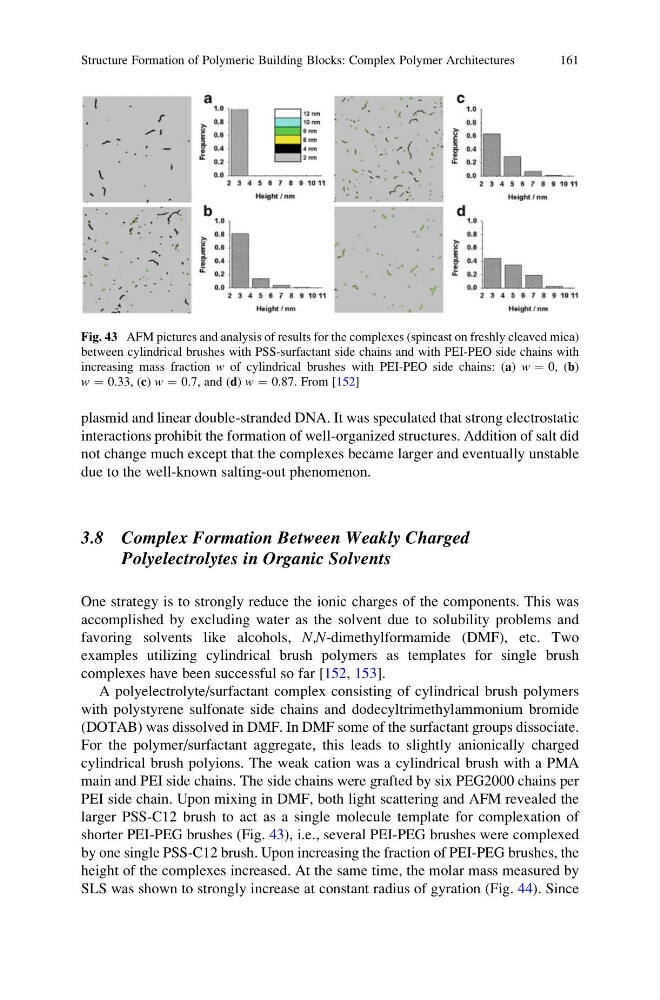
PEI side chain. Upon mixing in DMF, both light scattering and AFM revealed the
larger PSS-C12 brush to act as a single molecule template for complexation of
shorter PEI-PEG brushes (Fig. 43), i.e., several PEI-PEG brushes were complexed
by one single PSS-C12 brush. Upon increasing the fraction of PEI-PEG brushes, the
height of the complexes increased. At the same time, the molar mass measured by
SLS was shown to strongly increase at constant radius of gyration (Fig. 44). Since
Fig. 43 AFM pictures and analysis of results for the complexes (spincast on freshly cleaved mica)
between cylindrical brushes with PSS-surfactant side chains and with PEI-PEO side chains with
increasing mass fraction w of cylindrical brushes with PEI-PEO side chains: (a) w ¼ 0, (b)
w ¼ 0.33, (c) w ¼ 0.7, and (d) w ¼ 0.87. From [152]
Structure Formation of Polymeric Building Blocks: Complex Polymer Architectures
161
interactions prohibit the formation of well-organized structures. Addition of salt did
not change much except that the complexes became larger and eventually unstable
due to the well-known salting-out phenomenon.
3.8 Complex Formation Between Weakly Charged
Polyelectrolytes in Organic Solvents
One strategy is to strongly reduce the ionic charges of the components. This was
accomplished by excluding water as the solvent due to solubility problems and
favoring solvents like alcohols, N,N-dimethylformamide (DMF), etc. Two
examples utilizing cylindrical brush polymers as templates for single brush
complexes have been successful so far [152, 153].
A polyelectrolyte/surfactant complex consisting of cylindrical brush polymers
with polystyrene sulfonate side chains and dodecyltrimethylammonium bromide
(DOTAB) was dissolved in DMF. In DMF some of the surfactant groups dissociate.
For the polymer/surfactant aggregate, this leads to slightly anionically charged
cylindrical brush polyions. The weak cation was a cylindrical brush with a PMA
main and PEI side chains. The side chains were grafted by six PEG2000 chains per
PEI side chain. Upon mixing in DMF, both light scattering and AFM revealed the
larger PSS-C12 brush to act as a single molecule template for complexation of
shorter PEI-PEG brushes (Fig. 43), i.e., several PEI-PEG brushes were complexed
by one single PSS-C12 brush. Upon increasing the fraction of PEI-PEG brushes, the
height of the complexes increased. At the same time, the molar mass measured by
SLS was shown to strongly increase at constant radius of gyration (Fig. 44). Since
Fig. 43 AFM pictures and analysis of results for the complexes (spincast on freshly cleaved mica)
between cylindrical brushes with PSS-surfactant side chains and with PEI-PEO side chains with
increasing mass fraction w of cylindrical brushes with PEI-PEO side chains: (a) w ¼ 0, (b)
w ¼ 0.33, (c) w ¼ 0.7, and (d) w ¼ 0.87. From [152]
Structure Formation of Polymeric Building Blocks: Complex Polymer Architectures
161