

structure of the side arms, many model parameters may come into play when a
simulational modeling of this problem is attempted. However, for the sake of
simplicity this possible difference in chemistry has been ignored [157, 159]; thus,
in the modeling results (cf. Fig. 45) [157] a single parameter ε occurs (units chosen
such that k B T ¼ 1) that describes the strength of the short-range adsorption
potential.
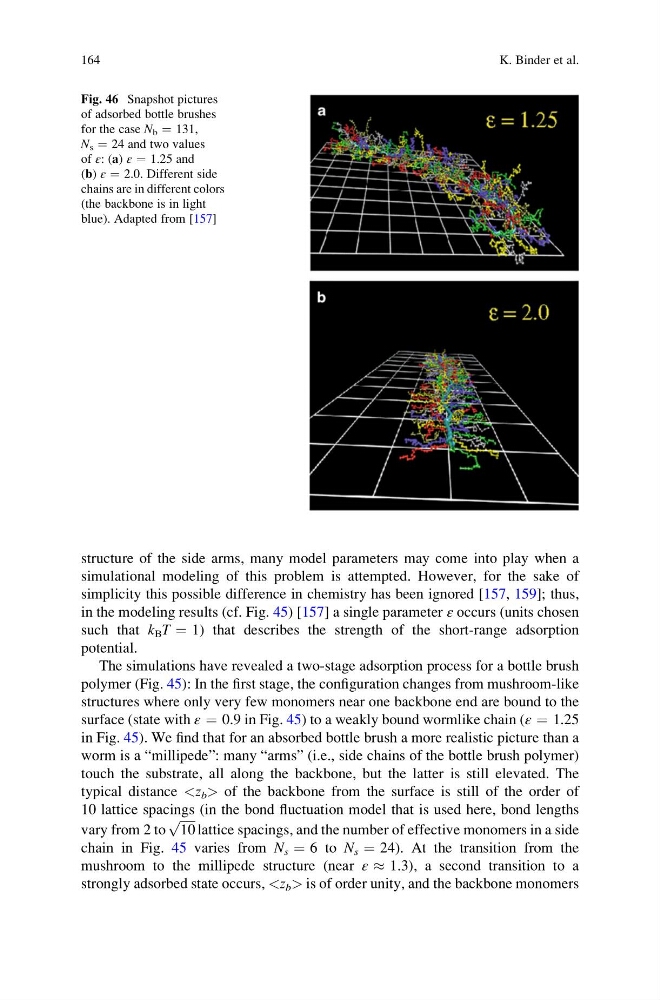
The simulations have revealed a two-stage adsorption process for a bottle brush
polymer (Fig. 45): In the first stage, the configuration changes from mushroom-like
structures where only very few monomers near one backbone end are bound to the
surface (state with ε ¼ 0.9 in Fig. 45) to a weakly bound wormlike chain (ε ¼ 1.25
in Fig. 45). We find that for an absorbed bottle brush a more realistic picture than a
worm is a “millipede”: many “arms” (i.e., side chains of the bottle brush polymer)
touch the substrate, all along the backbone, but the latter is still elevated. The
typical distance of the backbone from the surface is still of the order of
10 lattice spacings (in the bond fluctuation model that is used here, bond lengths
vary from 2 to
ffiffiffiffiffi
10
p
lattice spacings, and the number of effective monomers in a side
chain in Fig. 45 varies from N s ¼ 6 to N s ¼ 24). At the transition from the
mushroom to the millipede structure (near ε % 1.3), a second transition to a
strongly adsorbed state occurs, is of order unity, and the backbone monomers
Fig. 46 Snapshot pictures
of adsorbed bottle brushes
for the case N b ¼ 131,
N s ¼ 24 and two values
of ε: (a) ε ¼ 1.25 and
(b) ε ¼ 2.0. Different side
chains are in different colors
(the backbone is in light
blue). Adapted from [157]
164
K. Binder et al.
simulational modeling of this problem is attempted. However, for the sake of
simplicity this possible difference in chemistry has been ignored [157, 159]; thus,
in the modeling results (cf. Fig. 45) [157] a single parameter ε occurs (units chosen
such that k B T ¼ 1) that describes the strength of the short-range adsorption
potential.
The simulations have revealed a two-stage adsorption process for a bottle brush
polymer (Fig. 45): In the first stage, the configuration changes from mushroom-like
structures where only very few monomers near one backbone end are bound to the
surface (state with ε ¼ 0.9 in Fig. 45) to a weakly bound wormlike chain (ε ¼ 1.25
in Fig. 45). We find that for an absorbed bottle brush a more realistic picture than a
worm is a “millipede”: many “arms” (i.e., side chains of the bottle brush polymer)
touch the substrate, all along the backbone, but the latter is still elevated. The
typical distance
10 lattice spacings (in the bond fluctuation model that is used here, bond lengths
vary from 2 to
ffiffiffiffiffi
10
p
lattice spacings, and the number of effective monomers in a side
chain in Fig. 45 varies from N s ¼ 6 to N s ¼ 24). At the transition from the
mushroom to the millipede structure (near ε % 1.3), a second transition to a
strongly adsorbed state occurs,
Fig. 46 Snapshot pictures
of adsorbed bottle brushes
for the case N b ¼ 131,
N s ¼ 24 and two values
of ε: (a) ε ¼ 1.25 and
(b) ε ¼ 2.0. Different side
chains are in different colors
(the backbone is in light
blue). Adapted from [157]
164
K. Binder et al.