

and charge density and in Table 3 in terms of molar mass and dimensions. The
cylindrical brush polymers have the same PMA main chain but differ in side chain
length, which results in different number of chemical charges per main chain repeat
unit as well as in different chemistry of the cationic side chains, i.e.,
ethylpyridinium (PVP) versus ethyleneimine (PEI) side chains. One commercial
fifth generation poly(amido amine) (PAMAM) dendrimer sample was included for
comparison.
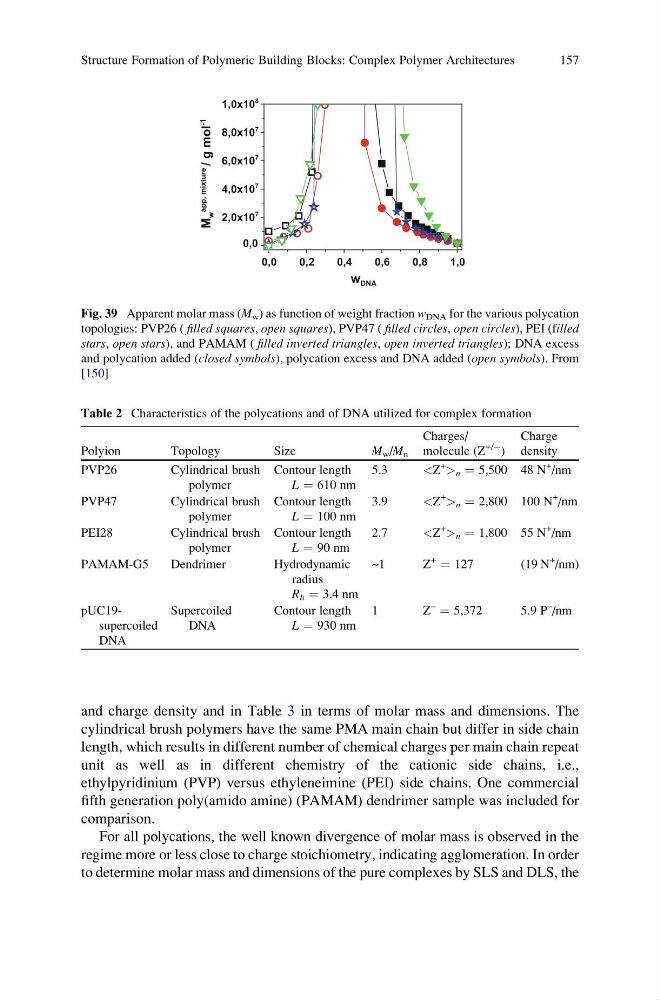
For all polycations, the well known divergence of molar mass is observed in the
regime more or less close to charge stoichiometry, indicating agglomeration. In order
to determine molar mass and dimensions of the pure complexes by SLS and DLS, the
0,0
0,2
0,4
0,6
0,8
1,0
0,0
2,0x10
7
4,0x10
7
6,0x10
7
8,0x10
7
1,0x10
8
w DNA
M
w
app, mixture
/ g mol
-1
Fig. 39 Apparent molar mass (M w ) as function of weight fraction w DNA for the various polycation
topologies: PVP26 ( filled squares, open squares), PVP47 ( filled circles, open circles), PEI (filled
stars, open stars), and PAMAM ( filled inverted triangles, open inverted triangles); DNA excess
and polycation added (closed symbols), polycation excess and DNA added (open symbols). From
[150]
Table 2 Characteristics of the polycations and of DNA utilized for complex formation
Polyion
Topology
Size
M w /M n
Charges/
molecule (Z
+/À
)
Charge
density
PVP26
Cylindrical brush
polymer
Contour length
L ¼ 610 nm
5.3
+ /nm
PVP47
Cylindrical brush
polymer
Contour length
L ¼ 100 nm
3.9
+ /nm
PEI28
Cylindrical brush
polymer
Contour length
L ¼ 90 nm
2.7
+ /nm
PAMAM-G5
Dendrimer
Hydrodynamic
radius
R h ¼ 3.4 nm
~1
Z
+ ¼ 127
(19 N
+ /nm)
pUC19supercoiled
DNA
Supercoiled
DNA
Contour length
L ¼ 930 nm
1
Z
– ¼ 5,372
5.9 P
–
/nm
Structure Formation of Polymeric Building Blocks: Complex Polymer Architectures
157
cylindrical brush polymers have the same PMA main chain but differ in side chain
length, which results in different number of chemical charges per main chain repeat
unit as well as in different chemistry of the cationic side chains, i.e.,
ethylpyridinium (PVP) versus ethyleneimine (PEI) side chains. One commercial
fifth generation poly(amido amine) (PAMAM) dendrimer sample was included for
comparison.
For all polycations, the well known divergence of molar mass is observed in the
regime more or less close to charge stoichiometry, indicating agglomeration. In order
to determine molar mass and dimensions of the pure complexes by SLS and DLS, the
0,0
0,2
0,4
0,6
0,8
1,0
0,0
2,0x10
7
4,0x10
7
6,0x10
7
8,0x10
7
1,0x10
8
w DNA
M
w
app, mixture
/ g mol
-1
Fig. 39 Apparent molar mass (M w ) as function of weight fraction w DNA for the various polycation
topologies: PVP26 ( filled squares, open squares), PVP47 ( filled circles, open circles), PEI (filled
stars, open stars), and PAMAM ( filled inverted triangles, open inverted triangles); DNA excess
and polycation added (closed symbols), polycation excess and DNA added (open symbols). From
[150]
Table 2 Characteristics of the polycations and of DNA utilized for complex formation
Polyion
Topology
Size
M w /M n
Charges/
molecule (Z
+/À
)
Charge
density
PVP26
Cylindrical brush
polymer
Contour length
L ¼ 610 nm
5.3
+ /nm
PVP47
Cylindrical brush
polymer
Contour length
L ¼ 100 nm
3.9
+ /nm
PEI28
Cylindrical brush
polymer
Contour length
L ¼ 90 nm
2.7
+ /nm
PAMAM-G5
Dendrimer
Hydrodynamic
radius
R h ¼ 3.4 nm
~1
Z
+ ¼ 127
(19 N
+ /nm)
pUC19supercoiled
DNA
Supercoiled
DNA
Contour length
L ¼ 930 nm
1
Z
– ¼ 5,372
5.9 P
–
/nm
Structure Formation of Polymeric Building Blocks: Complex Polymer Architectures
157