

3.7 Complexes Formed in Between Polyelectrolytes
in Aqueous Solution
The complex formation of oppositely charged macromolecules is a long-standing
subject of interest in polymer science. Whereas complexes comprising linear
flexible polyions [128–133] as well as linear polycations and DNA [134–143] are
frequently reported, studies on the influence of chain topology are mostly restricted
to dendrimers of various generations [144–147]. Only two reports deal with
the complexation of DNA and polymers with dendritically branched side chains
[148, 149]. We confine discussion to complexes formed by wormlike polyions with
large persistence length, such as anionically and cationically charged cylindrical
brush polyions and cationic cylindrical brush polymers and DNA. Particular
emphasis is given to question of equilibrium versus nonequilibrium complexes.
The complexes formed by excess polycations and DNA have found interesting
applications in gene transfection because the complexed DNA is believed to be
protected against degradation and the complexes exhibit a more or less pronounced
cationic charge, which facilitates cell uptake (Sect. 5). Here, the structure of the
complexes should be elucidated with respect to molar mass, radius of gyration R g ,
and hydrodynamic radius R h [150]. This is not easily achieved because complexes
are known to be stable only if they coexist with the non-complexed excess
component, i.e., either polycation or DNA. The situation is well illustrated by
Fig. 39, where the apparent molar mass of the mixture measured at a small but
finite concentration is plotted versus the mass fraction of DNA, w DNA ¼ m DNA /
(m DNA + m polycation ) with m DNA and m polycation being the respective mass fractions
of DNA and polycation. The data of the various polycations utilized and of DNA
are summarized in Table 2 in terms of chain topology, contour length, total charge,
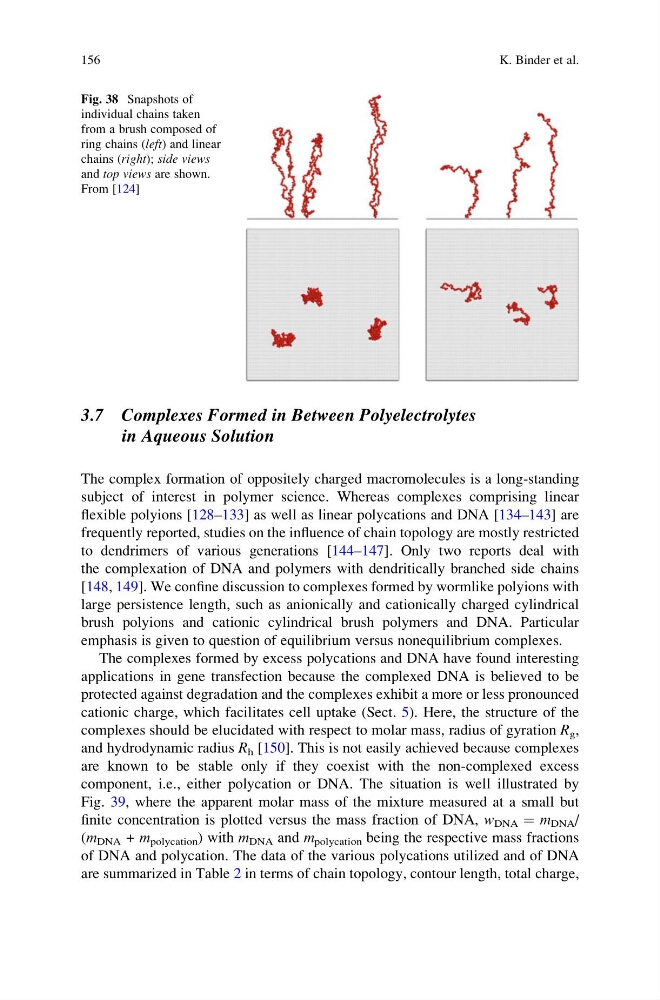
Fig. 38 Snapshots of
individual chains taken
from a brush composed of
ring chains (left) and linear
chains (right); side views
and top views are shown.
From [124]
156
K. Binder et al.
in Aqueous Solution
The complex formation of oppositely charged macromolecules is a long-standing
subject of interest in polymer science. Whereas complexes comprising linear
flexible polyions [128–133] as well as linear polycations and DNA [134–143] are
frequently reported, studies on the influence of chain topology are mostly restricted
to dendrimers of various generations [144–147]. Only two reports deal with
the complexation of DNA and polymers with dendritically branched side chains
[148, 149]. We confine discussion to complexes formed by wormlike polyions with
large persistence length, such as anionically and cationically charged cylindrical
brush polyions and cationic cylindrical brush polymers and DNA. Particular
emphasis is given to question of equilibrium versus nonequilibrium complexes.
The complexes formed by excess polycations and DNA have found interesting
applications in gene transfection because the complexed DNA is believed to be
protected against degradation and the complexes exhibit a more or less pronounced
cationic charge, which facilitates cell uptake (Sect. 5). Here, the structure of the
complexes should be elucidated with respect to molar mass, radius of gyration R g ,
and hydrodynamic radius R h [150]. This is not easily achieved because complexes
are known to be stable only if they coexist with the non-complexed excess
component, i.e., either polycation or DNA. The situation is well illustrated by
Fig. 39, where the apparent molar mass of the mixture measured at a small but
finite concentration is plotted versus the mass fraction of DNA, w DNA ¼ m DNA /
(m DNA + m polycation ) with m DNA and m polycation being the respective mass fractions
of DNA and polycation. The data of the various polycations utilized and of DNA
are summarized in Table 2 in terms of chain topology, contour length, total charge,
Fig. 38 Snapshots of
individual chains taken
from a brush composed of
ring chains (left) and linear
chains (right); side views
and top views are shown.
From [124]
156
K. Binder et al.