

there is a polymer-rich cluster, while the “equator” stays almost free of polymers
(of course, the orientation of the north–south axis through the particle is random,
resulting from fluctuations when cooling the particle down to a temperature of
about T ¼ T Θ /2, T Θ being the Theta temperature of the solution. Such inhomogeneous structures, a kind of irregular mesophase where polymer-rich “dimples”
alternate with regions that are almost free of polymers, are also known from flat
polymer brushes [116]. When two such inhomogeneous spherical polymer brushes
approach each other, rather elongated rod-like aggregates may form (Fig. 36b).
However, a quantitative analysis shows that in this case W(r) has a deep minimum,
of the order of at least À100 k B T, so it is clear that Fig. 36b depicts frozen
nonequilibrium structures [120].
A very special type of segregation between polymers in brushes also occurs when
ring polymers are densely grafted on substrates. The non-crossability constraint of
non-concatenated ring polymers causes the effect, even under good-solvent conditions,
that the polymers are much more strongly segregated from each other, unlike brushes
made of linear chains, where chains laterally interpenetrate much more strongly.
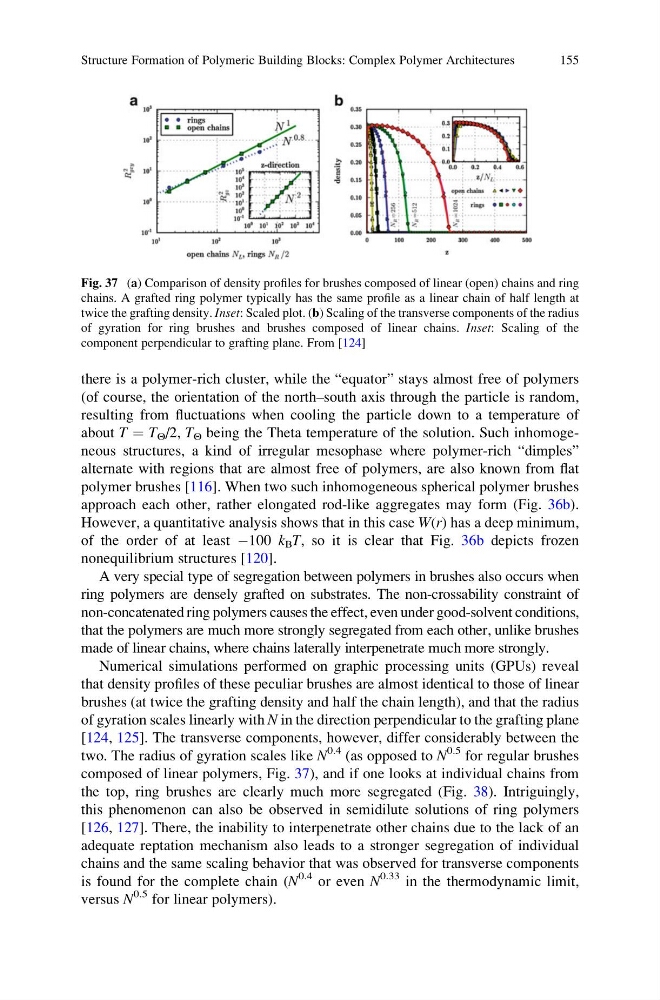
Numerical simulations performed on graphic processing units (GPUs) reveal
that density profiles of these peculiar brushes are almost identical to those of linear
brushes (at twice the grafting density and half the chain length), and that the radius
of gyration scales linearly with N in the direction perpendicular to the grafting plane
[124, 125]. The transverse components, however, differ considerably between the
two. The radius of gyration scales like N
0.4 (as opposed to N
0.5 for regular brushes
composed of linear polymers, Fig. 37), and if one looks at individual chains from
the top, ring brushes are clearly much more segregated (Fig. 38). Intriguingly,
this phenomenon can also be observed in semidilute solutions of ring polymers
[126, 127]. There, the inability to interpenetrate other chains due to the lack of an
adequate reptation mechanism also leads to a stronger segregation of individual
chains and the same scaling behavior that was observed for transverse components
is found for the complete chain (N
0.4 or even N
0.33 in the thermodynamic limit,
versus N
0.5 for linear polymers).
Fig. 37 (a) Comparison of density profiles for brushes composed of linear (open) chains and ring
chains. A grafted ring polymer typically has the same profile as a linear chain of half length at
twice the grafting density. Inset: Scaled plot. (b) Scaling of the transverse components of the radius
of gyration for ring brushes and brushes composed of linear chains. Inset: Scaling of the
component perpendicular to grafting plane. From [124]
Structure Formation of Polymeric Building Blocks: Complex Polymer Architectures
155
(of course, the orientation of the north–south axis through the particle is random,
resulting from fluctuations when cooling the particle down to a temperature of
about T ¼ T Θ /2, T Θ being the Theta temperature of the solution. Such inhomogeneous structures, a kind of irregular mesophase where polymer-rich “dimples”
alternate with regions that are almost free of polymers, are also known from flat
polymer brushes [116]. When two such inhomogeneous spherical polymer brushes
approach each other, rather elongated rod-like aggregates may form (Fig. 36b).
However, a quantitative analysis shows that in this case W(r) has a deep minimum,
of the order of at least À100 k B T, so it is clear that Fig. 36b depicts frozen
nonequilibrium structures [120].
A very special type of segregation between polymers in brushes also occurs when
ring polymers are densely grafted on substrates. The non-crossability constraint of
non-concatenated ring polymers causes the effect, even under good-solvent conditions,
that the polymers are much more strongly segregated from each other, unlike brushes
made of linear chains, where chains laterally interpenetrate much more strongly.
Numerical simulations performed on graphic processing units (GPUs) reveal
that density profiles of these peculiar brushes are almost identical to those of linear
brushes (at twice the grafting density and half the chain length), and that the radius
of gyration scales linearly with N in the direction perpendicular to the grafting plane
[124, 125]. The transverse components, however, differ considerably between the
two. The radius of gyration scales like N
0.4 (as opposed to N
0.5 for regular brushes
composed of linear polymers, Fig. 37), and if one looks at individual chains from
the top, ring brushes are clearly much more segregated (Fig. 38). Intriguingly,
this phenomenon can also be observed in semidilute solutions of ring polymers
[126, 127]. There, the inability to interpenetrate other chains due to the lack of an
adequate reptation mechanism also leads to a stronger segregation of individual
chains and the same scaling behavior that was observed for transverse components
is found for the complete chain (N
0.4 or even N
0.33 in the thermodynamic limit,
versus N
0.5 for linear polymers).
Fig. 37 (a) Comparison of density profiles for brushes composed of linear (open) chains and ring
chains. A grafted ring polymer typically has the same profile as a linear chain of half length at
twice the grafting density. Inset: Scaled plot. (b) Scaling of the transverse components of the radius
of gyration for ring brushes and brushes composed of linear chains. Inset: Scaling of the
component perpendicular to grafting plane. From [124]
Structure Formation of Polymeric Building Blocks: Complex Polymer Architectures
155