

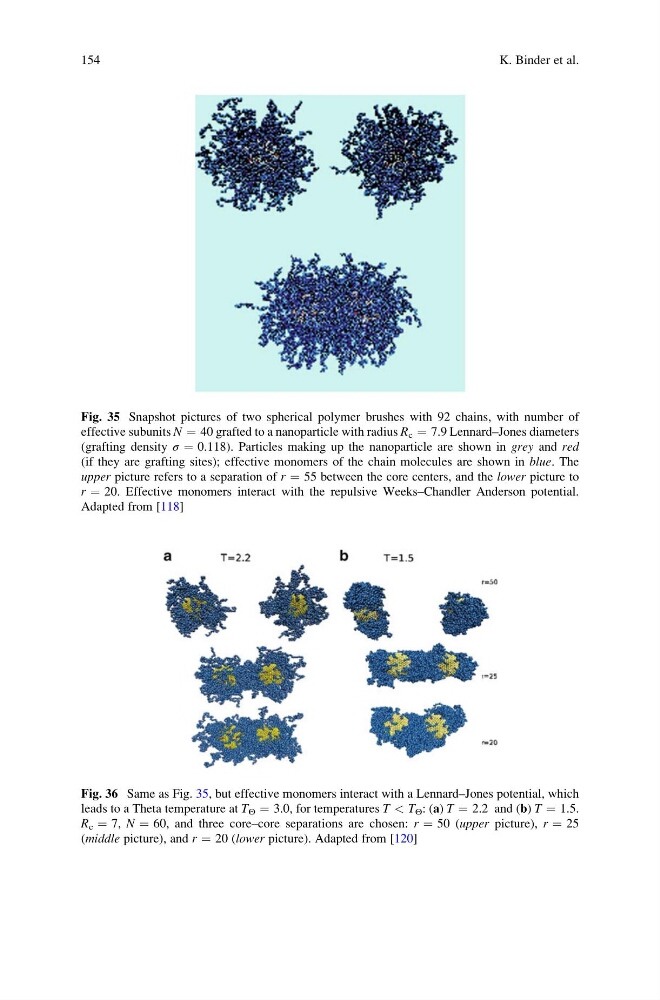
Fig. 35 Snapshot pictures of two spherical polymer brushes with 92 chains, with number of
effective subunits N ¼ 40 grafted to a nanoparticle with radius R c ¼ 7.9 Lennard–Jones diameters
(grafting density σ ¼ 0.118). Particles making up the nanoparticle are shown in grey and red
(if they are grafting sites); effective monomers of the chain molecules are shown in blue. The
upper picture refers to a separation of r ¼ 55 between the core centers, and the lower picture to
r ¼ 20. Effective monomers interact with the repulsive Weeks–Chandler Anderson potential.
Adapted from [118]
Fig. 36 Same as Fig. 35, but effective monomers interact with a Lennard–Jones potential, which
leads to a Theta temperature at T Θ ¼ 3.0, for temperatures T < T Θ : (a) T ¼ 2.2 and (b) T ¼ 1.5.
R c ¼ 7, N ¼ 60, and three core–core separations are chosen: r ¼ 50 (upper picture), r ¼ 25
(middle picture), and r ¼ 20 (lower picture). Adapted from [120]
154
K. Binder et al.
effective subunits N ¼ 40 grafted to a nanoparticle with radius R c ¼ 7.9 Lennard–Jones diameters
(grafting density σ ¼ 0.118). Particles making up the nanoparticle are shown in grey and red
(if they are grafting sites); effective monomers of the chain molecules are shown in blue. The
upper picture refers to a separation of r ¼ 55 between the core centers, and the lower picture to
r ¼ 20. Effective monomers interact with the repulsive Weeks–Chandler Anderson potential.
Adapted from [118]
Fig. 36 Same as Fig. 35, but effective monomers interact with a Lennard–Jones potential, which
leads to a Theta temperature at T Θ ¼ 3.0, for temperatures T < T Θ : (a) T ¼ 2.2 and (b) T ¼ 1.5.
R c ¼ 7, N ¼ 60, and three core–core separations are chosen: r ¼ 50 (upper picture), r ¼ 25
(middle picture), and r ¼ 20 (lower picture). Adapted from [120]
154
K. Binder et al.