

won if two lattice sites are occupied by monomers of the same kind.). Even for
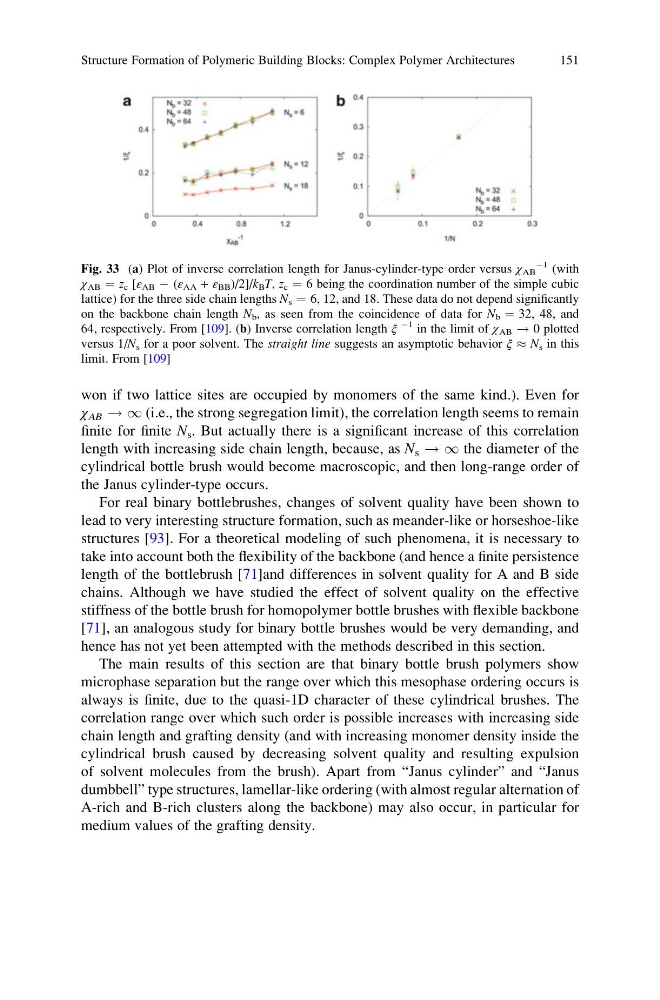
χ AB ! 1 (i.e., the strong segregation limit), the correlation length seems to remain
finite for finite N s . But actually there is a significant increase of this correlation
length with increasing side chain length, because, as N s ! 1 the diameter of the
cylindrical bottle brush would become macroscopic, and then long-range order of
the Janus cylinder-type occurs.
For real binary bottlebrushes, changes of solvent quality have been shown to
lead to very interesting structure formation, such as meander-like or horseshoe-like
structures [93]. For a theoretical modeling of such phenomena, it is necessary to
take into account both the flexibility of the backbone (and hence a finite persistence
length of the bottlebrush [71]and differences in solvent quality for A and B side
chains. Although we have studied the effect of solvent quality on the effective
stiffness of the bottle brush for homopolymer bottle brushes with flexible backbone
[71], an analogous study for binary bottle brushes would be very demanding, and
hence has not yet been attempted with the methods described in this section.
The main results of this section are that binary bottle brush polymers show
microphase separation but the range over which this mesophase ordering occurs is
always is finite, due to the quasi-1D character of these cylindrical brushes. The
correlation range over which such order is possible increases with increasing side
chain length and grafting density (and with increasing monomer density inside the
cylindrical brush caused by decreasing solvent quality and resulting expulsion
of solvent molecules from the brush). Apart from “Janus cylinder” and “Janus
dumbbell” type structures, lamellar-like ordering (with almost regular alternation of
A-rich and B-rich clusters along the backbone) may also occur, in particular for
medium values of the grafting density.
Fig. 33 (a) Plot of inverse correlation length for Janus-cylinder-type order versus χ AB
À1 (with
χ AB ¼ z c [ε AB À (ε AA + ε BB )/2]/k B T, z c ¼ 6 being the coordination number of the simple cubic
lattice) for the three side chain lengths N s ¼ 6, 12, and 18. These data do not depend significantly
on the backbone chain length N b , as seen from the coincidence of data for N b ¼ 32, 48, and
64, respectively. From [109]. (b) Inverse correlation length ξ
À1 in the limit of χ AB ! 0 plotted
versus 1/N s for a poor solvent. The straight line suggests an asymptotic behavior ξ % N s in this
limit. From [109]
Structure Formation of Polymeric Building Blocks: Complex Polymer Architectures
151
χ AB ! 1 (i.e., the strong segregation limit), the correlation length seems to remain
finite for finite N s . But actually there is a significant increase of this correlation
length with increasing side chain length, because, as N s ! 1 the diameter of the
cylindrical bottle brush would become macroscopic, and then long-range order of
the Janus cylinder-type occurs.
For real binary bottlebrushes, changes of solvent quality have been shown to
lead to very interesting structure formation, such as meander-like or horseshoe-like
structures [93]. For a theoretical modeling of such phenomena, it is necessary to
take into account both the flexibility of the backbone (and hence a finite persistence
length of the bottlebrush [71]and differences in solvent quality for A and B side
chains. Although we have studied the effect of solvent quality on the effective
stiffness of the bottle brush for homopolymer bottle brushes with flexible backbone
[71], an analogous study for binary bottle brushes would be very demanding, and
hence has not yet been attempted with the methods described in this section.
The main results of this section are that binary bottle brush polymers show
microphase separation but the range over which this mesophase ordering occurs is
always is finite, due to the quasi-1D character of these cylindrical brushes. The
correlation range over which such order is possible increases with increasing side
chain length and grafting density (and with increasing monomer density inside the
cylindrical brush caused by decreasing solvent quality and resulting expulsion
of solvent molecules from the brush). Apart from “Janus cylinder” and “Janus
dumbbell” type structures, lamellar-like ordering (with almost regular alternation of
A-rich and B-rich clusters along the backbone) may also occur, in particular for
medium values of the grafting density.
Fig. 33 (a) Plot of inverse correlation length for Janus-cylinder-type order versus χ AB
À1 (with
χ AB ¼ z c [ε AB À (ε AA + ε BB )/2]/k B T, z c ¼ 6 being the coordination number of the simple cubic
lattice) for the three side chain lengths N s ¼ 6, 12, and 18. These data do not depend significantly
on the backbone chain length N b , as seen from the coincidence of data for N b ¼ 32, 48, and
64, respectively. From [109]. (b) Inverse correlation length ξ
À1 in the limit of χ AB ! 0 plotted
versus 1/N s for a poor solvent. The straight line suggests an asymptotic behavior ξ % N s in this
limit. From [109]
Structure Formation of Polymeric Building Blocks: Complex Polymer Architectures
151