

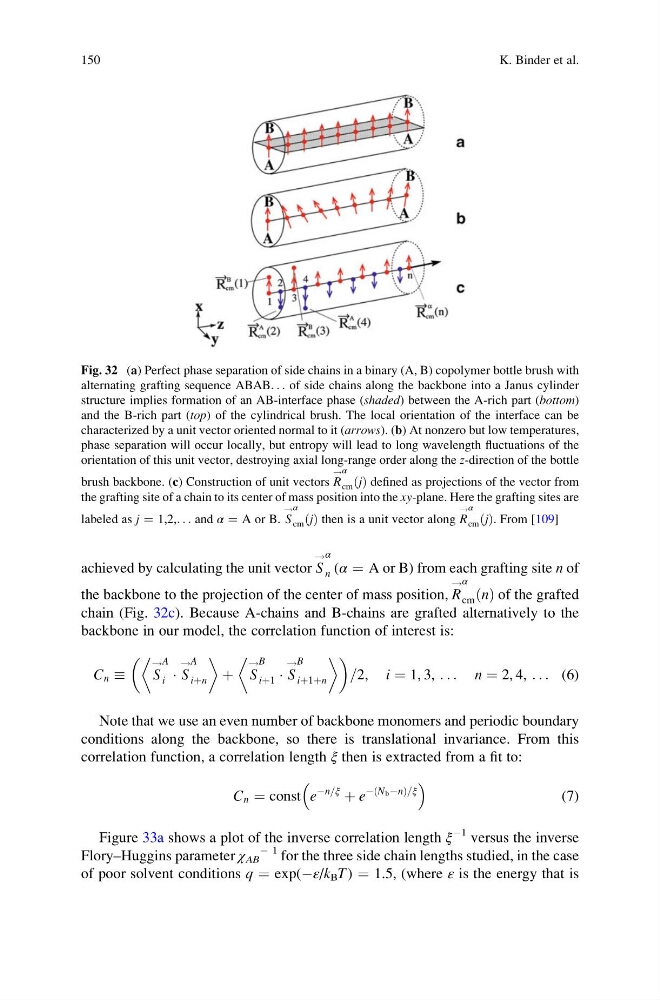
achieved by calculating the unit vector S
! α
n (α ¼ A or B) from each grafting site n of
the backbone to the projection of the center of mass position, R
! α
cm n
ð Þ of the grafted
chain (Fig. 32c). Because A-chains and B-chains are grafted alternatively to the
backbone in our model, the correlation function of interest is:
C n
S
! A
i Á S
! A
iþn
þ S
! B
iþ1 Á S
! B
iþ1þn
=2, i ¼ 1, 3, . . . n ¼ 2, 4, . . . (6)
Note that we use an even number of backbone monomers and periodic boundary
conditions along the backbone, so there is translational invariance. From this
correlation function, a correlation length ξ then is extracted from a fit to:
C n ¼ const e
Àn=ξ
þ e
À N b Àn
ð
Þ =ξ
(7)
Figure 33a shows a plot of the inverse correlation length ξ
À1 versus the inverse
Flory–Huggins parameter χ AB
À 1 for the three side chain lengths studied, in the case
of poor solvent conditions q ¼ exp(Àε/k B T) ¼ 1.5, (where ε is the energy that is
Fig. 32 (a) Perfect phase separation of side chains in a binary (A, B) copolymer bottle brush with
alternating grafting sequence ABAB. . . of side chains along the backbone into a Janus cylinder
structure implies formation of an AB-interface phase (shaded) between the A-rich part (bottom)
and the B-rich part (top) of the cylindrical brush. The local orientation of the interface can be
characterized by a unit vector oriented normal to it (arrows). (b) At nonzero but low temperatures,
phase separation will occur locally, but entropy will lead to long wavelength fluctuations of the
orientation of this unit vector, destroying axial long-range order along the z-direction of the bottle
brush backbone. (c) Construction of unit vectors R
! α
cm j
ð Þ defined as projections of the vector from
the grafting site of a chain to its center of mass position into the xy-plane. Here the grafting sites are
labeled as j ¼ 1,2,. . . and α ¼ A or B. S
! α
cm j
ð Þ then is a unit vector along R
! α
cm j
ð Þ. From [109]
150
K. Binder et al.
! α
n (α ¼ A or B) from each grafting site n of
the backbone to the projection of the center of mass position, R
! α
cm n
ð Þ of the grafted
chain (Fig. 32c). Because A-chains and B-chains are grafted alternatively to the
backbone in our model, the correlation function of interest is:
C n
S
! A
i Á S
! A
iþn
þ S
! B
iþ1 Á S
! B
iþ1þn
=2, i ¼ 1, 3, . . . n ¼ 2, 4, . . . (6)
Note that we use an even number of backbone monomers and periodic boundary
conditions along the backbone, so there is translational invariance. From this
correlation function, a correlation length ξ then is extracted from a fit to:
C n ¼ const e
Àn=ξ
þ e
À N b Àn
ð
Þ =ξ
(7)
Figure 33a shows a plot of the inverse correlation length ξ
À1 versus the inverse
Flory–Huggins parameter χ AB
À 1 for the three side chain lengths studied, in the case
of poor solvent conditions q ¼ exp(Àε/k B T) ¼ 1.5, (where ε is the energy that is
Fig. 32 (a) Perfect phase separation of side chains in a binary (A, B) copolymer bottle brush with
alternating grafting sequence ABAB. . . of side chains along the backbone into a Janus cylinder
structure implies formation of an AB-interface phase (shaded) between the A-rich part (bottom)
and the B-rich part (top) of the cylindrical brush. The local orientation of the interface can be
characterized by a unit vector oriented normal to it (arrows). (b) At nonzero but low temperatures,
phase separation will occur locally, but entropy will lead to long wavelength fluctuations of the
orientation of this unit vector, destroying axial long-range order along the z-direction of the bottle
brush backbone. (c) Construction of unit vectors R
! α
cm j
ð Þ defined as projections of the vector from
the grafting site of a chain to its center of mass position into the xy-plane. Here the grafting sites are
labeled as j ¼ 1,2,. . . and α ¼ A or B. S
! α
cm j
ð Þ then is a unit vector along R
! α
cm j
ð Þ. From [109]
150
K. Binder et al.