

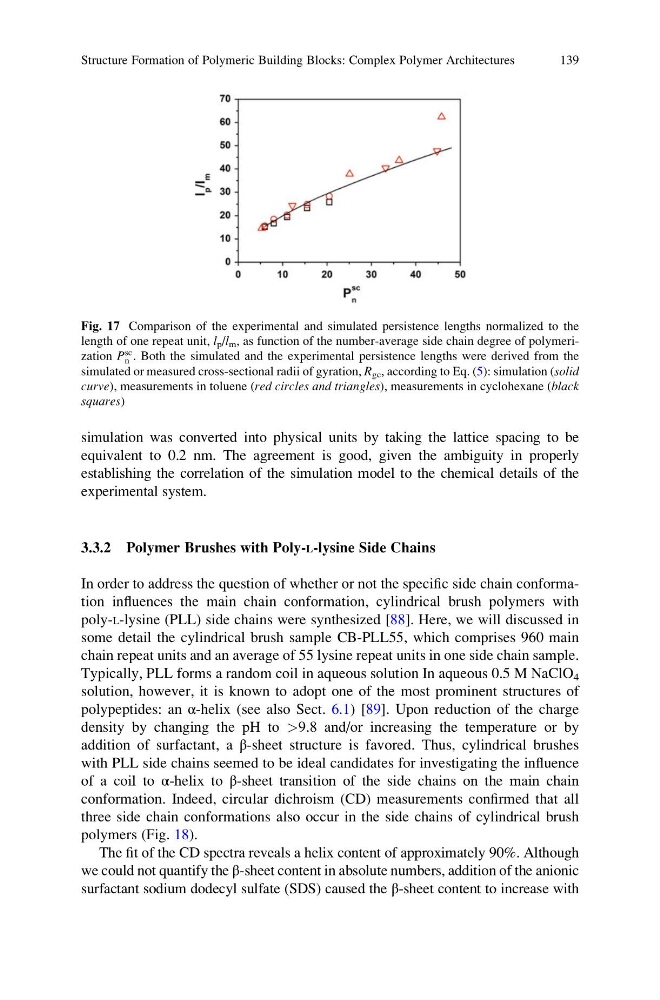
simulation was converted into physical units by taking the lattice spacing to be
equivalent to 0.2 nm. The agreement is good, given the ambiguity in properly
establishing the correlation of the simulation model to the chemical details of the
experimental system.
3.3.2 Polymer Brushes with Poly-L-lysine Side Chains
In order to address the question of whether or not the specific side chain conformation influences the main chain conformation, cylindrical brush polymers with
poly-L-lysine (PLL) side chains were synthesized [88]. Here, we will discussed in
some detail the cylindrical brush sample CB-PLL55, which comprises 960 main
chain repeat units and an average of 55 lysine repeat units in one side chain sample.
Typically, PLL forms a random coil in aqueous solution In aqueous 0.5 M NaClO 4
solution, however, it is known to adopt one of the most prominent structures of
polypeptides: an α-helix (see also Sect. 6.1) [89]. Upon reduction of the charge
density by changing the pH to >9.8 and/or increasing the temperature or by
addition of surfactant, a β-sheet structure is favored. Thus, cylindrical brushes
with PLL side chains seemed to be ideal candidates for investigating the influence
of a coil to α-helix to β-sheet transition of the side chains on the main chain
conformation. Indeed, circular dichroism (CD) measurements confirmed that all
three side chain conformations also occur in the side chains of cylindrical brush
polymers (Fig. 18).
The fit of the CD spectra reveals a helix content of approximately 90%. Although
we could not quantify the β-sheet content in absolute numbers, addition of the anionic
surfactant sodium dodecyl sulfate (SDS) caused the β-sheet content to increase with
Fig. 17 Comparison of the experimental and simulated persistence lengths normalized to the
length of one repeat unit, l p /l m , as function of the number-average side chain degree of polymerization P
sc
n . Both the simulated and the experimental persistence lengths were derived from the
simulated or measured cross-sectional radii of gyration, R gc , according to Eq. (5): simulation (solid
curve), measurements in toluene (red circles and triangles), measurements in cyclohexane (black
squares)
Structure Formation of Polymeric Building Blocks: Complex Polymer Architectures
139
equivalent to 0.2 nm. The agreement is good, given the ambiguity in properly
establishing the correlation of the simulation model to the chemical details of the
experimental system.
3.3.2 Polymer Brushes with Poly-L-lysine Side Chains
In order to address the question of whether or not the specific side chain conformation influences the main chain conformation, cylindrical brush polymers with
poly-L-lysine (PLL) side chains were synthesized [88]. Here, we will discussed in
some detail the cylindrical brush sample CB-PLL55, which comprises 960 main
chain repeat units and an average of 55 lysine repeat units in one side chain sample.
Typically, PLL forms a random coil in aqueous solution In aqueous 0.5 M NaClO 4
solution, however, it is known to adopt one of the most prominent structures of
polypeptides: an α-helix (see also Sect. 6.1) [89]. Upon reduction of the charge
density by changing the pH to >9.8 and/or increasing the temperature or by
addition of surfactant, a β-sheet structure is favored. Thus, cylindrical brushes
with PLL side chains seemed to be ideal candidates for investigating the influence
of a coil to α-helix to β-sheet transition of the side chains on the main chain
conformation. Indeed, circular dichroism (CD) measurements confirmed that all
three side chain conformations also occur in the side chains of cylindrical brush
polymers (Fig. 18).
The fit of the CD spectra reveals a helix content of approximately 90%. Although
we could not quantify the β-sheet content in absolute numbers, addition of the anionic
surfactant sodium dodecyl sulfate (SDS) caused the β-sheet content to increase with
Fig. 17 Comparison of the experimental and simulated persistence lengths normalized to the
length of one repeat unit, l p /l m , as function of the number-average side chain degree of polymerization P
sc
n . Both the simulated and the experimental persistence lengths were derived from the
simulated or measured cross-sectional radii of gyration, R gc , according to Eq. (5): simulation (solid
curve), measurements in toluene (red circles and triangles), measurements in cyclohexane (black
squares)
Structure Formation of Polymeric Building Blocks: Complex Polymer Architectures
139