

solvents have become available. In addition to the increase in anion size, another
approach emphasized the effect of delocalization of the anion charge [21]. It is
thought that the spreading of the anion charge to a larger area is responsible for the
weaker coordination. However, it is still unknown how the large size, shape, and
selective anion functionalization with fluoro-substituted phenylene groups at the
anion core and dendritic corona affect the dissociation and eventually the transport
properties of ions. To study ion transport, dielectric spectroscopy is the method of
choice because of its inherent ability to provide both the degree of ion dissociation
and the transport properties through the measured DC conductivity. Herein we
report on the ion dissociation and transport properties of a series of tetrabutylammonium salts (TBA
+
) of rigidly dendronized anions with various sizes (with
diameters up to 5 nm) in solution and as a function of the solvent polarity [21].
The DC conductivity of an ion-containing medium is expressed as the sum of the
individual contributions of all charge carriers, σ DC ¼
X n
i¼1
p i μ i q i . Here, p i , μ i , and q i are
the number density, the mobility, and the charge of the ith type of charge carrier,
respectively. An underlying assumption is that all charge carriers move independently
of each other with a constant mobility. In the present case there are two monovalent
charge carriers, i.e., the cations (TBA
+
) and respective anions. Therefore, the DC
conductivity of the fully dissociated ions can be expressed as σ DC ¼ p + μ + e + p À μ À e.
Measured DC conductivities (with values of %10
À5 S/cm) for the different dendrimers
in THF conform to σ DC ¼ σ 0 exp(ÀE σ /k B T), where σ 0 is the limiting conductivity and
E σ is the activation energy for ion transport. Furthermore, a linear concentration
dependence of the DC conductivity was found, which implies an increasing number
of mobile charge carriers at a fixed degree of ion dissociation. The degree of
ion dissociation can be extracted from the ratio of the measured DC conductivity
σ exp and the calculated conductivity σ calc that assumes complete ion dissociation as
α ¼ σ exp /σ calc , also known as the Haven ratio [24]. The denominator can be calculated
from the mobility, μ i ¼ e/6πηr i :
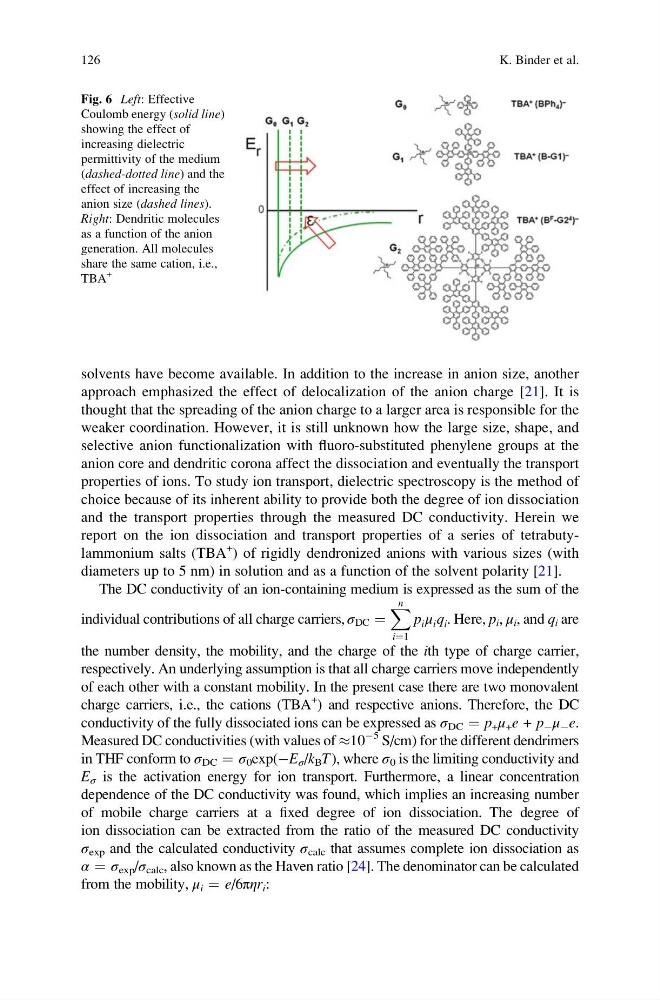
Fig. 6 Left: Effective
Coulomb energy (solid line)
showing the effect of
increasing dielectric
permittivity of the medium
(dashed-dotted line) and the
effect of increasing the
anion size (dashed lines).
Right: Dendritic molecules
as a function of the anion
generation. All molecules
share the same cation, i.e.,
TBA
+
126
K. Binder et al.
approach emphasized the effect of delocalization of the anion charge [21]. It is
thought that the spreading of the anion charge to a larger area is responsible for the
weaker coordination. However, it is still unknown how the large size, shape, and
selective anion functionalization with fluoro-substituted phenylene groups at the
anion core and dendritic corona affect the dissociation and eventually the transport
properties of ions. To study ion transport, dielectric spectroscopy is the method of
choice because of its inherent ability to provide both the degree of ion dissociation
and the transport properties through the measured DC conductivity. Herein we
report on the ion dissociation and transport properties of a series of tetrabutylammonium salts (TBA
+
) of rigidly dendronized anions with various sizes (with
diameters up to 5 nm) in solution and as a function of the solvent polarity [21].
The DC conductivity of an ion-containing medium is expressed as the sum of the
individual contributions of all charge carriers, σ DC ¼
X n
i¼1
p i μ i q i . Here, p i , μ i , and q i are
the number density, the mobility, and the charge of the ith type of charge carrier,
respectively. An underlying assumption is that all charge carriers move independently
of each other with a constant mobility. In the present case there are two monovalent
charge carriers, i.e., the cations (TBA
+
) and respective anions. Therefore, the DC
conductivity of the fully dissociated ions can be expressed as σ DC ¼ p + μ + e + p À μ À e.
Measured DC conductivities (with values of %10
À5 S/cm) for the different dendrimers
in THF conform to σ DC ¼ σ 0 exp(ÀE σ /k B T), where σ 0 is the limiting conductivity and
E σ is the activation energy for ion transport. Furthermore, a linear concentration
dependence of the DC conductivity was found, which implies an increasing number
of mobile charge carriers at a fixed degree of ion dissociation. The degree of
ion dissociation can be extracted from the ratio of the measured DC conductivity
σ exp and the calculated conductivity σ calc that assumes complete ion dissociation as
α ¼ σ exp /σ calc , also known as the Haven ratio [24]. The denominator can be calculated
from the mobility, μ i ¼ e/6πηr i :
Fig. 6 Left: Effective
Coulomb energy (solid line)
showing the effect of
increasing dielectric
permittivity of the medium
(dashed-dotted line) and the
effect of increasing the
anion size (dashed lines).
Right: Dendritic molecules
as a function of the anion
generation. All molecules
share the same cation, i.e.,
TBA
+
126
K. Binder et al.