

E C ¼
e
2
4πε 0 ε r r c
(1)
Here, e is the elementary charge, ε 0 is the permittivity of free space, r c is the
distance separating a point-like cation from a point-like anion and ε r is the dielectric
permittivity of the surrounding medium. The “escape distance” from the Coulomb
energy is set by the Bjerrum length, λ B ¼ e
2 /4πε 0 ε r k B T, giving the characteristic
separation between two ions at which Coulombic interactions are balanced by the
thermal energy. Here, k B is the Boltzmann constant and T the temperature. In
liquids of low polarity, such as toluene or even tetrahydrofuran (THF), the Bjerrum
length is 20.4 and 7.4 nm, respectively. Ion dissociation in such solvents is limited
unless the ion size approaches the escape distance set by λ B .
Figure 6 schematically describes the effect of solvent polarity and ion size on the
Coulomb potential. It shows that increasing the dielectric permittivity of the solvent
raises the attractive part of the potential, making the potential less attractive and
facilitating ion dissociation. On the other hand, increasing the ionic size effectively
shifts the repulsive part of the potential to length scales that approach the Bjerrum
length promoting ion separation. With respect to electric conductivity and charge
transport, one has to take into account the balance between ion dissociation
(promoted by the bulky ions) and mobility (inhibited by the large ions). With
respect to the latter, extensive research on increasing the size and bulkiness of
molecular anions has led to a new class of compounds known as weakly
coordinating anions [23].
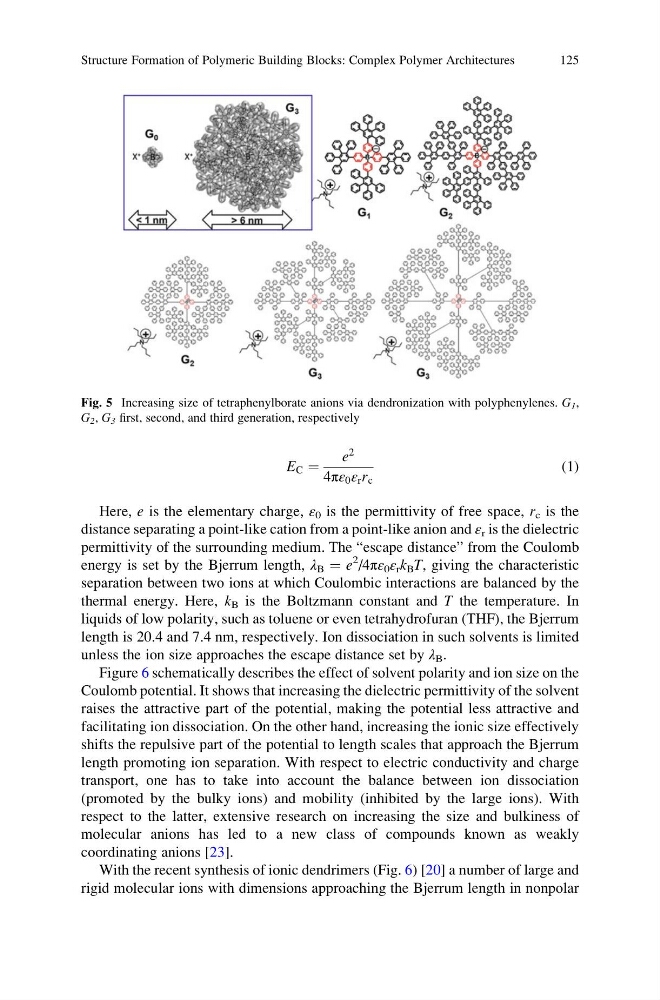
With the recent synthesis of ionic dendrimers (Fig. 6) [20] a number of large and
rigid molecular ions with dimensions approaching the Bjerrum length in nonpolar
Fig. 5 Increasing size of tetraphenylborate anions via dendronization with polyphenylenes. G 1 ,
G 2 , G 3 first, second, and third generation, respectively
Structure Formation of Polymeric Building Blocks: Complex Polymer Architectures
125
e
2
4πε 0 ε r r c
(1)
Here, e is the elementary charge, ε 0 is the permittivity of free space, r c is the
distance separating a point-like cation from a point-like anion and ε r is the dielectric
permittivity of the surrounding medium. The “escape distance” from the Coulomb
energy is set by the Bjerrum length, λ B ¼ e
2 /4πε 0 ε r k B T, giving the characteristic
separation between two ions at which Coulombic interactions are balanced by the
thermal energy. Here, k B is the Boltzmann constant and T the temperature. In
liquids of low polarity, such as toluene or even tetrahydrofuran (THF), the Bjerrum
length is 20.4 and 7.4 nm, respectively. Ion dissociation in such solvents is limited
unless the ion size approaches the escape distance set by λ B .
Figure 6 schematically describes the effect of solvent polarity and ion size on the
Coulomb potential. It shows that increasing the dielectric permittivity of the solvent
raises the attractive part of the potential, making the potential less attractive and
facilitating ion dissociation. On the other hand, increasing the ionic size effectively
shifts the repulsive part of the potential to length scales that approach the Bjerrum
length promoting ion separation. With respect to electric conductivity and charge
transport, one has to take into account the balance between ion dissociation
(promoted by the bulky ions) and mobility (inhibited by the large ions). With
respect to the latter, extensive research on increasing the size and bulkiness of
molecular anions has led to a new class of compounds known as weakly
coordinating anions [23].
With the recent synthesis of ionic dendrimers (Fig. 6) [20] a number of large and
rigid molecular ions with dimensions approaching the Bjerrum length in nonpolar
Fig. 5 Increasing size of tetraphenylborate anions via dendronization with polyphenylenes. G 1 ,
G 2 , G 3 first, second, and third generation, respectively
Structure Formation of Polymeric Building Blocks: Complex Polymer Architectures
125