

2.2 Synthesis of PPDs
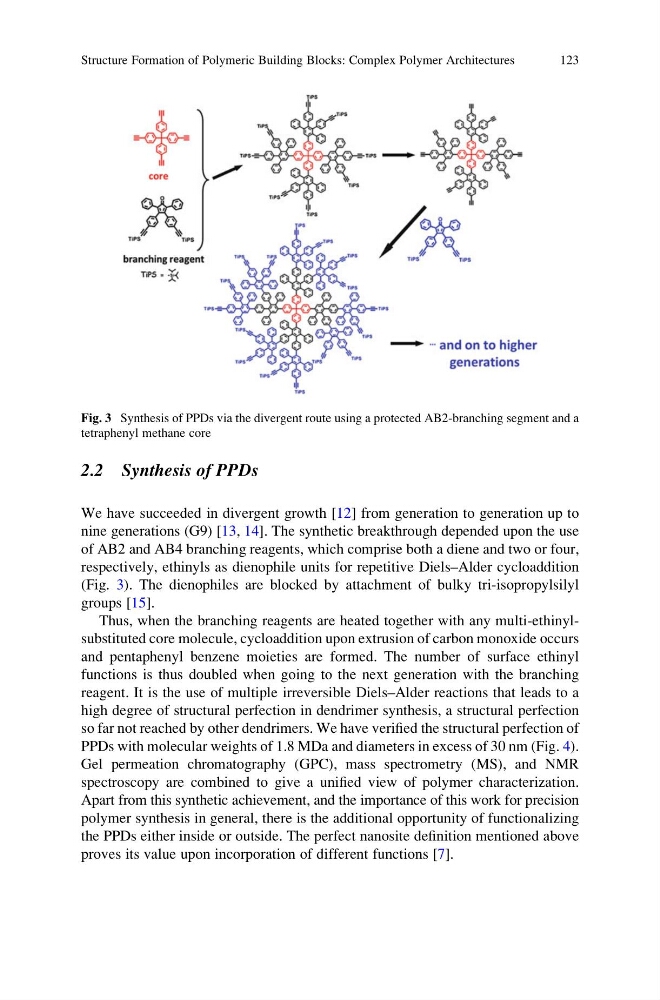
We have succeeded in divergent growth [12] from generation to generation up to
nine generations (G9) [13, 14]. The synthetic breakthrough depended upon the use
of AB2 and AB4 branching reagents, which comprise both a diene and two or four,
respectively, ethinyls as dienophile units for repetitive Diels–Alder cycloaddition
(Fig. 3). The dienophiles are blocked by attachment of bulky tri-isopropylsilyl
groups [15].
Thus, when the branching reagents are heated together with any multi-ethinylsubstituted core molecule, cycloaddition upon extrusion of carbon monoxide occurs
and pentaphenyl benzene moieties are formed. The number of surface ethinyl
functions is thus doubled when going to the next generation with the branching
reagent. It is the use of multiple irreversible Diels–Alder reactions that leads to a
high degree of structural perfection in dendrimer synthesis, a structural perfection
so far not reached by other dendrimers. We have verified the structural perfection of
PPDs with molecular weights of 1.8 MDa and diameters in excess of 30 nm (Fig. 4).
Gel permeation chromatography (GPC), mass spectrometry (MS), and NMR
spectroscopy are combined to give a unified view of polymer characterization.
Apart from this synthetic achievement, and the importance of this work for precision
polymer synthesis in general, there is the additional opportunity of functionalizing
the PPDs either inside or outside. The perfect nanosite definition mentioned above
proves its value upon incorporation of different functions [7].
Fig. 3 Synthesis of PPDs via the divergent route using a protected AB2-branching segment and a
tetraphenyl methane core
Structure Formation of Polymeric Building Blocks: Complex Polymer Architectures
123
We have succeeded in divergent growth [12] from generation to generation up to
nine generations (G9) [13, 14]. The synthetic breakthrough depended upon the use
of AB2 and AB4 branching reagents, which comprise both a diene and two or four,
respectively, ethinyls as dienophile units for repetitive Diels–Alder cycloaddition
(Fig. 3). The dienophiles are blocked by attachment of bulky tri-isopropylsilyl
groups [15].
Thus, when the branching reagents are heated together with any multi-ethinylsubstituted core molecule, cycloaddition upon extrusion of carbon monoxide occurs
and pentaphenyl benzene moieties are formed. The number of surface ethinyl
functions is thus doubled when going to the next generation with the branching
reagent. It is the use of multiple irreversible Diels–Alder reactions that leads to a
high degree of structural perfection in dendrimer synthesis, a structural perfection
so far not reached by other dendrimers. We have verified the structural perfection of
PPDs with molecular weights of 1.8 MDa and diameters in excess of 30 nm (Fig. 4).
Gel permeation chromatography (GPC), mass spectrometry (MS), and NMR
spectroscopy are combined to give a unified view of polymer characterization.
Apart from this synthetic achievement, and the importance of this work for precision
polymer synthesis in general, there is the additional opportunity of functionalizing
the PPDs either inside or outside. The perfect nanosite definition mentioned above
proves its value upon incorporation of different functions [7].
Fig. 3 Synthesis of PPDs via the divergent route using a protected AB2-branching segment and a
tetraphenyl methane core
Structure Formation of Polymeric Building Blocks: Complex Polymer Architectures
123