

2 Polyphenylene Dendrimers
2.1 Introduction
One of the key features in the synthesis of semirigid macromolecules such as
dendrimers is to keep the entropy price low in all kinds of hierarchical structure
formation. Dendrimers as unique macromolecules with three-dimensional
(3D) shape have found multiple applications [1]. However, in spite of their multifunctional character and their remarkable aesthetic appeal [2], there remain
conceptual and experimental problems: How perfectly can they be synthesized
[3, 4] and are they really spherical? Many dendrimers described in the literature
are not shape-persistent because they are made from conformationally flexible
building blocks [5, 6]. They change their shape under the influence of external
forces or the prevailing environment. Polyphenylene dendrimers (PPDs) [7–9]
introduced here adopt a special role because they (1) possess a high degree of
structural perfection, (2) are extremely stable even under harsh conditions, and
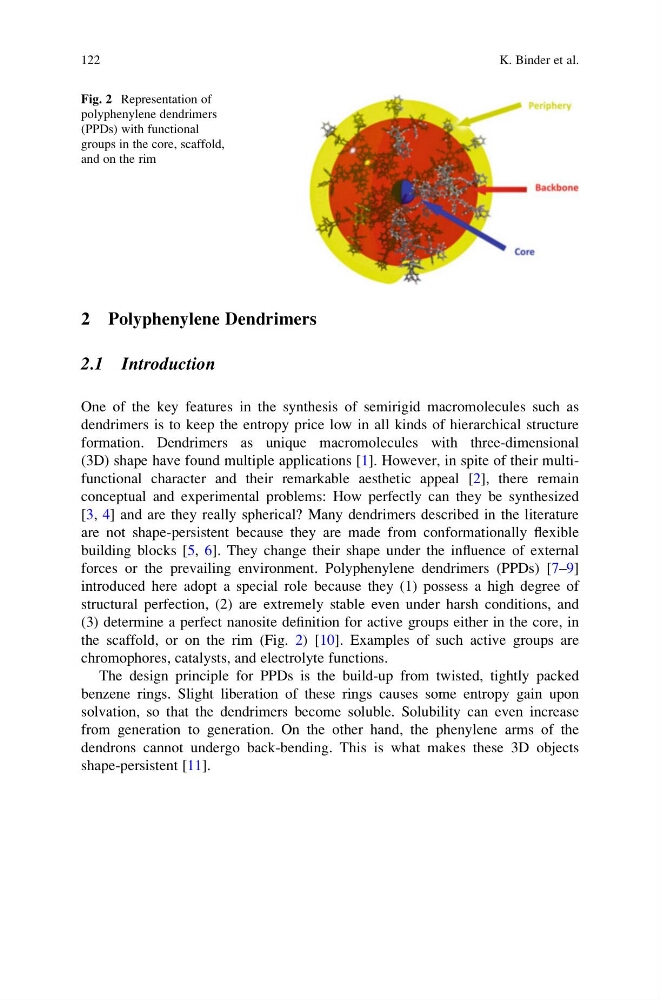
(3) determine a perfect nanosite definition for active groups either in the core, in
the scaffold, or on the rim (Fig. 2) [10]. Examples of such active groups are
chromophores, catalysts, and electrolyte functions.
The design principle for PPDs is the build-up from twisted, tightly packed
benzene rings. Slight liberation of these rings causes some entropy gain upon
solvation, so that the dendrimers become soluble. Solubility can even increase
from generation to generation. On the other hand, the phenylene arms of the
dendrons cannot undergo back-bending. This is what makes these 3D objects
shape-persistent [11].
Fig. 2 Representation of
polyphenylene dendrimers
(PPDs) with functional
groups in the core, scaffold,
and on the rim
122
K. Binder et al.
2.1 Introduction
One of the key features in the synthesis of semirigid macromolecules such as
dendrimers is to keep the entropy price low in all kinds of hierarchical structure
formation. Dendrimers as unique macromolecules with three-dimensional
(3D) shape have found multiple applications [1]. However, in spite of their multifunctional character and their remarkable aesthetic appeal [2], there remain
conceptual and experimental problems: How perfectly can they be synthesized
[3, 4] and are they really spherical? Many dendrimers described in the literature
are not shape-persistent because they are made from conformationally flexible
building blocks [5, 6]. They change their shape under the influence of external
forces or the prevailing environment. Polyphenylene dendrimers (PPDs) [7–9]
introduced here adopt a special role because they (1) possess a high degree of
structural perfection, (2) are extremely stable even under harsh conditions, and
(3) determine a perfect nanosite definition for active groups either in the core, in
the scaffold, or on the rim (Fig. 2) [10]. Examples of such active groups are
chromophores, catalysts, and electrolyte functions.
The design principle for PPDs is the build-up from twisted, tightly packed
benzene rings. Slight liberation of these rings causes some entropy gain upon
solvation, so that the dendrimers become soluble. Solubility can even increase
from generation to generation. On the other hand, the phenylene arms of the
dendrons cannot undergo back-bending. This is what makes these 3D objects
shape-persistent [11].
Fig. 2 Representation of
polyphenylene dendrimers
(PPDs) with functional
groups in the core, scaffold,
and on the rim
122
K. Binder et al.