

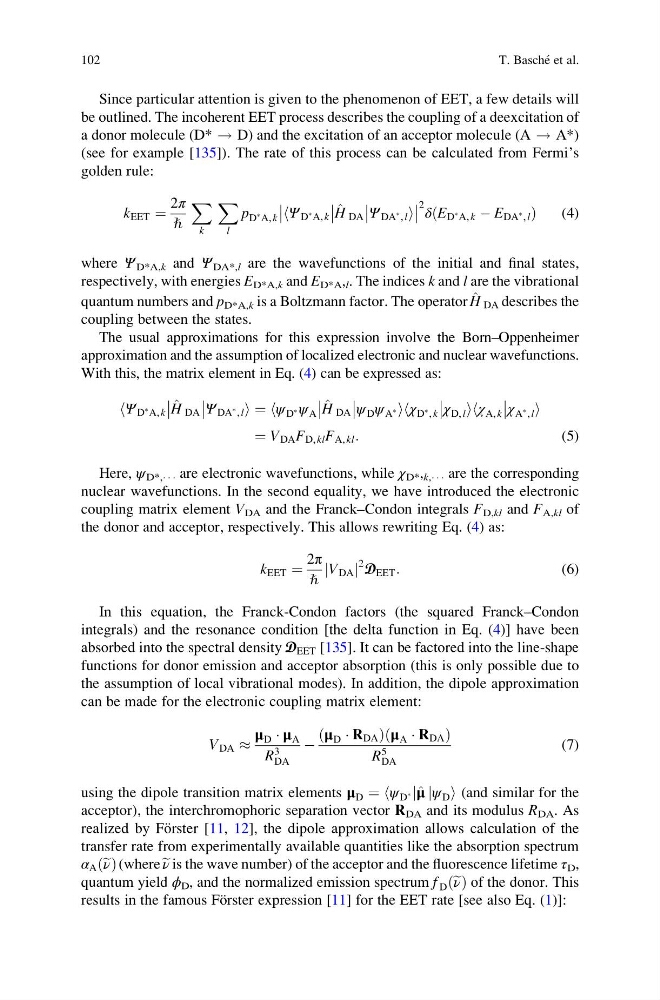
Since particular attention is given to the phenomenon of EET, a few details will
be outlined. The incoherent EET process describes the coupling of a deexcitation of
a donor molecule (D* ! D) and the excitation of an acceptor molecule (A ! A*)
(see for example [135]). The rate of this process can be calculated from Fermi’s
golden rule:
k EET ¼
2π
ℏ
X
k
X
l
p D
à A, k hΨ D
à A, k
^
H DA
Ψ DA
à , l i
2 δ E D
à A, k À E DA
à , l
ð
Þ
(4)
where Ψ D*A,k and Ψ DA*,l are the wavefunctions of the initial and final states,
respectively, with energies E D*A,k and E D*A , l . The indices k and l are the vibrational
quantum numbers and p D*A,k is a Boltzmann factor. The operator ^
H DA describes the
coupling between the states.
The usual approximations for this expression involve the Born–Oppenheimer
approximation and the assumption of localized electronic and nuclear wavefunctions.
With this, the matrix element in Eq. (4) can be expressed as:
hΨ D
à A, k
^
H DA
Ψ DA
à , l i ¼ hψ D
à ψ A ^
H DA
ψ D ψ A
à ihχ D
à , k
χ D, l ihχ A, k
χ A
à , l i
¼ V DA F D, kl F A, kl :
(5)
Here, ψ D*,Á Á Á are electronic wavefunctions, while χ D* , k,Á Á Á are the corresponding
nuclear wavefunctions. In the second equality, we have introduced the electronic
coupling matrix element V DA and the Franck–Condon integrals F D,kl and F A,kl of
the donor and acceptor, respectively. This allows rewriting Eq. (4) as:
k EET ¼
2π
ℏ
V DA
j
j
2 D EET :
(6)
In this equation, the Franck-Condon factors (the squared Franck–Condon
integrals) and the resonance condition [the delta function in Eq. (4)] have been
absorbed into the spectral density D EET [135]. It can be factored into the line-shape
functions for donor emission and acceptor absorption (this is only possible due to
the assumption of local vibrational modes). In addition, the dipole approximation
can be made for the electronic coupling matrix element:
V DA %
μ D Á μ A
R
3
DA
À
μ D Á R DA
ð
Þμ A Á R DA
ð
Þ
R
5
DA
(7)
using the dipole transition matrix elements μ D ¼ hψ D
à ^
μ
j jψ D i (and similar for the
acceptor), the interchromophoric separation vector R DA and its modulus R DA . As
realized by Fo ¨rster [11, 12], the dipole approximation allows calculation of the
transfer rate from experimentally available quantities like the absorption spectrum
α A e ν
ð Þ(where e ν is the wave number) of the acceptor and the fluorescence lifetime τ D ,
quantum yield ϕ D , and the normalized emission spectrum f D e ν
ð Þ of the donor. This
results in the famous Fo ¨rster expression [11] for the EET rate [see also Eq. (1)]:
102
T. Basche ´ et al.
be outlined. The incoherent EET process describes the coupling of a deexcitation of
a donor molecule (D* ! D) and the excitation of an acceptor molecule (A ! A*)
(see for example [135]). The rate of this process can be calculated from Fermi’s
golden rule:
k EET ¼
2π
ℏ
X
k
X
l
p D
à A, k hΨ D
à A, k
^
H DA
Ψ DA
à , l i
2 δ E D
à A, k À E DA
à , l
ð
Þ
(4)
where Ψ D*A,k and Ψ DA*,l are the wavefunctions of the initial and final states,
respectively, with energies E D*A,k and E D*A , l . The indices k and l are the vibrational
quantum numbers and p D*A,k is a Boltzmann factor. The operator ^
H DA describes the
coupling between the states.
The usual approximations for this expression involve the Born–Oppenheimer
approximation and the assumption of localized electronic and nuclear wavefunctions.
With this, the matrix element in Eq. (4) can be expressed as:
hΨ D
à A, k
^
H DA
Ψ DA
à , l i ¼ hψ D
à ψ A ^
H DA
ψ D ψ A
à ihχ D
à , k
χ D, l ihχ A, k
χ A
à , l i
¼ V DA F D, kl F A, kl :
(5)
Here, ψ D*,Á Á Á are electronic wavefunctions, while χ D* , k,Á Á Á are the corresponding
nuclear wavefunctions. In the second equality, we have introduced the electronic
coupling matrix element V DA and the Franck–Condon integrals F D,kl and F A,kl of
the donor and acceptor, respectively. This allows rewriting Eq. (4) as:
k EET ¼
2π
ℏ
V DA
j
j
2 D EET :
(6)
In this equation, the Franck-Condon factors (the squared Franck–Condon
integrals) and the resonance condition [the delta function in Eq. (4)] have been
absorbed into the spectral density D EET [135]. It can be factored into the line-shape
functions for donor emission and acceptor absorption (this is only possible due to
the assumption of local vibrational modes). In addition, the dipole approximation
can be made for the electronic coupling matrix element:
V DA %
μ D Á μ A
R
3
DA
À
μ D Á R DA
ð
Þμ A Á R DA
ð
Þ
R
5
DA
(7)
using the dipole transition matrix elements μ D ¼ hψ D
à ^
μ
j jψ D i (and similar for the
acceptor), the interchromophoric separation vector R DA and its modulus R DA . As
realized by Fo ¨rster [11, 12], the dipole approximation allows calculation of the
transfer rate from experimentally available quantities like the absorption spectrum
α A e ν
ð Þ(where e ν is the wave number) of the acceptor and the fluorescence lifetime τ D ,
quantum yield ϕ D , and the normalized emission spectrum f D e ν
ð Þ of the donor. This
results in the famous Fo ¨rster expression [11] for the EET rate [see also Eq. (1)]:
102
T. Basche ´ et al.