

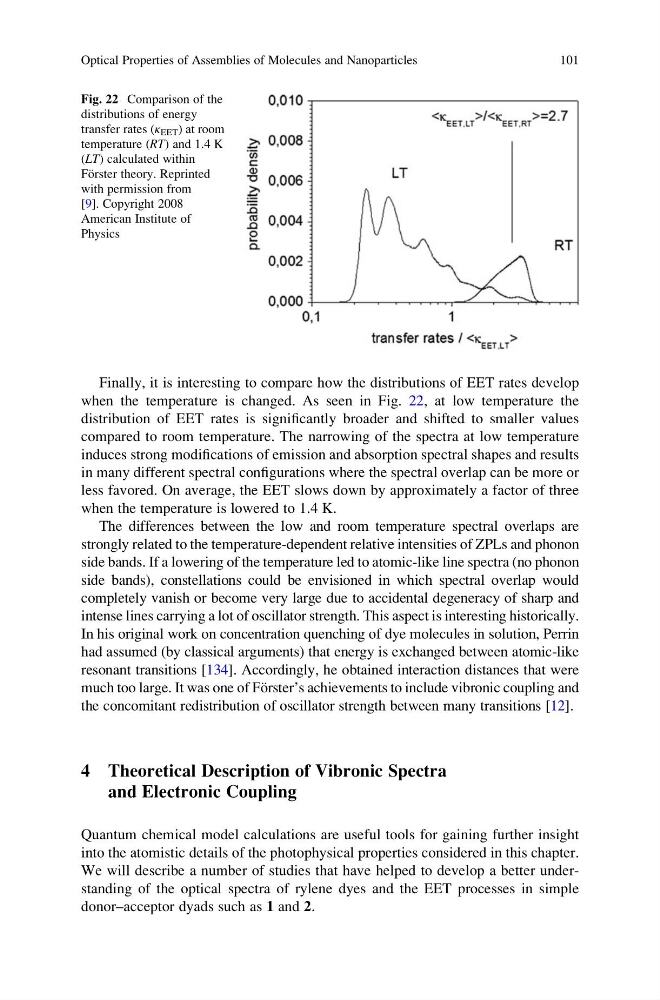
Finally, it is interesting to compare how the distributions of EET rates develop
when the temperature is changed. As seen in Fig. 22, at low temperature the
distribution of EET rates is significantly broader and shifted to smaller values
compared to room temperature. The narrowing of the spectra at low temperature
induces strong modifications of emission and absorption spectral shapes and results
in many different spectral configurations where the spectral overlap can be more or
less favored. On average, the EET slows down by approximately a factor of three
when the temperature is lowered to 1.4 K.
The differences between the low and room temperature spectral overlaps are
strongly related to the temperature-dependent relative intensities of ZPLs and phonon
side bands. If a lowering of the temperature led to atomic-like line spectra (no phonon
side bands), constellations could be envisioned in which spectral overlap would
completely vanish or become very large due to accidental degeneracy of sharp and
intense lines carrying a lot of oscillator strength. This aspect is interesting historically.
In his original work on concentration quenching of dye molecules in solution, Perrin
had assumed (by classical arguments) that energy is exchanged between atomic-like
resonant transitions [134]. Accordingly, he obtained interaction distances that were
much too large. It was one of Fo ¨rster’s achievements to include vibronic coupling and
the concomitant redistribution of oscillator strength between many transitions [12].
4 Theoretical Description of Vibronic Spectra
and Electronic Coupling
Quantum chemical model calculations are useful tools for gaining further insight
into the atomistic details of the photophysical properties considered in this chapter.
We will describe a number of studies that have helped to develop a better understanding of the optical spectra of rylene dyes and the EET processes in simple
donor–acceptor dyads such as 1 and 2.
Fig. 22 Comparison of the
distributions of energy
transfer rates (κ EET ) at room
temperature (RT) and 1.4 K
(LT) calculated within
Fo ¨rster theory. Reprinted
with permission from
[9]. Copyright 2008
American Institute of
Physics
Optical Properties of Assemblies of Molecules and Nanoparticles
101
when the temperature is changed. As seen in Fig. 22, at low temperature the
distribution of EET rates is significantly broader and shifted to smaller values
compared to room temperature. The narrowing of the spectra at low temperature
induces strong modifications of emission and absorption spectral shapes and results
in many different spectral configurations where the spectral overlap can be more or
less favored. On average, the EET slows down by approximately a factor of three
when the temperature is lowered to 1.4 K.
The differences between the low and room temperature spectral overlaps are
strongly related to the temperature-dependent relative intensities of ZPLs and phonon
side bands. If a lowering of the temperature led to atomic-like line spectra (no phonon
side bands), constellations could be envisioned in which spectral overlap would
completely vanish or become very large due to accidental degeneracy of sharp and
intense lines carrying a lot of oscillator strength. This aspect is interesting historically.
In his original work on concentration quenching of dye molecules in solution, Perrin
had assumed (by classical arguments) that energy is exchanged between atomic-like
resonant transitions [134]. Accordingly, he obtained interaction distances that were
much too large. It was one of Fo ¨rster’s achievements to include vibronic coupling and
the concomitant redistribution of oscillator strength between many transitions [12].
4 Theoretical Description of Vibronic Spectra
and Electronic Coupling
Quantum chemical model calculations are useful tools for gaining further insight
into the atomistic details of the photophysical properties considered in this chapter.
We will describe a number of studies that have helped to develop a better understanding of the optical spectra of rylene dyes and the EET processes in simple
donor–acceptor dyads such as 1 and 2.
Fig. 22 Comparison of the
distributions of energy
transfer rates (κ EET ) at room
temperature (RT) and 1.4 K
(LT) calculated within
Fo ¨rster theory. Reprinted
with permission from
[9]. Copyright 2008
American Institute of
Physics
Optical Properties of Assemblies of Molecules and Nanoparticles
101