

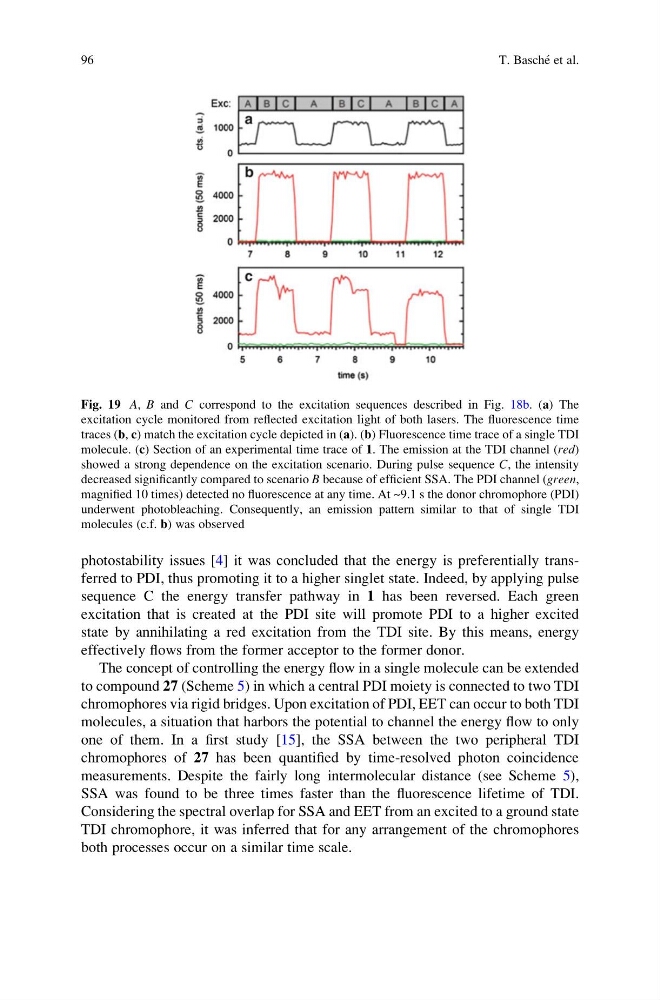
photostability issues [4] it was concluded that the energy is preferentially transferred to PDI, thus promoting it to a higher singlet state. Indeed, by applying pulse
sequence C the energy transfer pathway in 1 has been reversed. Each green
excitation that is created at the PDI site will promote PDI to a higher excited
state by annihilating a red excitation from the TDI site. By this means, energy
effectively flows from the former acceptor to the former donor.
The concept of controlling the energy flow in a single molecule can be extended
to compound 27 (Scheme 5) in which a central PDI moiety is connected to two TDI
chromophores via rigid bridges. Upon excitation of PDI, EET can occur to both TDI
molecules, a situation that harbors the potential to channel the energy flow to only
one of them. In a first study [15], the SSA between the two peripheral TDI
chromophores of 27 has been quantified by time-resolved photon coincidence
measurements. Despite the fairly long intermolecular distance (see Scheme 5),
SSA was found to be three times faster than the fluorescence lifetime of TDI.
Considering the spectral overlap for SSA and EET from an excited to a ground state
TDI chromophore, it was inferred that for any arrangement of the chromophores
both processes occur on a similar time scale.
Fig. 19 A, B and C correspond to the excitation sequences described in Fig. 18b. (a) The
excitation cycle monitored from reflected excitation light of both lasers. The fluorescence time
traces (b, c) match the excitation cycle depicted in (a). (b) Fluorescence time trace of a single TDI
molecule. (c) Section of an experimental time trace of 1. The emission at the TDI channel (red)
showed a strong dependence on the excitation scenario. During pulse sequence C, the intensity
decreased significantly compared to scenario B because of efficient SSA. The PDI channel (green,
magnified 10 times) detected no fluorescence at any time. At ~9.1 s the donor chromophore (PDI)
underwent photobleaching. Consequently, an emission pattern similar to that of single TDI
molecules (c.f. b) was observed
96
T. Basche ´ et al.
sequence C the energy transfer pathway in 1 has been reversed. Each green
excitation that is created at the PDI site will promote PDI to a higher excited
state by annihilating a red excitation from the TDI site. By this means, energy
effectively flows from the former acceptor to the former donor.
The concept of controlling the energy flow in a single molecule can be extended
to compound 27 (Scheme 5) in which a central PDI moiety is connected to two TDI
chromophores via rigid bridges. Upon excitation of PDI, EET can occur to both TDI
molecules, a situation that harbors the potential to channel the energy flow to only
one of them. In a first study [15], the SSA between the two peripheral TDI
chromophores of 27 has been quantified by time-resolved photon coincidence
measurements. Despite the fairly long intermolecular distance (see Scheme 5),
SSA was found to be three times faster than the fluorescence lifetime of TDI.
Considering the spectral overlap for SSA and EET from an excited to a ground state
TDI chromophore, it was inferred that for any arrangement of the chromophores
both processes occur on a similar time scale.
Fig. 19 A, B and C correspond to the excitation sequences described in Fig. 18b. (a) The
excitation cycle monitored from reflected excitation light of both lasers. The fluorescence time
traces (b, c) match the excitation cycle depicted in (a). (b) Fluorescence time trace of a single TDI
molecule. (c) Section of an experimental time trace of 1. The emission at the TDI channel (red)
showed a strong dependence on the excitation scenario. During pulse sequence C, the intensity
decreased significantly compared to scenario B because of efficient SSA. The PDI channel (green,
magnified 10 times) detected no fluorescence at any time. At ~9.1 s the donor chromophore (PDI)
underwent photobleaching. Consequently, an emission pattern similar to that of single TDI
molecules (c.f. b) was observed
96
T. Basche ´ et al.