

3.3 Read-Out of the Spin State of a Single Molecule
by the Emission from Proximate Fluorophores
The 2D graphene-type molecule hexa-peri-hexabenzocoronene (HBC) has gained
considerable interest because of its self-assembling and photophysical properties.
The large intersystem crossing rate and long triplet state (T 1 ) lifetime in the range of
seconds are prohibitive for direct single-molecule observation. Yet, at the single
molecule level it may be highly interesting to take advantage of the long population
storage times in T 1 . By covalently linking fluorescent acceptor molecules (PMI) to
HBC giving rise to 35 [37], efficient EET from HBC to PMI leads to strong PMI
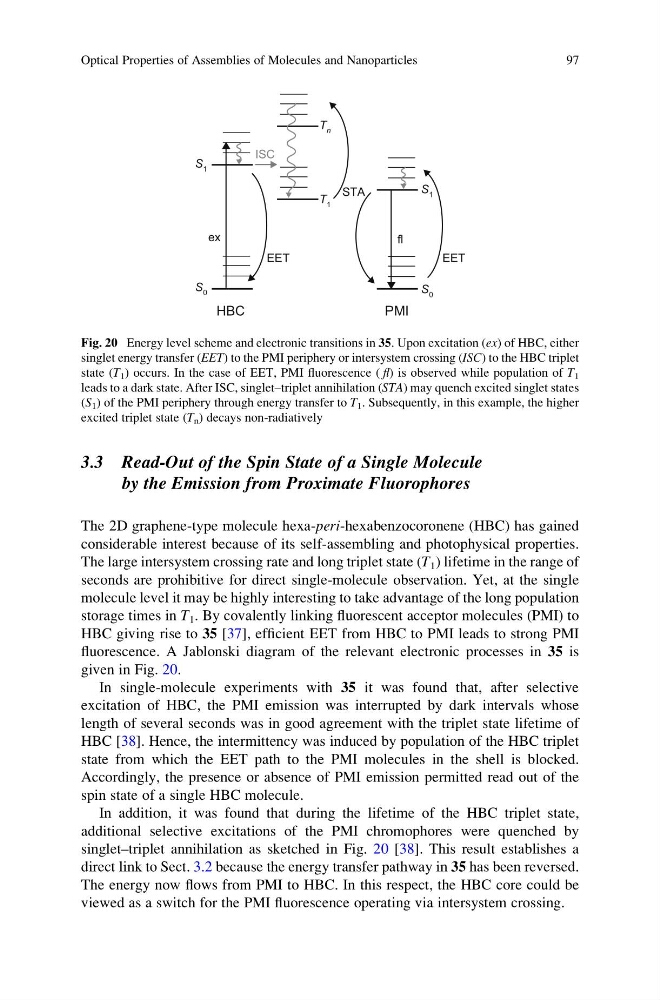
fluorescence. A Jablonski diagram of the relevant electronic processes in 35 is
given in Fig. 20.
In single-molecule experiments with 35 it was found that, after selective
excitation of HBC, the PMI emission was interrupted by dark intervals whose
length of several seconds was in good agreement with the triplet state lifetime of
HBC [38]. Hence, the intermittency was induced by population of the HBC triplet
state from which the EET path to the PMI molecules in the shell is blocked.
Accordingly, the presence or absence of PMI emission permitted read out of the
spin state of a single HBC molecule.
In addition, it was found that during the lifetime of the HBC triplet state,
additional selective excitations of the PMI chromophores were quenched by
singlet–triplet annihilation as sketched in Fig. 20 [38]. This result establishes a
direct link to Sect. 3.2 because the energy transfer pathway in 35 has been reversed.
The energy now flows from PMI to HBC. In this respect, the HBC core could be
viewed as a switch for the PMI fluorescence operating via intersystem crossing.
S 1
S 0
STA
ISC
EET
EET
ex
T n
T 1
HBC
PMI
S 1
S 0
fl
Fig. 20 Energy level scheme and electronic transitions in 35. Upon excitation (ex) of HBC, either
singlet energy transfer (EET) to the PMI periphery or intersystem crossing (ISC) to the HBC triplet
state (T 1 ) occurs. In the case of EET, PMI fluorescence ( fl) is observed while population of T 1
leads to a dark state. After ISC, singlet–triplet annihilation (STA) may quench excited singlet states
(S 1 ) of the PMI periphery through energy transfer to T 1 . Subsequently, in this example, the higher
excited triplet state (T n ) decays non-radiatively
Optical Properties of Assemblies of Molecules and Nanoparticles
97
by the Emission from Proximate Fluorophores
The 2D graphene-type molecule hexa-peri-hexabenzocoronene (HBC) has gained
considerable interest because of its self-assembling and photophysical properties.
The large intersystem crossing rate and long triplet state (T 1 ) lifetime in the range of
seconds are prohibitive for direct single-molecule observation. Yet, at the single
molecule level it may be highly interesting to take advantage of the long population
storage times in T 1 . By covalently linking fluorescent acceptor molecules (PMI) to
HBC giving rise to 35 [37], efficient EET from HBC to PMI leads to strong PMI
fluorescence. A Jablonski diagram of the relevant electronic processes in 35 is
given in Fig. 20.
In single-molecule experiments with 35 it was found that, after selective
excitation of HBC, the PMI emission was interrupted by dark intervals whose
length of several seconds was in good agreement with the triplet state lifetime of
HBC [38]. Hence, the intermittency was induced by population of the HBC triplet
state from which the EET path to the PMI molecules in the shell is blocked.
Accordingly, the presence or absence of PMI emission permitted read out of the
spin state of a single HBC molecule.
In addition, it was found that during the lifetime of the HBC triplet state,
additional selective excitations of the PMI chromophores were quenched by
singlet–triplet annihilation as sketched in Fig. 20 [38]. This result establishes a
direct link to Sect. 3.2 because the energy transfer pathway in 35 has been reversed.
The energy now flows from PMI to HBC. In this respect, the HBC core could be
viewed as a switch for the PMI fluorescence operating via intersystem crossing.
S 1
S 0
STA
ISC
EET
EET
ex
T n
T 1
HBC
PMI
S 1
S 0
fl
Fig. 20 Energy level scheme and electronic transitions in 35. Upon excitation (ex) of HBC, either
singlet energy transfer (EET) to the PMI periphery or intersystem crossing (ISC) to the HBC triplet
state (T 1 ) occurs. In the case of EET, PMI fluorescence ( fl) is observed while population of T 1
leads to a dark state. After ISC, singlet–triplet annihilation (STA) may quench excited singlet states
(S 1 ) of the PMI periphery through energy transfer to T 1 . Subsequently, in this example, the higher
excited triplet state (T n ) decays non-radiatively
Optical Properties of Assemblies of Molecules and Nanoparticles
97