

traces as displayed in Fig. 19b. Trivially, the PDI channel detected no signal. On the
TDI channel, nearly no fluorescence was observed during sequence A, since the
green laser pulses merely had a chance to excite TDI. As expected, during
sequences B and C the fluorescence signal was almost constant. In Fig. 19c, a
section of an experimental time trace of molecule 1 is displayed. It was found that
the fluorescence intensity recorded at the TDI channel significantly changed
depending on the excitation sequence. By solely exciting the donor with the
green laser (sequence A), efficient EET took place. Thus, only TDI emission was
observed. Switching on the red laser in scenario B led to stronger TDI fluorescence.
(Note that the red laser had a higher intensity than the green one.) Both the red and
green excitation energies are emitted via TDI since only a single excitation was
present in the molecule at a given time. In contrast, by applying sequence C, both
chromophores were excited at virtually the same time. Although the number of
exciting photons was equal to sequence B (Fig. 19c), a significant decrease in the
TDI fluorescence intensity was detected. On the PDI channel, fluorescence was not
detected during any of the three excitation sequences.
It was concluded that the radiative losses observed for 1 stem from efficient SSA
induced by pulse sequence C. From the experimental data the efficiency of the
process was calculated to be ~86%, which was in reasonable agreement with
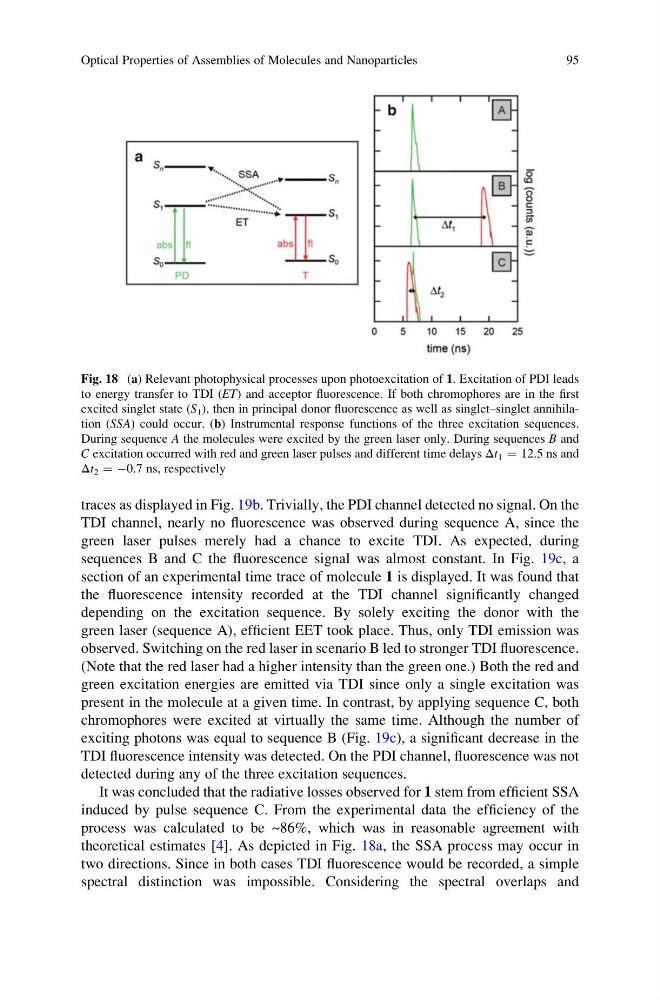
theoretical estimates [4]. As depicted in Fig. 18a, the SSA process may occur in
two directions. Since in both cases TDI fluorescence would be recorded, a simple
spectral distinction was impossible. Considering the spectral overlaps and
Fig. 18 (a) Relevant photophysical processes upon photoexcitation of 1. Excitation of PDI leads
to energy transfer to TDI (ET) and acceptor fluorescence. If both chromophores are in the first
excited singlet state (S 1 ), then in principal donor fluorescence as well as singlet–singlet annihilation (SSA) could occur. (b) Instrumental response functions of the three excitation sequences.
During sequence A the molecules were excited by the green laser only. During sequences B and
C excitation occurred with red and green laser pulses and different time delays Δt 1 ¼ 12.5 ns and
Δt 2 ¼ À0.7 ns, respectively
Optical Properties of Assemblies of Molecules and Nanoparticles
95
TDI channel, nearly no fluorescence was observed during sequence A, since the
green laser pulses merely had a chance to excite TDI. As expected, during
sequences B and C the fluorescence signal was almost constant. In Fig. 19c, a
section of an experimental time trace of molecule 1 is displayed. It was found that
the fluorescence intensity recorded at the TDI channel significantly changed
depending on the excitation sequence. By solely exciting the donor with the
green laser (sequence A), efficient EET took place. Thus, only TDI emission was
observed. Switching on the red laser in scenario B led to stronger TDI fluorescence.
(Note that the red laser had a higher intensity than the green one.) Both the red and
green excitation energies are emitted via TDI since only a single excitation was
present in the molecule at a given time. In contrast, by applying sequence C, both
chromophores were excited at virtually the same time. Although the number of
exciting photons was equal to sequence B (Fig. 19c), a significant decrease in the
TDI fluorescence intensity was detected. On the PDI channel, fluorescence was not
detected during any of the three excitation sequences.
It was concluded that the radiative losses observed for 1 stem from efficient SSA
induced by pulse sequence C. From the experimental data the efficiency of the
process was calculated to be ~86%, which was in reasonable agreement with
theoretical estimates [4]. As depicted in Fig. 18a, the SSA process may occur in
two directions. Since in both cases TDI fluorescence would be recorded, a simple
spectral distinction was impossible. Considering the spectral overlaps and
Fig. 18 (a) Relevant photophysical processes upon photoexcitation of 1. Excitation of PDI leads
to energy transfer to TDI (ET) and acceptor fluorescence. If both chromophores are in the first
excited singlet state (S 1 ), then in principal donor fluorescence as well as singlet–singlet annihilation (SSA) could occur. (b) Instrumental response functions of the three excitation sequences.
During sequence A the molecules were excited by the green laser only. During sequences B and
C excitation occurred with red and green laser pulses and different time delays Δt 1 ¼ 12.5 ns and
Δt 2 ¼ À0.7 ns, respectively
Optical Properties of Assemblies of Molecules and Nanoparticles
95