

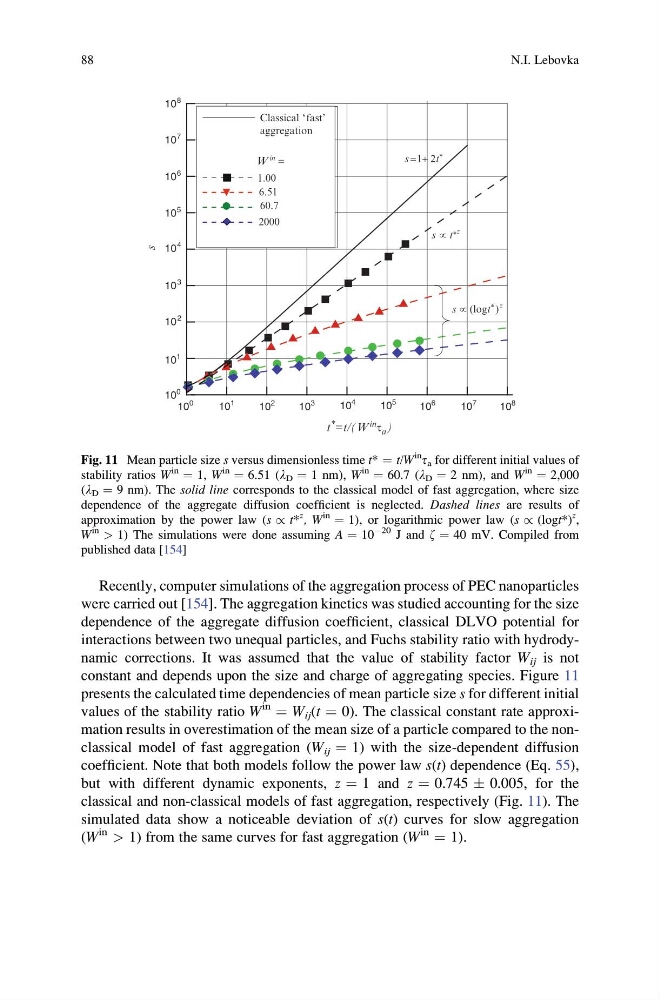
Recently, computer simulations of the aggregation process of PEC nanoparticles
were carried out [154]. The aggregation kinetics was studied accounting for the size
dependence of the aggregate diffusion coefficient, classical DLVO potential for
interactions between two unequal particles, and Fuchs stability ratio with hydrodynamic corrections. It was assumed that the value of stability factor W ij is not
constant and depends upon the size and charge of aggregating species. Figure 11
presents the calculated time dependencies of mean particle size s for different initial
values of the stability ratio W
in ¼ W ij (t ¼ 0). The classical constant rate approximation results in overestimation of the mean size of a particle compared to the nonclassical model of fast aggregation (W ij ¼ 1) with the size-dependent diffusion
coefficient. Note that both models follow the power law s(t) dependence (Eq. 55),
but with different dynamic exponents, z ¼ 1 and z ¼ 0.745 Æ 0.005, for the
classical and non-classical models of fast aggregation, respectively (Fig. 11). The
simulated data show a noticeable deviation of s(t) curves for slow aggregation
(W
in
> 1) from the same curves for fast aggregation (W
in
¼ 1).
10
8
10
7
10
6
10
5
10
4
10
3
10
2
10
1
10
0
10
0
10
1
10
2
10
3
10
4
10
5
10
6
10
7
10
8
t
* =t/(W
in τ a )
s
W
in =
6.51
60.7
2000
1.00
s ∝ (logt * )
z
s ∝ t*
z
s =1+ 2t *
Classical ‘ fast’
aggregation
Fig. 11 Mean particle size s versus dimensionless time t* ¼ t/W
in
t a for different initial values of
stability ratios W
in ¼ 1, W
in ¼ 6.51 (l D ¼ 1 nm), W
in ¼ 60.7 (l D ¼ 2 nm), and W
in ¼ 2,000
(l D ¼ 9 nm). The solid line corresponds to the classical model of fast aggregation, where size
dependence of the aggregate diffusion coefficient is neglected. Dashed lines are results of
approximation by the power law (s / t*
z
, W
in ¼ 1), or logarithmic power law (s / (logt*)
z ,
W
in > 1) The simulations were done assuming A ¼ 10
À20 J and z ¼ 40 mV. Compiled from
published data [154]
88
N.I. Lebovka
were carried out [154]. The aggregation kinetics was studied accounting for the size
dependence of the aggregate diffusion coefficient, classical DLVO potential for
interactions between two unequal particles, and Fuchs stability ratio with hydrodynamic corrections. It was assumed that the value of stability factor W ij is not
constant and depends upon the size and charge of aggregating species. Figure 11
presents the calculated time dependencies of mean particle size s for different initial
values of the stability ratio W
in ¼ W ij (t ¼ 0). The classical constant rate approximation results in overestimation of the mean size of a particle compared to the nonclassical model of fast aggregation (W ij ¼ 1) with the size-dependent diffusion
coefficient. Note that both models follow the power law s(t) dependence (Eq. 55),
but with different dynamic exponents, z ¼ 1 and z ¼ 0.745 Æ 0.005, for the
classical and non-classical models of fast aggregation, respectively (Fig. 11). The
simulated data show a noticeable deviation of s(t) curves for slow aggregation
(W
in
> 1) from the same curves for fast aggregation (W
in
¼ 1).
10
8
10
7
10
6
10
5
10
4
10
3
10
2
10
1
10
0
10
0
10
1
10
2
10
3
10
4
10
5
10
6
10
7
10
8
t
* =t/(W
in τ a )
s
W
in =
6.51
60.7
2000
1.00
s ∝ (logt * )
z
s ∝ t*
z
s =1+ 2t *
Classical ‘ fast’
aggregation
Fig. 11 Mean particle size s versus dimensionless time t* ¼ t/W
in
t a for different initial values of
stability ratios W
in ¼ 1, W
in ¼ 6.51 (l D ¼ 1 nm), W
in ¼ 60.7 (l D ¼ 2 nm), and W
in ¼ 2,000
(l D ¼ 9 nm). The solid line corresponds to the classical model of fast aggregation, where size
dependence of the aggregate diffusion coefficient is neglected. Dashed lines are results of
approximation by the power law (s / t*
z
, W
in ¼ 1), or logarithmic power law (s / (logt*)
z ,
W
in > 1) The simulations were done assuming A ¼ 10
À20 J and z ¼ 40 mV. Compiled from
published data [154]
88
N.I. Lebovka