

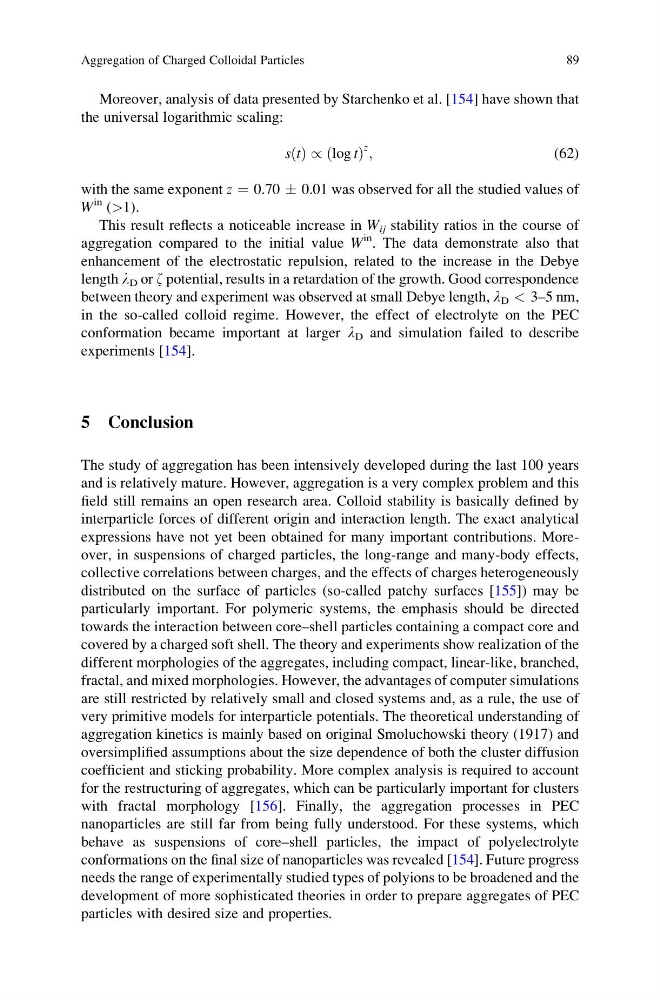
Moreover, analysis of data presented by Starchenko et al. [154] have shown that
the universal logarithmic scaling:
sðtÞ / ðlog tÞ
z ;
(62)
with the same exponent z ¼ 0.70 Æ 0.01 was observed for all the studied values of
W
in (>1).
This result reflects a noticeable increase in W ij stability ratios in the course of
aggregation compared to the initial value W
in . The data demonstrate also that
enhancement of the electrostatic repulsion, related to the increase in the Debye
length l D or z potential, results in a retardation of the growth. Good correspondence
between theory and experiment was observed at small Debye length, l D < 3–5 nm,
in the so-called colloid regime. However, the effect of electrolyte on the PEC
conformation became important at larger l D and simulation failed to describe
experiments [154].
5 Conclusion
The study of aggregation has been intensively developed during the last 100 years
and is relatively mature. However, aggregation is a very complex problem and this
field still remains an open research area. Colloid stability is basically defined by
interparticle forces of different origin and interaction length. The exact analytical
expressions have not yet been obtained for many important contributions. Moreover, in suspensions of charged particles, the long-range and many-body effects,
collective correlations between charges, and the effects of charges heterogeneously
distributed on the surface of particles (so-called patchy surfaces [155]) may be
particularly important. For polymeric systems, the emphasis should be directed
towards the interaction between core–shell particles containing a compact core and
covered by a charged soft shell. The theory and experiments show realization of the
different morphologies of the aggregates, including compact, linear-like, branched,
fractal, and mixed morphologies. However, the advantages of computer simulations
are still restricted by relatively small and closed systems and, as a rule, the use of
very primitive models for interparticle potentials. The theoretical understanding of
aggregation kinetics is mainly based on original Smoluchowski theory (1917) and
oversimplified assumptions about the size dependence of both the cluster diffusion
coefficient and sticking probability. More complex analysis is required to account
for the restructuring of aggregates, which can be particularly important for clusters
with fractal morphology [156]. Finally, the aggregation processes in PEC
nanoparticles are still far from being fully understood. For these systems, which
behave as suspensions of core–shell particles, the impact of polyelectrolyte
conformations on the final size of nanoparticles was revealed [154]. Future progress
needs the range of experimentally studied types of polyions to be broadened and the
development of more sophisticated theories in order to prepare aggregates of PEC
particles with desired size and properties.
Aggregation of Charged Colloidal Particles
89
the universal logarithmic scaling:
sðtÞ / ðlog tÞ
z ;
(62)
with the same exponent z ¼ 0.70 Æ 0.01 was observed for all the studied values of
W
in (>1).
This result reflects a noticeable increase in W ij stability ratios in the course of
aggregation compared to the initial value W
in . The data demonstrate also that
enhancement of the electrostatic repulsion, related to the increase in the Debye
length l D or z potential, results in a retardation of the growth. Good correspondence
between theory and experiment was observed at small Debye length, l D < 3–5 nm,
in the so-called colloid regime. However, the effect of electrolyte on the PEC
conformation became important at larger l D and simulation failed to describe
experiments [154].
5 Conclusion
The study of aggregation has been intensively developed during the last 100 years
and is relatively mature. However, aggregation is a very complex problem and this
field still remains an open research area. Colloid stability is basically defined by
interparticle forces of different origin and interaction length. The exact analytical
expressions have not yet been obtained for many important contributions. Moreover, in suspensions of charged particles, the long-range and many-body effects,
collective correlations between charges, and the effects of charges heterogeneously
distributed on the surface of particles (so-called patchy surfaces [155]) may be
particularly important. For polymeric systems, the emphasis should be directed
towards the interaction between core–shell particles containing a compact core and
covered by a charged soft shell. The theory and experiments show realization of the
different morphologies of the aggregates, including compact, linear-like, branched,
fractal, and mixed morphologies. However, the advantages of computer simulations
are still restricted by relatively small and closed systems and, as a rule, the use of
very primitive models for interparticle potentials. The theoretical understanding of
aggregation kinetics is mainly based on original Smoluchowski theory (1917) and
oversimplified assumptions about the size dependence of both the cluster diffusion
coefficient and sticking probability. More complex analysis is required to account
for the restructuring of aggregates, which can be particularly important for clusters
with fractal morphology [156]. Finally, the aggregation processes in PEC
nanoparticles are still far from being fully understood. For these systems, which
behave as suspensions of core–shell particles, the impact of polyelectrolyte
conformations on the final size of nanoparticles was revealed [154]. Future progress
needs the range of experimentally studied types of polyions to be broadened and the
development of more sophisticated theories in order to prepare aggregates of PEC
particles with desired size and properties.
Aggregation of Charged Colloidal Particles
89