

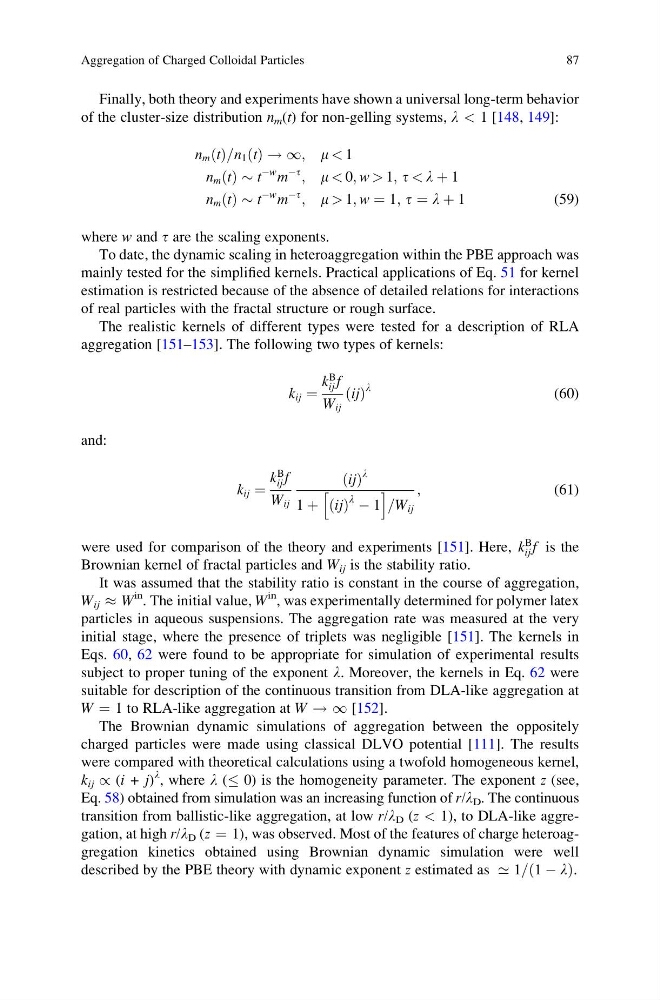
Finally, both theory and experiments have shown a universal long-term behavior
of the cluster-size distribution n m (t) for non-gelling systems, l < 1 [148, 149]:
n m ðtÞ=n 1 ðtÞ ! 1; m < 1
n m ðtÞ $ t
Àw m
Àt
; m < 0; w > 1; t < l þ 1
n m ðtÞ $ t
Àw m
Àt
; m > 1; w ¼ 1; t ¼ l þ 1
(59)
where w and t are the scaling exponents.
To date, the dynamic scaling in heteroaggregation within the PBE approach was
mainly tested for the simplified kernels. Practical applications of Eq. 51 for kernel
estimation is restricted because of the absence of detailed relations for interactions
of real particles with the fractal structure or rough surface.
The realistic kernels of different types were tested for a description of RLA
aggregation [151–153]. The following two types of kernels:
k ij ¼
k
B
ij f
W ij
ðijÞ
l
(60)
and:
k ij ¼
k
B
ij f
W ij
ðijÞ
l
1 þ ij
ð Þ
l À 1
h
i
=W ij
;
(61)
were used for comparison of the theory and experiments [151]. Here, k
B
ij f is the
Brownian kernel of fractal particles and W ij is the stability ratio.
It was assumed that the stability ratio is constant in the course of aggregation,
W ij % W
in . The initial value, W
in , was experimentally determined for polymer latex
particles in aqueous suspensions. The aggregation rate was measured at the very
initial stage, where the presence of triplets was negligible [151]. The kernels in
Eqs. 60, 62 were found to be appropriate for simulation of experimental results
subject to proper tuning of the exponent l. Moreover, the kernels in Eq. 62 were
suitable for description of the continuous transition from DLA-like aggregation at
W ¼ 1 to RLA-like aggregation at W ! 1 [152].
The Brownian dynamic simulations of aggregation between the oppositely
charged particles were made using classical DLVO potential [111]. The results
were compared with theoretical calculations using a twofold homogeneous kernel,
k ij / (i + j)
l , where l ( 0) is the homogeneity parameter. The exponent z (see,
Eq. 58) obtained from simulation was an increasing function of r/l D . The continuous
transition from ballistic-like aggregation, at low r/l D (z < 1), to DLA-like aggregation, at high r/l D (z ¼ 1), was observed. Most of the features of charge heteroaggregation kinetics obtained using Brownian dynamic simulation were well
described by the PBE theory with dynamic exponent z estimated as ’ 1= 1 À l
ð
Þ.
Aggregation of Charged Colloidal Particles
87
of the cluster-size distribution n m (t) for non-gelling systems, l < 1 [148, 149]:
n m ðtÞ=n 1 ðtÞ ! 1; m < 1
n m ðtÞ $ t
Àw m
Àt
; m < 0; w > 1; t < l þ 1
n m ðtÞ $ t
Àw m
Àt
; m > 1; w ¼ 1; t ¼ l þ 1
(59)
where w and t are the scaling exponents.
To date, the dynamic scaling in heteroaggregation within the PBE approach was
mainly tested for the simplified kernels. Practical applications of Eq. 51 for kernel
estimation is restricted because of the absence of detailed relations for interactions
of real particles with the fractal structure or rough surface.
The realistic kernels of different types were tested for a description of RLA
aggregation [151–153]. The following two types of kernels:
k ij ¼
k
B
ij f
W ij
ðijÞ
l
(60)
and:
k ij ¼
k
B
ij f
W ij
ðijÞ
l
1 þ ij
ð Þ
l À 1
h
i
=W ij
;
(61)
were used for comparison of the theory and experiments [151]. Here, k
B
ij f is the
Brownian kernel of fractal particles and W ij is the stability ratio.
It was assumed that the stability ratio is constant in the course of aggregation,
W ij % W
in . The initial value, W
in , was experimentally determined for polymer latex
particles in aqueous suspensions. The aggregation rate was measured at the very
initial stage, where the presence of triplets was negligible [151]. The kernels in
Eqs. 60, 62 were found to be appropriate for simulation of experimental results
subject to proper tuning of the exponent l. Moreover, the kernels in Eq. 62 were
suitable for description of the continuous transition from DLA-like aggregation at
W ¼ 1 to RLA-like aggregation at W ! 1 [152].
The Brownian dynamic simulations of aggregation between the oppositely
charged particles were made using classical DLVO potential [111]. The results
were compared with theoretical calculations using a twofold homogeneous kernel,
k ij / (i + j)
l , where l ( 0) is the homogeneity parameter. The exponent z (see,
Eq. 58) obtained from simulation was an increasing function of r/l D . The continuous
transition from ballistic-like aggregation, at low r/l D (z < 1), to DLA-like aggregation, at high r/l D (z ¼ 1), was observed. Most of the features of charge heteroaggregation kinetics obtained using Brownian dynamic simulation were well
described by the PBE theory with dynamic exponent z estimated as ’ 1= 1 À l
ð
Þ.
Aggregation of Charged Colloidal Particles
87